
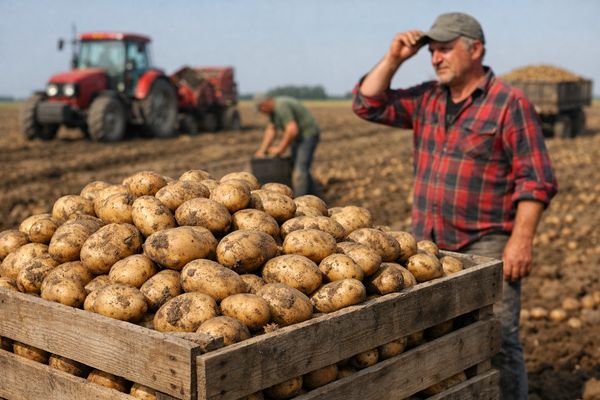
Polish potato prices have collapsed as on-farm stocks have doubled year-on-year and a massive EU-wide surplus weighs on the market. Farm-gate prices near 0.20 PLN/kg (around 0.05 EUR/kg) are often below production costs, forcing accelerated sales and triggering a sector-wide profitability crisis.
The current situation is driven by a Polish harvest above 7 million tons, continued imports and a wider European surplus estimated at more than 3.3 million tons. Germany and other key EU producers also report elevated inventories, while demand growth and exports lag behind supply. With storage capacity limited, many growers are liquidating potatoes quickly, pushing prices down to distressed levels and shifting some volumes into processing and non-food outlets.
Exclusive Offers on CMBroker

Potato starch
powder
FCA 0.85 €/kg
(from PL)
📈 Prices & Market Mood
Domestic table potato prices in Poland have fallen from about 0.80 PLN/kg to roughly 0.20 PLN/kg (around 0.18 EUR/kg to 0.05 EUR/kg), implying a 75% decline in a short period. This aligns with a broader European downturn, where benchmark potato contracts have dropped more than 25% month-on-month and over 80% year-on-year.
In contrast, the value-added segment is holding up somewhat better: recent offers for Polish potato starch (FCA Łódź) are around 0.85 EUR/kg, slightly up from 0.82 EUR/kg in March, indicating still-firm demand from the food and industrial sectors. The divergence between collapsing raw potato prices and relatively stable starch quotations underlines strong pressure at farm level and comparatively better margins downstream.
🌍 Supply & Demand Balance
Polish production exceeded 7 million tons this season, while imports continued to flow, leaving stocks in storage at roughly double last year’s level. At the same time, the EU potato surplus is estimated above 3.3 million tons, with Germany and Belgium also reporting very high inventories and slow drawdowns.
Export channels are not absorbing the excess, as regional markets are saturated and processors have substantial contracted volumes already covered. In Belgium, for example, industrial potatoes for processing have traded at exceptionally low levels, even approaching zero on the spot market in some deals, highlighting how extreme the oversupply is across north-west Europe.
📊 Fundamentals & Policy Response
Limited and uneven storage capacity in Poland is a key pressure point. Many growers lack long-term, climate-controlled facilities, forcing early sales at distressed prices and limiting the ability to smooth volumes into later months. This accelerates the price decline and increases the share of potatoes routed to feed, starch and other low-value outlets.
The Polish Ministry of Agriculture is evaluating support measures, including promoting additional uses for potatoes and encouraging domestic consumption. Retailers have started to create new product categories (e.g. small-caliber potatoes) to move surplus volumes through price promotions and marketing initiatives. However, these steps are unlikely to fully offset the structural surplus as long as EU stocks remain high and export demand subdued.
🌦 Weather & Short-Term Outlook
Weather conditions in mid-April are seasonally cool and unsettled across Central Europe, with Poland facing overcast, wet episodes rather than extreme heat. This pattern supports storage quality in the short term and does not present an immediate yield risk for the upcoming crop.
Given the already heavy stocks, near-term weather has limited impact on spot prices. The main risk is that a normal or above-average 2026/27 crop would prolong the surplus well into the next marketing year, unless planted area is reduced or policy and industry interventions succeed in expanding processing and alternative uses.
📆 Trading & Risk Management View
- Producers (Poland): Focus on cash-flow driven sales of lower-quality lots and consider storing only the highest quality potatoes where proper facilities exist; lock in any forward contracts with processors that still offer cost-covering prices.
- Processors & Starch Industry: Current raw material oversupply offers an opportunity to secure volumes at historically low levels; elongate coverage into the new season but manage storage and quality risk carefully.
- Buyers/Retailers: Retail programs can leverage abundant supply to run promotions and develop new product formats while monitoring any policy-driven supply adjustments in Poland and neighboring EU states.
📉 3-Day Price Indication (EUR)
| Market/Segment | Current Level (approx.) | 3-Day Outlook |
|---|---|---|
| PL farm-gate table potatoes | ~0.05 EUR/kg | Sideways to slightly lower under stock pressure |
| EU processing potatoes (benchmarks) | ~0.02–0.03 EUR/kg equivalent | Sideways; downside limited by already extreme lows |
| PL potato starch, FCA Łódź | 0.85 EUR/kg | Stable to slightly firm on steady industrial demand |