
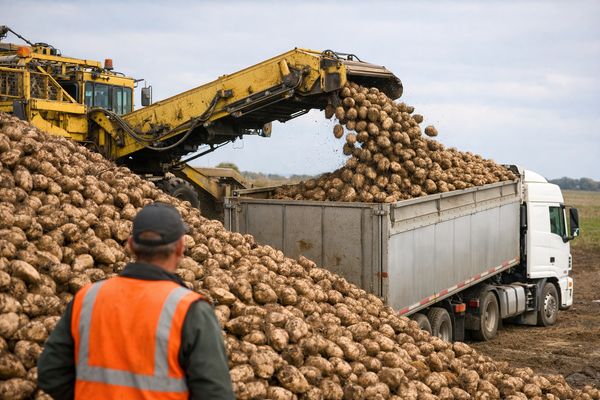
Sugar prices in the EU have been under pressure from record stocks, but shrinking beet area and higher costs signal an imminent tightening and potential price upturn.
After two seasons of oversupply, the European sugar complex appears close to an inflection point. Record inventories and weak prices have undermined grower profitability, prompting a marked reduction in beet area ahead of the 2026/27 campaign. With energy and geopolitical costs still elevated, the system is becoming more vulnerable to any weather or yield shock. Spot prices in Central Europe, including Poland, are stable but no longer falling, suggesting the downside phase is largely exhausted and the market is preparing for a shift toward a tighter balance.
Exclusive Offers on CMBroker

Sugar granulated
KAT EU 2 Czech
FCA 0.45 €/kg
(from PL)

Sugar granulated
white-crystal, Icumsa-45
FCA 0.47 €/kg
(from PL)

Sugar granulated
Kat EU2
FCA 0.43 €/kg
(from PL)
📈 Prices & Market Mood
EU sugar prices have trended lower in recent seasons under the weight of high production and increased imports, creating strong downward pressure on the entire value chain. In Poland and neighboring markets, FCA offers for standard granulated sugar currently cluster around EUR 0.43–0.47/kg, with Polish white crystal sugar near EUR 0.47/kg FCA Warsaw and EU Cat. II grades around EUR 0.43–0.45/kg FCA Kalisz. Over the last four weeks, these spot offers have stabilized, with only marginal week‑to‑week changes, indicating that the previous bearish trend has largely run its course.
| Product | Location | Latest price (EUR/kg) | 1M trend |
|---|---|---|---|
| Sugar granulated, Kat EU2 (PL) | Kalisz, PL | 0.43 | Sideways |
| Sugar granulated, white crystal (PL) | Warsaw, PL | 0.47 | Sideways / slightly firmer |
| Sugar granulated, KAT EU 2 (CZ→PL) | Kalisz, PL | 0.45 | Modest uptick vs. early April |
🌍 Supply & Demand Turning Point
The 2025/26 season in the EU ends with some of the highest sugar stocks seen in years, the direct result of strong beet harvests and robust import flows. This oversupply has kept prices subdued and eroded profitability across the sector, particularly for beet growers who face rising input and energy costs. However, the supply cushion may prove short‑lived as farmers react aggressively to poor margins.
Industry analysis for the 2026/27 season points to a 7–8% reduction in sugar beet area across the EU and the UK. Since the 2017/18 market reform, beet area has already shrunk by roughly 300,000 ha, accompanied by the closure of 21 sugar factories in Europe. This structural downsizing reduces the system’s flexibility and means that even a moderate weather‑related yield shortfall could quickly swing the EU market from surplus into deficit, forcing prices higher.
📊 Fundamentals & Cost Pressures
The immediate balance still looks comfortable due to record stocks, but forward fundamentals are tightening. Lower planted area for 2026/27 implies smaller potential output even under normal yields, while any disease, pest, or drought event would likely push production below domestic consumption needs. In that scenario, the EU would have to rely more heavily on imports in a context of uncertain global availability and freight conditions.
At the same time, producers continue to face elevated energy and logistics costs, amplified by ongoing geopolitical tensions. These factors raise the floor under production costs and limit the scope for further price declines at wholesale level. As a result, current flat spot prices around EUR 0.43–0.47/kg look increasingly like a base rather than a ceiling for the next marketing year.
⛅ Weather & Short-Term Outlook (Central Europe)
In the very near term, beet planting and early crop development in Central Europe, including Poland, proceed under seasonally mixed but manageable weather conditions, with no major stress episodes expected over the next few days. Given the already reduced intended area, even minor planting delays or patchy emergence would further cap the region’s production potential. For now, weather is not yet a bullish driver on its own, but it adds asymmetrical risk: any deterioration would quickly reinforce the tightening narrative built on lower acreage and high costs.
📆 Trading & Risk Management View
- For processors and users: Consider securing a portion of 2026/27 needs while spot prices remain near EUR 0.43–0.47/kg, as the probability of structurally lower prices is diminishing with the projected supply deficit.
- For beet growers: Reduced area supports improved price prospects, but margins remain sensitive to energy and input costs; conservative forward sales strategies with price floors may balance upside participation and risk control.
- For traders: Watch for early signs of weather stress and updated area/yield estimates; any confirmation of a material EU deficit in 2026/27 is likely to trigger a repricing phase from the current sideways range.
📉 3‑Day Regional Price Indication
- Poland (FCA, standard granulated sugar): Prices expected to remain broadly stable around EUR 0.43–0.47/kg over the next three days, with a slight upward bias as buyers test supply ahead of the new season.
- Neighboring Central Europe (imports into PL): Czech and Lithuanian EU Cat. II sugars likely to hold near EUR 0.45/kg, with limited discounting given tightening forward fundamentals.
- Overall trend: Sideways in the very short term, but the balance of risks for late 2026/27 shifts gradually toward firmer prices rather than renewed declines.
Related posts:
 Sugar beet market under pressure as white sugar futures retreat
 ICE White Sugar Curve Firms, Supporting EU Sugar Beet Price Expectations
 Central European Sugar Beet: Beet Weather Favourable as Local Sugar Prices Firm
 Sugar Beet Market: ICE White Sugar Softens While EU Beet Signals Tightness Ahead
 Firm White Sugar Futures Support Stable but Cautious Sugar Beet Outlook
 Sugar beet market: ICE white sugar correction but EU prices stay firm