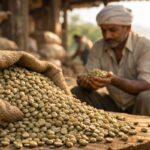
Uganda’s coffee sector is shipping more but earning less per bag: March 2026 exports rose 2.9% year on year to 671,152 bags, while export earnings fell 13.6% as global prices softened. Despite this monthly squeeze, 12‑month coffee export revenue jumped to $2.4 billion from $1.8 billion, underscoring a still-strong overall earnings base.
Uganda remains Africa’s largest coffee exporter, with a structurally strong position built on two harvests per year and a robusta‑weighted supply base. The latest data show a healthy crop and resilient trade flows, but also highlight how quickly global price corrections can erode value, even when volumes rise. International benchmarks for both arabica and robusta have eased from the peaks of late 2024 and early 2025, while weather‑aided supply recovery in Brazil and Vietnam is rebuilding global availability. For roasters, this offers cost relief; for Ugandan producers and exporters, it compresses margins and heightens dependency on further volume growth or a price rebound.
📈 Prices & Revenue Dynamics
In March 2026, Uganda exported 671,152 sixty‑kilogram bags of coffee, up 2.9% compared with March 2025, but export earnings dropped 13.6% year on year. This combination implies a marked decline in the average price per bag received by Ugandan exporters, consistent with the broader downswing in global coffee benchmarks.
Over the twelve months to March 2026, coffee export earnings reached $2.4 billion, a 33.3% increase from $1.8 billion in the prior period, reflecting the earlier period of elevated prices and stronger values per unit. More recent daily data from the Uganda Coffee Development Authority show indicative export prices on 1 April 2026 around 175 US cents/lb for top robusta grades and about 293 US cents/lb for premium arabicas, confirming price levels below the peak ranges seen in late 2024/early 2025.
| Indicator | Latest Level (approx.) | In EUR (approx.) | Comment |
|---|---|---|---|
| Robusta export (Screen 18) | 174.7 US cts/lb | ≈ 3.50 EUR/kg | Moderate vs 2024 peak; softer but still historically firm |
| Arabica Bugisu AA | 293.3 US cts/lb | ≈ 5.90 EUR/kg | Premium over robusta preserved, but below prior highs |
| 12‑month export earnings | $2.4 bn | ≈ 2.2 bn EUR | Up 33.3% from prior 12‑month period |
🌍 Supply & Demand Setting
Uganda’s March volume increase is directly tied to higher domestic production under favourable growing conditions in key robusta and arabica regions. Two cropping seasons per year continue to underpin supply reliability, with the latest harvests supporting strong pipeline availability for export.
Internationally, global coffee markets are digesting recovering output in Brazil and Vietnam, the top arabica and robusta suppliers. Recent assessments indicate expanding 2025/26 and 2026/27 crops, contributing to the current easing in the World Bank’s beverage price index and specifically in coffee. For robusta in particular, improved Vietnamese and Indonesian flows are rebuilding exportable surpluses, adding competitive pressure on Ugandan offers, even as Uganda maintains its lead position in African coffee exports.
📊 Fundamentals & Policy Factors
The contrast between strong 12‑month earnings and weaker March unit values highlights the timing effect of earlier price peaks. Earnings over the past year were boosted by the high price environment of late 2024 and early 2025, whereas the latest month reflects a market that has since corrected lower. As a result, the commercial benefit of today’s good crop is partially absorbed by less favourable prices rather than fully accruing to producers and exporters.
Domestic policy has so far focused on supporting production and safeguarding export competitiveness rather than intervening in prices. Structural challenges remain: limited value‑added processing, heavy reliance on bulk commodity exports, and exposure to benchmark futures on ICE Europe (for robusta) and ICE New York (for arabica). These factors leave Uganda’s sector highly sensitive to external price cycles and currency movements. Bank of Uganda commentary has also flagged that moderating coffee prices could temper export income even as volumes rise, underscoring the macro‑level stakes.
☁️ Weather & Global Market Environment
Weather conditions in Uganda’s coffee belt have been broadly supportive, enabling the production gains reflected in March exports. There are currently no major domestic weather disruptions reported that would threaten near‑term output.
In Brazil, however, forecasters report a pattern of intense heat and dry weather in early May ahead of a strong cold front, conditions that can temporarily stress coffee trees and heighten speculative concerns around frost risk later in the season. Combined with strong on‑the‑ground shipments from Vietnam and other origins, the net global picture is one of ample supply but elevated weather and logistics risk, which could inject fresh volatility into futures and differentials in the coming weeks.
📆 Market Outlook (30–180 Days)
Over the next 30–90 days, Uganda’s coffee export volumes are likely to remain robust, supported by ongoing harvest flows and confirmed March momentum. Projections from domestic authorities suggest April exports could edge even higher as the main harvest peaks in Greater Masaka and the South West, reinforcing Uganda’s role as a key robusta supplier to Europe and Asia.
Export earnings, however, will remain tightly coupled to global benchmarks, particularly London robusta futures, where recent moves show a softer but still elevated market compared with pre‑2024 levels. Over a 6–12 month horizon, maintaining the current $2.4 billion earnings base will require either continued incremental volume growth or some recovery in average export prices. A renewed price upswing could materialise if weather issues in Brazil, Vietnam or Indonesia curtail supply, but the baseline scenario from multilateral institutions remains for somewhat lower average coffee prices in 2026 compared with 2025 as global supply expands.
🧭 Trading & Procurement Outlook
- Roasters in Europe: Use the current softer price environment to extend coverage modestly on Uganda‑linked robusta blends for Q3–Q4 2026, while avoiding over‑hedging given the downside risk from further supply growth.
- Exporters in Uganda: Prioritise forward sales strategies that lock in acceptable margins on nearby shipments, but retain some discretionary volume for potential weather‑driven price spikes later in the Brazilian winter.
- Producers: Focus on yield and quality investments while managing cash‑flow expectations around lower per‑bag prices; cooperative marketing and quality upgrading can partially offset benchmark weakness via better differentials.
- Risk managers: Monitor London robusta and New York arabica spreads closely; rising inter‑origin competition and changing freight premia will influence Uganda’s relative pricing in key European and Asian destinations.
📍 3‑Day Price Indication (Directional)
Converted into EUR terms, indicative Ugandan export prices for top robusta grades currently sit around 3.4–3.6 EUR/kg, with premium arabicas near 5.8–6.0 EUR/kg based on 1 April 2026 quotations and current FX levels.
- ICE Europe Robusta Futures (next 3 days): Bias: sideways to slightly softer in EUR terms, reflecting comfortable near‑term supply but headline‑driven volatility risk.
- Uganda Robusta Export Quotes: Expected to track futures closely with stable to mildly lower EUR/kg indications, barring abrupt weather or logistics shocks.
- Uganda Arabica (Bugisu) Differentials: Likely steady versus New York, with modest EUR price fluctuation driven mainly by FX and futures moves rather than origin‑specific news.