
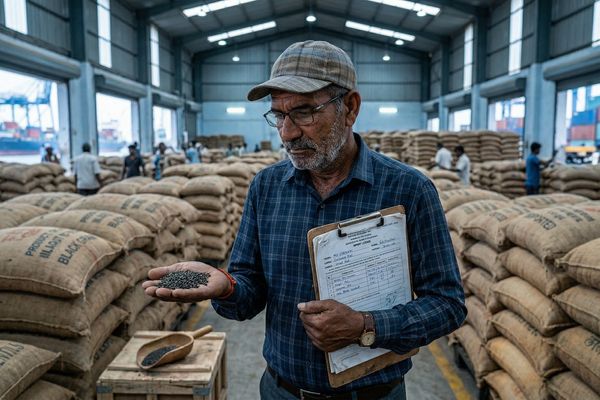
Prices in the lentil complex are broadly rangebound, with Indian black gram (urad) easing for a second session on soft dal-mill demand even as Myanmar export values firm, creating a cautious stand-off between buyers and sellers. Near-term downside looks limited thanks to low Indian buffer stocks, steady imports and seasonal papad industry demand, suggesting a floor for prices rather than a full reversal higher.
Indian black gram markets are currently digesting a mix of weak spot demand and supportive fundamentals. Domestic millers are resisting higher offers, but sellers are equally reluctant to offload aggressively given firmer Myanmar values and thin public stocks. At the same time, steady import arrivals into Chennai and lower-yielding new-crop supplies from Andhra Pradesh are keeping physical availability adequate but not burdensome. For international lentil buyers, especially in Europe, this configuration argues for cautious procurement: nearby prices are likely to oscillate in a narrow band, with the main risk skewed toward firmer values if Myanmar flows tighten.
Exclusive Offers on CMBroker

Lentils dried
Red football
FOB 2.60 €/kg
(from CA)

Lentils dried
Laird, Green
FOB 1.77 €/kg
(from CA)

Lentils dried
Eston Green
FOB 1.67 €/kg
(from CA)
📈 Prices & Spreads
Across key Indian hubs, black gram prices slipped modestly but stayed within a well-defined range. At Chennai port, imported FAQ grade fell by roughly Rs 75 per quintal, with SQ easing by Rs 50, while Delhi, Mumbai and Guntur also recorded declines of Rs 50–100 per quintal. Kolkata FAQ values were notably stable, underlining that this is a mild correction rather than a sharp sell-off.
Translating to the broader lentil complex, current FOB offers for Canadian dried lentils show a slightly firmer tone in euro terms: red football lentils around EUR 2.60/kg, Laird green near EUR 1.77/kg, and Eston green roughly EUR 1.67/kg. Chinese small green lentils are steady to marginally softer, with conventional product near EUR 1.18/kg and organic around EUR 1.24/kg. Overall, the international price structure points to gentle firming in major origins rather than a broad-based downturn.
🌍 Supply & Demand Drivers
India’s black gram balance is finely poised. Between 11 and 17 March, Chennai port received over 31,000 tonnes of pulses, including about 8,850 tonnes of black gram from Myanmar and 3,450 tonnes from Brazil, alongside significant pigeon pea arrivals. These steady inflows are preventing any spot shortages, but they are not large enough to fully offset tight domestic fundamentals and low official inventories.
On the demand side, dal-processing mills across India are buying cautiously, which has triggered the recent two-session price decline. However, the papad-making season is underway, underpinning consumption of black gram mogar, while South Indian household demand remains structurally firm. Fresh domestic crop arrivals in Andhra Pradesh, though timely, are reported at lower productivity than last year, limiting the potential for a deeper correction as long as Myanmar shipments continue at current levels.
📊 Fundamentals & Policy Context
Government buffer stocks of black gram in India’s central pool are critically low, with purchases at the Minimum Support Price reaching only about 80,000 tonnes against an estimated buffer need of 100,000 tonnes. This 20% shortfall acts as an important backstop: official stocks are not sufficient to dampen any sudden price spike should imports slow or weather disrupt domestic flows. Consequently, local market participants remain reluctant to sell aggressively into short-term weakness.
Meanwhile, Myanmar export prices for black gram have firmed recently, reducing selling pressure at lower levels and reinforcing a latent bullish undertone. For Europe and other importing regions that increasingly source Indian-origin lentils and black gram, Myanmar’s pricing and shipment rhythm are the primary swing factors for near-term landed costs. As long as Indian demand is underpinned by papad and household use, and public stocks remain thin, any tightening of Myanmar flows could ripple quickly into higher global offers.
🌦 Weather & Short-Term Outlook
With the current phase driven more by logistics and demand than by immediate weather shocks, no acute weather premium is evident in black gram and lentil prices. New-crop arrivals in Andhra Pradesh are proceeding, albeit with lower yields, which will be monitored closely for any further downgrades that could tighten the balance later in the season. For now, steady import flows are compensating for domestic shortfalls.
Market participants broadly expect prices to remain rangebound over the next two to three weeks. The combination of firm Myanmar benchmarks, low Indian buffer stocks, and active stockist participation suggests that recent declines are more of a consolidation than the start of a bear trend. South Indian consumption demand should continue to provide a solid floor, particularly while the papad season remains active.
📆 Trading Outlook & Recommendations
- Importers and food manufacturers: Use the current dip in Indian black gram prices to cover short- to medium-term needs, prioritising nearby shipments while maintaining flexibility beyond the next 2–3 weeks.
- European buyers of Indian black gram and lentils: Monitor Myanmar export values and shipment pace closely; any disruption or further firming there is likely to translate quickly into higher CIF Europe prices.
- Stockists and traders in South Asia: Avoid aggressive short-selling at current levels given low government buffers and lower-yielding domestic arrivals; a floor appears to be forming, with limited further downside.
📉 3-Day Price Directional View (Indicative)
| Market / Product | Current Level (indicative) | 3-Day Bias |
|---|---|---|
| India black gram (FAQ/SQ, major hubs) | Soft but stable vs. last week (EUR-equivalent) | Sideways to slightly firmer |
| Canada red football lentils (FOB) | ~EUR 2.60/kg | Sideways |
| Canada green lentils (Laird/Eston, FOB) | ~EUR 1.67–1.77/kg | Sideways |
| China small green lentils (FOB) | ~EUR 1.18–1.24/kg | Sideways to slightly softer |
Related posts:
 Lentil Market Steady but Cautious as South Asian Pulse Prices Soften
 Indian Green Gram Overhang Keeps Global Lentil Market Capped
 Lentil Market Steady Under Indian Buffer Sales and Cautious Buying
 Lentil Market Tracks Indian Pulse Tensions and Rising Freight Risk
 Indian Lentil Jitters: Duty Risk Meets Heavy Global Supply
 Lentil Market in Decision Phase as New Crop Arrivals Shape Next Move
 Chinese Lentil FOB Prices Hold Steady Amid Global Oversupply
 Mixed Pulse Signals Shape a Two-Speed Global Lentil Market