
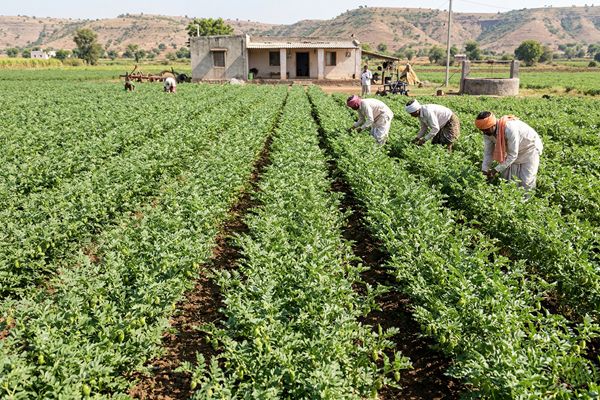
Chickpea prices are holding firm on short-term mill demand and tight old-crop supplies, but traders doubt the rally can extend once India’s new-crop flow peaks and state procurement patterns are clearer.
The market is pivoting around India, where fresh arrivals from Madhya Pradesh and Rajasthan are building, yet still meeting solid demand from dal processors and government agencies. New-crop desi chickpeas in Delhi and Rajasthan have edged higher, supported by tight old-crop stocks and active Minimum Support Price (MSP) purchases that have already crossed 100,000 tonnes and could reach several million tonnes. At the same time, higher rabi sowing and material production gains in the key states argue for plentiful supplies later this season, curbing enthusiasm for aggressive stock-building.
Exclusive Offers on CMBroker

Chickpeas dried
count 42-44, 12 mm
FOB 1.28 €/kg
(from MX)

Chickpeas dried
count 75-80, 8 mm
FOB 0.81 €/kg
(from MX)

Chickpeas dried
count 60-62, 8 mm
FOB 0.83 €/kg
(from IN)
📈 Prices & Short-Term Trend
Domestic chickpea prices in India firmed modestly even as new-crop arrivals increased. New Rajasthan-origin chickpeas in Delhi gained the equivalent of around EUR 53–54 per tonne, while Madhya Pradesh lots booked similar incremental gains, reflecting better mill buying and still-limited late-harvest pressure. Jaipur line values were broadly steady, suggesting that the recent strength is more demand-driven than structural.
On the export side, Australian chickpeas offered into Mumbai for May–June shipment at about USD 565 per tonne cost and freight translate to roughly EUR 520–540 per tonne, maintaining a premium over most domestic Indian quotes but still competitive for quality-conscious buyers. Indicative FOB offers for Indian kabuli-style chickpeas around New Delhi have eased slightly over recent weeks, with larger calibres now broadly in a EUR 0.88–0.97/kg range, while Mexican origins show a softening trend from about EUR 1.22–1.19/kg for 12 mm types, signalling gentle downside correction in global benchmark values.
🌍 Supply & Demand Balance
India’s rabi chickpea area is higher year-on-year, underlining expectations for increased production, particularly in Madhya Pradesh and Rajasthan. Fresh arrivals are now building in major producing-state wholesale markets, but the full harvest flush has not yet passed through the system. For now, tight old-crop desi chickpea stocks, especially of premium grades, are providing a notable support to spot prices.
Dal processing mills are buying largely on a hand-to-mouth basis, wary of overpaying ahead of heavier arrivals in the coming weeks. Stockists are also restrained, avoiding aggressive accumulation at current levels. This behaviour, combined with comfortable port stocks of imported chickpeas, notably Australian and other origins, is preventing any panic-driven price spikes despite the seasonal transition.
📊 Policy, Procurement & Fundamentals
Government intervention is the key stabiliser in the present market. MSP procurement has already surpassed 100,000 tonnes and could eventually scale toward several million tonnes, with an aspirational ceiling as high as 10 million tonnes if needed to protect farmer incomes. Active buying is underway in Karnataka, Maharashtra and Gujarat, and is expected to accelerate in Madhya Pradesh and Rajasthan as large-scale arrivals peak.
This procurement framework effectively establishes a floor for domestic prices and limits downside risk from harvest pressure in the near term. At the same time, the prospect of materially higher production from expanded acreage tempers the case for any sustained, sharp rally. Traders generally agree that unless the state substantially over-delivers on procurement or weather disrupts late harvest logistics, the market is more likely to oscillate within a broad range than to break decisively higher.
📆 Outlook & Trading Strategy
Over the next 2–4 weeks, the critical variables are the pace of new-crop arrivals from Madhya Pradesh and Rajasthan and the actual scale and speed of MSP procurement in these states. If arrivals accelerate quickly as harvest concludes and procurement lags expectations, domestic prices are likely to face renewed downward pressure, with export parity also shifting lower. Conversely, if state buying is aggressive and well-coordinated, it could absorb a significant share of the surplus and keep prices broadly supported into early summer.
- For importers and processors: Use current firmness but limited upside momentum to secure near-term coverage selectively; stagger purchases to benefit from potential post-harvest dips.
- For exporters (India, Mexico, Australia): Maintain offer discipline but be prepared for modest downward adjustments if Indian arrivals surge and MSP buying underwhelms.
- For stockists: Avoid heavy long exposure at current levels; focus on basis and quality spreads, with a view to building positions only if prices soften toward MSP-linked floors.
📉 3‑Day Directional View (in EUR)
| Market | Product | Indicative Level | 3‑Day Bias |
|---|---|---|---|
| India FOB New Delhi | Chickpeas dried 10–12 mm | ~EUR 0.88–0.97/kg | Sideways to slightly softer |
| Mexico FOB | Chickpeas dried 10–12 mm | ~EUR 1.18–1.22/kg | Slightly softer |
| Mumbai (CFR) | Australian chickpeas | ~EUR 520–540/t | Stable |
Related posts:
 Speculative Buying Lifts Lentils as New Indian Crop Arrivals Build
 New Indian Crop Pressures Chickpea Prices as MSP Support Looms
 Indian Chickpea Market Firms as MSP Buying Ramps Up, Imports Cap Upside
 Chickpea Prices Steady but Supported as Indian Procurement Ramps Up
 Lentil Market Steady Under Indian Buffer Sales and Cautious Buying
 Chickpea Prices Ease in India and Mexico as Heat Builds in Key Regions
 Desi Chana Holds Firm While Export Chickpea Values Ease Slightly
 Chickpea Market Softens: Indian Desi Chana Under Demand Pressure