
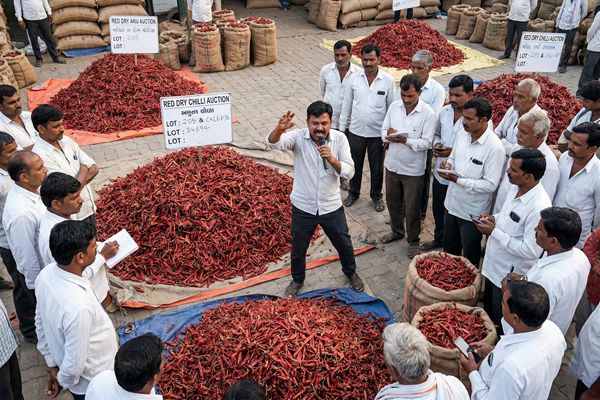
Indian chilli prices are holding firm despite peak fresh crop arrivals in key Indian markets, with earlier cyclone damage and strong export demand preventing any meaningful correction. Short term, only a shallow price softening is likely as arrivals remain heavy, while structurally tighter supply and robust overseas buying keep the market underpinned.
Chilli trade in India has moved into its seasonal arrival peak, yet benchmark markets such as Guntur and Delhi are signalling solid underlying demand at current levels. Exporter buying is absorbing much of the seasonal flush, while earlier weather damage to the crop has reduced total available supplies for the season. For European and international buyers, this combination points to a broadly stable market with a slight downside bias in the next 2–3 weeks, but limited scope for deeper price breaks.
Exclusive Offers on CMBroker

Chilli dried whole
bird eye, grade a
FOB 4.65 €/kg
(from IN)

Chilli dried
powder, grade a
FOB 4.40 €/kg
(from IN)

Chilli dried
flakes, grade a
FOB 4.35 €/kg
(from IN)
📈 Prices & Current Levels (in EUR)
At Guntur, India’s largest chilli hub, daily arrivals are reported around 100,000–125,000 bags, yet spot prices for key varieties remain resilient. 334-variety chilli is quoted at the equivalent of roughly EUR 195–245 per quintal, while 341-variety trades around EUR 205–225 per quintal, indicating no sharp discounting despite heavy inflows.
In the Delhi wholesale spice market, 334-variety has recently gained about INR 500 per quintal, and now trades near EUR 215–235 per quintal, underlining firm domestic demand at the consumer and processing level. Warangal in Telangana shows a similar pattern: Fatki-grade chilli is available at more discounted levels around EUR 100–140 per quintal, while 341-variety there is aligned with Delhi at approximately EUR 215–235 per quintal.
FOB offers from India for value-added and organic product lines corroborate this firmness. Recent offers (21 March 2026) show organic bird-eye whole at about EUR 4.65/kg FOB New Delhi, organic powder near EUR 4.40/kg and organic flakes around EUR 4.35/kg FOB Andhra Pradesh, while conventional stemless whole trades close to EUR 2.15/kg FOB. These values have been broadly stable over recent weeks, with only marginal upticks, confirming a steady international price floor.
| Product / Market | Specification | Price (EUR) | Unit | Terms |
|---|---|---|---|---|
| Guntur (AP) | Chilli 334 | ~195–245 | per quintal | Domestic spot |
| Guntur (AP) | Chilli 341 | ~205–225 | per quintal | Domestic spot |
| Delhi | Chilli 334 | ~215–235 | per quintal | Domestic spot |
| FOB New Delhi | Chilli dried whole, bird eye, organic | 4.65 | per kg | FOB |
| FOB Andhra Pradesh | Chilli powder, organic | 4.40 | per kg | FOB |
| FOB Andhra Pradesh | Chilli flakes, organic | 4.35 | per kg | FOB |
| FOB Andhra Pradesh | Chilli whole, stemless, conventional | 2.15 | per kg | FOB |
🌍 Supply & Demand Drivers
A key feature of the current season is the contrast between heavy arrivals and structurally tighter total supply. A cyclone that struck major chilli belts in Andhra Pradesh and Telangana earlier in the season is estimated to have damaged about 25–30% of the standing crop, particularly in important clusters such as Guntur and Warangal. This loss is now being felt as the harvest progresses, reducing the overall availability even as daily inflows remain high.
Nevertheless, arrivals in the current peak are robust, and quality is gradually improving as fields dry and harvest operations normalise. Exporter participation at Guntur is particularly strong, providing the incremental demand needed to clear the market without aggressive price-cutting. For now, this balance of slightly constrained supply and solid offtake is keeping the market in a firm but not overheated configuration.
Demand-side dynamics are anchored by strong overseas interest. According to official trade data for April–December 2025, Indian chilli exports increased by about 23% in volume year on year, to more than 5.36 million quintals, while export earnings grew 6% to roughly INR 75.5 billion. This shows that global buyers have been willing to absorb higher volumes at prevailing price levels, especially from markets in the Middle East, Southeast Asia and Europe, reinforcing India’s role as a key global supplier.
📊 Fundamentals & Weather Outlook
Fundamentally, the market sits on a notably tighter balance sheet than originally expected. Pre-season expectations of a comfortable surplus have been revised down because of weather-related field losses, disease pressure and lower yields in some pockets. The cyclone-related 25–30% damage estimate in the main producing states means that, even with strong arrivals in March, the total marketed surplus for 2025/26 will be below initial projections.
Recent trade and crop reports from late 2025 highlighted that Cyclone Montha, which hit Andhra Pradesh and Telangana in late October, caused meaningful damage to chilli acreage and increased the risk of pest and disease incidence during flowering and fruiting. Combined with ongoing concerns about moisture and quality in early arrivals, this has made buyers more selective, with better grades commanding a premium while lower grades see more resistance.
Weather conditions in late March 2026 in the Deccan chilli belt are seasonally dry and broadly favourable for harvest and post-harvest drying. Short-term forecasts for Andhra Pradesh and Telangana point to generally stable, warm conditions without imminent large-scale rainfall systems, suggesting that the current pace of arrivals should continue without major disruption over the coming 1–2 weeks. This supports the expectation of a short window of slightly easier prices as supply remains visible and logistics function normally.
📆 Short-Term Outlook & Trading Strategy
Over the next two to three weeks, the chilli market is expected to remain broadly stable with a mild softening bias, driven by sustained peak arrivals and continued but orderly exporter buying. Any correction, however, is likely to be shallow and short-lived given the underlying seasonal crop loss and strong export pipeline.
Once arrivals start to taper, the focus will quickly shift back to the tighter full-season balance and the pace of export shipments. If overseas demand remains as solid as in the first nine months of the 2025/26 marketing year, the remaining stocks could tighten more quickly than usual, limiting downside and potentially reintroducing upward pressure into the second quarter.
📌 Strategic Pointers for Market Participants
- European and international buyers: Use the current peak-arrival window to secure forward coverage for Q2 at today’s stable EUR price levels, especially for premium and organic grades where quality-related premia may widen later.
- Indian exporters: Maintain active procurement in Guntur and Warangal while spot prices remain capped; focus on quality differentiation to capture stronger margins in Europe and high-spec Asian markets.
- Domestic processors and traders: Stagger purchases over the next 2–3 weeks to benefit from any marginal softening, but avoid waiting for a deep correction that is unlikely given the cyclone-induced supply loss.
- Risk management: Consider hedging part of forward exposure via staggered contracting rather than large one-off purchases, as upside risks will re-emerge once arrivals decline and export dispatches accelerate.
📉 3-Day Directional Price Indication (EUR)
- Guntur (spot, 334/341): Largely sideways with a slight downward bias (−0.5% to −1%) as arrivals stay heavy but exporter demand continues.
- Warangal (spot, mixed grades): Stable to marginally softer, with lower grades under mild pressure, higher grades steady.
- FOB India (New Delhi / Andhra ports): EUR-denominated offers expected to remain flat around current levels for whole, flakes and powder, with narrow room for negotiation on larger volumes.
Related posts:
 Indian Chilli Prices Steady at High Levels as Heat Builds in Andhra
 Indian Turmeric Prices Hold Steady as New Crop Pressure Meets Firm Export Demand
 Red Chilli Market Holds Firm: Stable Prices, Low Downside Risk
 Cumin market holds firm as demand absorbs limited arrivals
 Jeera Holds Firm: Quality Cumin in Demand Despite Heavy Arrivals
 Indian chilli prices edge higher on tight supply and strong exports
 Egypt Laurel Prices Hold Firm as Weather and Freight Stay Watchpoints