
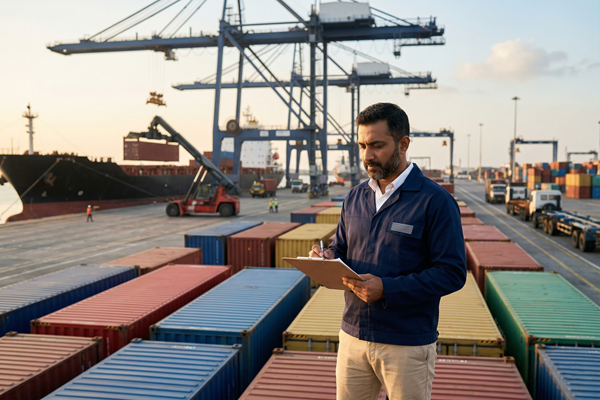
India has announced a 15-day fee waiver at Mundra port for export containers bound for the Middle East. The government introduced the measure on Tuesday to ease logistics costs and support exporters disrupted by the ongoing West Asia crisis. Special Secretary in the Ministry of Shipping, Rajesh Sinha, confirmed the waiver at the daily inter-ministerial briefing.
Context: West Asia Crisis and Indian Trade Exposure
India is one of Asia’s largest exporters to the Middle East, making regional shipping stability a critical concern. Consequently, disruptions to Gulf trade routes directly affect Indian commodity exporters across sectors including agriculture, textiles, and refined petroleum products. Mundra port, located in Gujarat on India’s western coast, serves as a primary gateway for containerised cargo bound for the Gulf region.
The Mundra Port Fee Waiver
The government confirmed the waiver applies to all export containers departing Mundra for Middle East destinations. Additionally, Special Secretary Sinha stated the measure is intended to ensure smoother trade flows and reduce cost pressures on exporters. The waiver runs for 15 days from the date of announcement, though the government did not specify whether an extension is under consideration.
Meanwhile, Prime Minister Narendra Modi held a call with Sri Lankan President Anura Kumar to discuss the evolving West Asia situation. Both leaders reaffirmed the importance of keeping shipping lanes open and secure for the global community. The diplomatic exchange signals coordinated regional concern about trade route integrity.
Supply Chain and Trade Flow Impact
The waiver reduces short-term logistics costs for Indian exporters routing cargo through Mundra toward Gulf markets. Furthermore, the measure signals government intent to shield exporters from the financial impact of regional disruption. Volume data on containers affected was not reported in official communications.
Fuel Supply Stability Measures
The government also moved to reassure markets on domestic fuel availability. Sujata Sharma, Joint Secretary at the Ministry of Petroleum and Natural Gas, confirmed that sufficient crude oil is available at all domestic refineries and that supply chains remain stable. Petrol and diesel prices have not increased, and petrol pumps across the country hold adequate stocks.
Oil marketing companies are conducting surprise inspections to ensure uninterrupted fuel distribution. Moreover, enforcement agencies have seized approximately 2,000 LPG cylinders in raids targeting supply irregularities. The government confirmed there is no shortage at LPG distributorships, and 5-kg cylinders are being prioritised for migrant workers.
Market Reactions and Stakeholder Views
Exporters using Mundra for Gulf-bound cargo will benefit directly from reduced port cost exposure during the waiver period. Nevertheless, the underlying disruption risk from the West Asia crisis remains, and traders should monitor whether the waiver is extended beyond the initial 15 days. The government’s active inter-ministerial coordination suggests a sustained policy response is in place.
Global Context
The West Asia crisis is creating logistics pressure across multiple trade corridors connecting Asia to the Gulf. As a result, similar support measures may emerge from other major export economies with significant Middle East trade exposure. European commodity buyers sourcing from India should monitor whether disruption escalates and affects Indian export capacity or shipping timelines.
Market Outlook
In the near term, the Mundra fee waiver offers limited but meaningful relief to Indian exporters for the duration of the 15-day window. However, the measure does not address underlying shipping route risk in the West Asia region, which remains the primary variable. Traders should track whether enforcement incidents, port congestion, or insurance cost increases follow the Iran strait access restrictions announced earlier this week.
Over a six to twelve month horizon, sustained regional instability could prompt India to introduce broader export support mechanisms. Additionally, commodity buyers in Europe sourcing Indian agricultural and industrial goods should assess whether alternative routing or supply diversification is warranted. The government’s active inter-ministerial response suggests New Delhi is treating this as a serious and potentially extended disruption.
Related posts:
 Dairy Sector Faces Cost Pressure Amid Middle East Tensions; Feed Prices May Rise
 Kandla-Mundra Port Freight Rates Rise 20% as Diesel Costs Surge
 Iran Plans Strait of Hormuz Transit Fees Amid War, Sparks Global Oil and Food Price Fears
 Mini Cyclone Hits Kutch: Ships Collide at Mundra Port, Crane Damaged
 War May Slow Economy Briefly, India to Support Exporters
 Middle East Conflict Threatens Global Food Prices via Fertilizer and Energy Supply
 Six Ships Attacked in Gulf and Strait of Hormuz as Middle East War Threatens Global Shipping
 Oman Evacuates Major Oil Export Port as Tanker Attacks Deepen Middle East Energy Crisis