
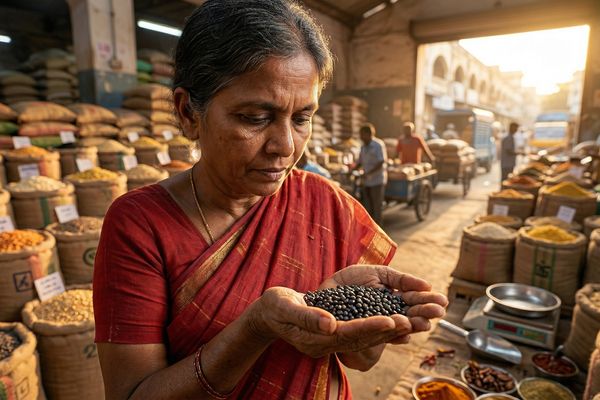
Lentil prices are holding broadly steady to slightly firmer, but the wider pulse complex shows that subdued mill demand and import policy uncertainty can quickly cap rallies. Black gram dynamics in India point to tightening domestic supply but active, mostly duty‑free imports acting as a ceiling on price recovery.
The lentil market is caught between firm structural demand and still-comfortable international supply. Recent price offers for Canadian red and green lentils and Chinese small green types point to a narrow, largely sideways range, even as the broader pulse sector in India signals that processors are buying cautiously and relying on imports when economical. At the same time, government decisions on duty-free windows for pulses such as black gram and lentils are shaping trade flows and limiting upside. Traders should watch Indian tariff and quota decisions, as well as Myanmar and North American weather, as the key triggers for any break-out from the current range.
Exclusive Offers on CMBroker

Lentils dried
small, green
99.5%
FOB 1.26 €/kg
(from CN)

Lentils dried
small, green
99.5%
FOB 1.17 €/kg
(from CN)

Lentils dried
Red football
FOB 2.60 €/kg
(from CA)
📈 Prices
Price action in the pulse complex is currently best illustrated by black gram, where Indian wholesale markets have softened for a third straight session due to weak mill buying and steady import arrivals. Imported Myanmar-origin black gram FAQ is quoted around $840/t CnF Chennai for March–April, with superior SQ near $935/t, both slightly lower on the week. At the domestic wholesale level, black gram has eased modestly across Chennai, Delhi, Mumbai and Kolkata, indicating a gently weaker tone rather than a sharp sell-off.
Lentil offers, by contrast, are comparatively stable. Converting recent FOB indications into EUR, Chinese small green lentils (Beijing, FOB) are trading near EUR 1.08–1.16/kg for conventional and roughly EUR 1.16–1.17/kg for organic product, with only minor week‑on‑week moves. Canadian-origin red “football” lentils are around EUR 2.30–2.32/kg FOB, while large and medium green types (Laird, Eston) are near EUR 1.56–1.61/kg, reflecting a modest premium for large greens but no sign of panic buying or acute shortage.
| Origin / Type | Delivery | Latest Price (EUR/kg) | 1 Week Ago (EUR/kg) | Trend |
|---|---|---|---|---|
| China small green, non-organic | FOB Beijing | ≈1.08 | ≈1.09 | Slightly softer |
| China small green, organic | FOB Beijing | ≈1.16 | ≈1.15 | Slightly firmer |
| Canada red “football” | FOB Ottawa | ≈2.30 | ≈2.28 | Stable to firmer |
| Canada Laird green | FOB Ottawa | ≈1.56 | ≈1.54 | Stable to firmer |
| Canada Eston green | FOB Ottawa | ≈1.47 | ≈1.45 | Stable to firmer |
🌍 Supply & Demand
In India’s pulse sector, the current black gram situation highlights how processors are limiting purchases to immediate needs, keeping overall sentiment subdued despite signs of tightening domestic availability. Fresh arrivals at producer markets are down from earlier in the season, and major producing states such as Andhra Pradesh are reporting production below last year even as new-crop flows start. Nevertheless, imports continue to arrive steadily, and government buffer stocks, although low for black gram, still contribute to overall supply security for pulses.
For lentils, this environment implies that Indian import demand can remain opportunistic and price-sensitive. The government has already signalled a willingness to use duty-free or low-duty windows across pulses to manage food inflation and supplies, as seen with black gram and previous decisions on lentils. Policy discussions now centre on whether to extend duty-free treatment or other concessions beyond March 2026 for selected pulses, which would keep import flows active and prevent any sharp price spike. Buyers in Europe and Asia who rely on Indian-origin pulses or Indian processing capacity should be aware that mills will likely continue to buy hand-to-mouth until there is clarity on the next phase of import policy.
📊 Fundamentals & Policy
The black gram market offers a useful template for how quickly fundamentals and policy can interact. Domestic Indian production is under pressure in parts of Andhra Pradesh, and official buffer stocks around 80,000 tonnes are below what would be expected for a comfortable position. Yet the market is not rallying because mills assume that ongoing imports, supported by an expected extension of duty-free rules past 31 March 2026, will fill the gap. Myanmar-origin black gram prices have just started to firm again after recent weakness, hinting that future import cargoes may become more expensive and could eventually raise replacement costs for Indian processors.
Lentils sit adjacent to this policy framework. India has historically adjusted basic customs duty and additional duties on lentils to balance farmer returns and consumer prices, and more recently has used temporary duty suspensions and low-duty windows. As the government explores broader pulse self-sufficiency strategies, it is likely to keep lentil tariffs flexible, using them as a lever alongside similar measures for black gram and pigeon pea. For the global lentil market, this means that any official move—such as extending or cancelling reduced-duty treatment—could quickly tighten or loosen import demand from one of the world’s key consuming countries, especially if domestic crops underperform.
🌦 Weather Outlook
Weather in key lentil-producing regions is entering a critical transition period. In Canada, much of the Prairies is moving from winter into early spring, with recent major snow events across parts of southern Canada indicating that fieldwork could be delayed in some areas, even though the moisture is broadly beneficial for soil profiles ahead of seeding. A gradual warming trend into early April would support timely planting, but any extended cold or further storms could compress the seeding window and introduce yield risk later in the season.
In Myanmar and India, black gram production conditions for the next season will also matter indirectly for lentil sentiment. If adverse weather were to tighten supplies of competing pulses like black gram, Indian demand might shift more heavily into lentils and other substitutes. For now, however, no immediate weather shock is visible that would justify a strong weather premium in lentil prices, and the market is instead focused on policy and trade flows.
📆 Short-Term Market View
Over the next two to three weeks, the pulse complex is likely to remain rangebound, mirroring the outlook for black gram where prices are expected to trade slightly softer to sideways. Any confirmation from New Delhi of an extended duty-free or low-duty import window for black gram—and potentially for lentils—would reinforce this cap on prices by signalling that imports will continue to play a balancing role. Conversely, sustained firming in Myanmar export quotations or any logistical disruptions could start to lift replacement costs and put a floor under the broader pulse market.
For lentils specifically, current FOB levels in China and Canada suggest mild upward drift rather than a breakaway rally. The market is fundamentally well supplied, but not oversupplied, with strong underlying demand from South Asia, the Middle East and Europe. Price risk appears skewed slightly to the upside later in the year if weather or policy developments tighten supply, but in the very near term buyers still have opportunities to secure coverage on modest dips.
💡 Trading Outlook
- Food manufacturers and packers: Use current rangebound prices to extend coverage modestly into Q2, prioritising large green and red lentils where Canadian offers remain competitive. Consider layering purchases rather than front-loading, given the risk of short-term softness if import policies stay buyer-friendly.
- Importers into India and South Asia: Monitor New Delhi’s decisions on pulse duty-free windows closely. For now, keep positions balanced and avoid aggressive long exposure until there is clarity on extensions beyond March 2026 for black gram and, by implication, lentils.
- European buyers: Diversify origins between Canada and China to mitigate freight and policy risks. Watch Myanmar and broader pulse prices as a leading indicator of when replacement costs for lentils might begin to firm.
📉 3-Day Price Indication (Directional)
- Canada (FOB, all lentil types, EUR terms): Stable to slightly firmer as exporters test small increases but face limited nearby demand.
- China (FOB Beijing small green lentils): Mostly stable, with a mild softening bias for conventional product and steady to slightly firmer tone for organic.
- India (delivered pulses, including black gram as proxy): Slight downside risk in the immediate term due to weak mill demand, but downside is increasingly limited by tightening domestic supplies and firmer Myanmar offers.
Related posts:
 Lentil Market Steady but Cautious as South Asian Pulse Prices Soften
 Lentil Market Steady Under Indian Buffer Sales and Cautious Buying
 Lentil Market Tracks Indian Pulse Tensions and Rising Freight Risk
 Mixed Pulse Signals Shape a Two-Speed Global Lentil Market
 Cautious Mill Buying Puts Imported Urad Under Pressure While Lentils and Arhar Hold Steady in India’s Pulse Market
 Lentil Prices Climb Amid Tight Supplies: What’s Next for the Pulse Market?