
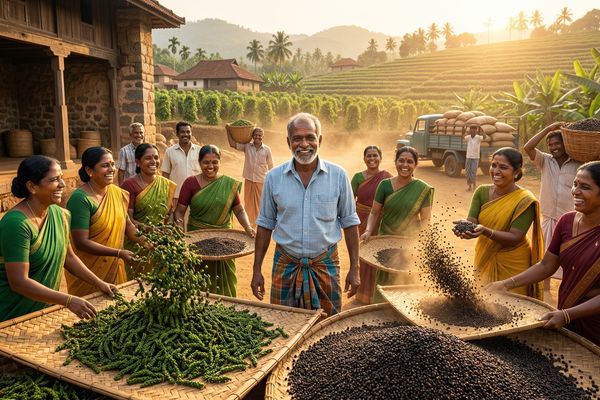
Indian black pepper is edging firmer on tightening domestic supply, but aggressive farmer holding and geopolitical disruption in Middle Eastern trade lanes are preventing a sustained rally. Near‑term, prices are likely to stay rangebound, with upside capped until export demand from the Gulf and Europe normalises.
Black pepper trade in India is navigating a rare mix of structurally tighter supply and fragile demand. New-crop arrivals in Kerala remain thin as farmers hold stocks for better levels, while Karnataka’s crop shortfall and the halt in Brazilian imports further constrain availability. At the same time, the Iran–Israel–US conflict is slowing shipments through the Persian Gulf, muting buying interest from key Middle Eastern buyers and tempering bullish momentum just as fundamentals would normally support a stronger price breakout.
Exclusive Offers on CMBroker

Pepper powder
black
FOB 8.85 €/kg
(from IN)

Pepper
white whole
FOB 7.20 €/kg
(from IN)

Pepper
green dehydrated
FOB 8.65 €/kg
(from LK)
📈 Prices & Short-Term Trend
In India’s domestic markets, black pepper has recovered modestly after earlier weakness. Delhi wholesale prices have firmed by about USD 0.06/kg to around USD 8.93–9.05/kg, mirroring similar gains at Kochi. Kozhikode, however, is lagging, with quotes softer at approximately USD 8.39–8.51/kg after a USD 0.12/kg decline, reflecting more subdued buying in that market segment.
FOB offers mirror this mildly constructive but not explosive tone. Indian black whole 500 g/l organic pepper around New Delhi is near EUR 8.15/kg, with conventional 500 g/l clean pepper closer to EUR 5.85/kg, indicating a quality and origin premium but no runaway rally. Vietnam’s FOB black pepper remains cheaper, roughly EUR 5.8–6.6/kg depending on grade, underlining India’s role as a relatively high‑priced, quality‑driven origin rather than a volume discounter.
| Product | Origin | Location | Latest FOB Price (EUR/kg) | 1-week Change (approx.) |
|---|---|---|---|---|
| Black pepper powder, organic | India | New Delhi | 8.85 | −0.05 |
| Black whole 500 g/l, organic | India | New Delhi | 8.15 | −0.10 |
| Black 500 g/l, clean | India | New Delhi | 5.85 | ≈ flat |
| Black 550–600 g/l, clean | Vietnam | Hanoi | ≈6.05–6.40 | −0.20 |
🌍 Supply & Demand Balance
The fundamental backdrop in India is tightening. Kerala’s new crop has been running for roughly 2.5–3 months, yet arrivals into major wholesale markets such as Kozhikode have dwindled to negligible levels as farmers deliberately restrict sales. This is a classic bullish configuration: visible supply is constrained despite the harvest being well underway.
Structurally, output is lower: Karnataka is expected to deliver only about 50% of a normal crop, while Kerala’s production is estimated down 20–25%. Imports from Brazil, which had been an important balancing factor, have now stopped. On the demand side, domestic usage remains resilient, but export flows are softer. India shipped 14,477 tonnes in the first nine months of FY 2025–26, down from 15,321 tonnes a year earlier, yet export value rose to USD 105.25 million from USD 88.24 million, signalling higher realisations per tonne even as volumes eased.
📊 Geopolitics, Logistics & Weather
The Iran–Israel–US war and the associated Strait of Hormuz crisis have become critical exogenous headwinds. Risk premiums in the Persian Gulf and intermittent restrictions on shipping are discouraging routine trade with Middle Eastern buyers, a key market for Indian pepper. Several advisories highlight sharply elevated security risks, drone attacks on vessels and a marked slowdown in commercial traffic through Gulf shipping lanes, making freight planning and insurance more complex and costly for spice cargoes.
This environment has led some Gulf and wider Middle Eastern counterparties to temporarily pause or scale back purchases until there is more clarity on transit safety and costs. The resulting demand softness is offsetting the domestic supply squeeze, helping explain why Indian prices are merely edging higher instead of breaking decisively upward. Weather in Kerala and Karnataka is currently not the primary driver; with the new crop already in, immediate risks relate more to logistics and political risk than to near‑term agro‑climatic shocks.
📆 2–3 Week Market Outlook
Market sentiment is broadly cautious. Tight domestic availability, farmer holding, a reduced Indian and Brazilian supply base and the structural importance of Indian pepper for Middle Eastern and European food industries all argue for a constructive medium‑term tone. However, ongoing war‑related disruptions in Gulf shipping and hesitant trade buying are likely to keep prices locked in a broad range in the coming 2–3 weeks.
A clear improvement in navigational security and freight economics through the Persian Gulf, or a visible rebound in inquiries from Middle Eastern and European buyers, would be the main catalysts for a fresh leg higher. Conversely, if geopolitical tensions were to escalate further and extend demand paralysis, some short‑term downside or prolonged sideways trading cannot be ruled out despite the tighter crop fundamentals.
🧭 Trading & Procurement Strategy
- European and Middle Eastern buyers: Consider securing a portion of Q2–Q3 coverage now to hedge against the risk of deeper supply tightness if Gulf logistics normalise while crops in India and Brazil remain smaller. Focus on staggered purchases rather than front‑loading, given current rangebound dynamics.
- Indian industrial users: With farmers holding stocks and visible arrivals weak, short physical positions carry increasing risk. Gradual inventory rebuilding at current levels appears prudent, particularly for higher‑quality grades where replacement risk is higher.
- Traders and exporters: Monitor freight, insurance and routing options closely, including diversions away from the most exposed Gulf corridors where feasible. Basis and quality spreads may widen; capturing premiums on clean and organic lots could offset volume pressure from softer Gulf demand.
📍 3-Day Price Indication (Directional)
- India – Delhi wholesale & FOB: Mildly firmer to sideways in EUR terms, supported by tight arrivals but capped by export hesitancy.
- India – Kochi/Kerala mandis: Slight upward bias as farmer holding continues and market digests lower state and Karnataka output.
- Vietnam – Hanoi FOB: Stable to marginally softer against Indian origin, maintaining a competitive discount but with limited fresh downside near current ranges.
Related posts:
 Black Cardamom Market Holds Firm as Tight Supply Meets Cautious Buying
 Geopolitics Push Indian Mustard Seed Higher While Export Offers Lag
 Indian Organic Rosemary FOB New Delhi Holds Steady Amid Firm Export Demand
 Indian Dill Seed FOB New Delhi Eases But Holds Firm Tone
 Red Chilli Market Holds Firm: Stable Prices, Low Downside Risk
 Nigella (Kalonji) Market Holds Firm: Sideways Now, Optional Upside Later
 Organic Indian Cassia Holds Firm as Asian Supply Stays Ample