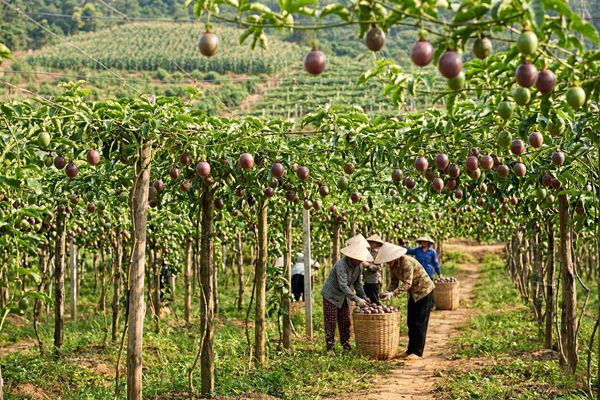
Vietnam’s passion fruit sector faces rising regulatory risk in the EU after a high rate of pesticide residue violations, while FOB prices for dried product from Vietnam remain broadly stable in EUR terms.
Tighter EU scrutiny could translate into higher testing and compliance costs, longer lead times and potential demand shifts within Europe. For now, spot prices in Vietnam show only marginal softening, but the regulatory overhang is likely to weigh on forward negotiations, especially for buyers exposed to strict retailer standards and food-safety audits.
Exclusive Offers on CMBroker

Passion fruit
dried
FOB 6.75 €/kg
(from VN)
📈 Prices & Market Tone
Recent indicative offers for dried passion fruit (origin Vietnam, FOB Hanoi) have been broadly stable around EUR 6.75–6.80/kg in March 2026, with the latest quote on 21 March at EUR 6.75/kg, just below earlier March levels of EUR 6.80/kg. This slight easing suggests modest buyer resistance and some discounting ahead of potential EU control changes rather than a supply shock.
| Date | Product | Origin | Price (EUR/kg, FOB) |
|---|---|---|---|
| 2026-03-21 | Passion fruit, dried | Vietnam | 6.75 |
| 2026-03-14 | Passion fruit, dried | Vietnam | 6.80 |
| 2026-03-07 | Passion fruit, dried | Vietnam | 6.80 |
Currency moves have been volatile, with the Vietnamese dong weakening sharply on the black market in recent days, which slightly cushions local exporters in VND terms even if EUR-denominated prices remain flat.
🌍 Supply, Demand & Regulatory Backdrop
A February 2026 assessment from France’s General Directorate for Food, based on 2024 inspections, found that 32% of sampled Vietnamese passion fruit consignments to the EU breached maximum residue limits (MRLs) for pesticides, including detections of omethoate, a substance considered potentially harmful for consumers. Out of 47 samples, 15 exceeded EU limits, flagging a systemic residue-control issue in parts of the Vietnamese supply chain.
These results feed into the EU’s coordinated control program, which underpins twice‑yearly updates to import regulations for high‑risk products. Given the elevated non‑compliance rate, Vietnamese passion fruit now faces a real risk of being classified as a high‑risk commodity: inclusion in Annex I would mean more frequent identity and physical checks at EU borders, while Annex II status would add mandatory pre‑export testing and certification in Vietnam. Either route raises costs and increases the risk of delays and shipment rejections.
Although the EU is a smaller volume outlet compared with China, it is a high‑value market for Vietnamese fruit, with passion fruit exports contributing hundreds of millions of dollars annually to horticultural income. Any escalation of EU controls could prompt some buyers to switch origin or reduce Vietnamese exposure, especially in premium retail channels, while less sensitive industrial users may stay but demand price concessions to offset higher compliance risk.
📊 Fundamentals & Cost Structure
Stricter residue control would tighten margins along the Vietnamese supply chain. More frequent laboratory testing, improved traceability from farm to packhouse, segregated handling of compliant lots, and potential reprocessing or downgrading of non‑compliant batches all add cost. For exporters, this comes on top of potentially longer customs clearance times in Europe, raising storage and logistics expenses and increasing working‑capital needs.
Reputational risk is another fundamental factor: if violations persist, EU buyers may renegotiate contracts toward stricter quality clauses, shared testing obligations, or even penalty structures. This could incentivize better pesticide management at farm level but also accelerate consolidation toward larger, more professionally managed growers and processors who can consistently meet EU standards.
☀️ Weather & Production Outlook (Vietnam)
Late‑March conditions in Vietnam’s main fruit‑growing belts are typically warm to hot with the transition toward the rainy season, and no major extreme‑weather disruptions have been reported in recent days that would immediately threaten passion fruit availability.
Under normal conditions, near‑term supply is expected to remain adequate, meaning that short‑run price drivers are likely to be regulatory and currency‑related rather than weather‑driven. However, lingering soil moisture anomalies from the 2025 flood season in parts of Central Vietnam could still affect local orchard management and pest‑pressure patterns, keeping pesticide‑use practices in the spotlight.
📆 Market & Trading Outlook
- Short term (0–3 months): Dried passion fruit FOB Vietnam likely trades in a relatively narrow band around current EUR 6.7–6.9/kg levels as buyers monitor EU decisions; downside is cushioned by a weaker dong, while upside is capped by regulatory uncertainty.
- Medium term (2H 2026): The next EU review in the second half of 2026 will be pivotal. If Vietnamese compliance improves, the risk premium may fade; if not, stricter Annex I/II measures could trigger origin diversification and demand some price discounting to remain competitive.
🧭 Strategy Pointers
- EU buyers: Consider diversifying suppliers and insisting on pre‑shipment residue analyses, while negotiating shared testing protocols and contingency clauses for potential border delays.
- Vietnamese exporters: Prioritise investments in pesticide management, internal MRL screening and certification to position as low‑risk suppliers, and lock in medium‑term contracts before any formal EU reclassification.
- Traders and processors: Hedge EUR/VND exposure where possible and maintain optionality between EU and Asian outlets to arbitrate any future regulatory‑driven price spreads.
📍 3‑Day Directional Outlook (EUR-based)
- FOB Hanoi (dried passion fruit, Vietnam): Stable to slightly soft; prices expected to hover around EUR 6.7–6.8/kg over the next three days, with limited liquidity and a modest seller bias as some exporters pre‑emptively trim offers.
- EU import market (spot, processed uses): Mostly steady; buyers are cautious but not yet aggressively pushing for discounts, pending clearer guidance from forthcoming EU control updates.