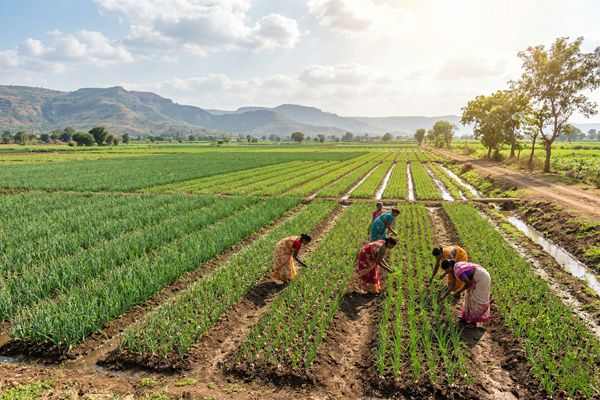
Maharashtra’s onion market is trapped in a low‑price, oversupply phase, prompting the state to set up a high‑level committee to stabilise farmer incomes and reduce recurring price crashes over the next few seasons.
The committee, drawing senior officials from Agriculture, Finance and Marketing, signals a shift away from ad‑hoc intervention towards structural reform in India’s key onion state. With production having outpaced market demand, farm‑gate prices have come under sustained pressure even as consumer availability remains comfortable. The government aims to combine short‑term support for distressed growers with a medium‑term roadmap built on diversification, improved crop management and cleaner trade practices. The policy backdrop is particularly relevant as India’s onion sector again faces the familiar cycle of heavy arrivals, thin margins and political sensitivity around farmer incomes and retail prices.
Exclusive Offers on CMBroker

Onions fried
crispy freid onions
FCA 2.75 €/kg
(from PL)

Onion powder
grade - B
FOB 1.25 €/kg
(from IN)

Onion
powder
FOB 2.60 €/kg
(from IN)
📈 Prices & Recent Moves
Official concern about falling farm‑gate prices in Maharashtra reflects a broad oversupply dynamic rather than a sudden weather or policy shock. In Lasalgaon and other benchmark mandis, seasonal studies show March–April as structurally weak price months, consistent with heavy rabi arrivals and current softness in the market.
On processed products, euro‑converted export offers from India indicate relatively stable but low price levels for onion powder and flakes ex‑New Delhi, while EU value‑added products such as fried onions in Poland show a mild softening trend over March, underlining downstream pressure along the chain. Together, this points to buyers retaining the upper hand in the short term, with limited evidence yet of a price floor forming at origin.
🌍 Supply, Demand & Policy Response
The core driver behind Maharashtra’s new committee is chronic oversupply: onion production in key belts like Nashik, Pune, Ahilyanagar and Solapur has expanded faster than domestic and export demand, amplifying seasonal volatility. The state explicitly acknowledges that repeated cycles of bumper crops followed by state support operations and market disruption are leaving farmers worse off overall.
Authorities have also highlighted distortions from intermediaries who buy cheaply from farmers and resell to agencies such as Nafed, capturing much of the benefit of any state procurement. By raising trade issues with the Centre and planning discussions with the Union Commerce Minister, Maharashtra is clearly pushing for tighter oversight of trading practices and stronger export channels to absorb surplus stocks and improve price realisation at the farm gate.
📊 Structural Reforms & Diversification
The committee’s mandate goes beyond firefighting: it is tasked with immediate relief recommendations and a comprehensive structural roadmap within two to three months. A key plank will be crop diversification in the main onion districts, starting from the coming kharif season, to gradually rebalance area away from chronically oversupplied onions toward more profitable alternatives.
Parallel efforts will target better seed selection, productivity and crop management to reduce post‑harvest losses and quality discounts, helping farmers earn more per hectare rather than only per kilogram. Politically, the Chief Minister has framed this as moving away from loss‑making cycles of excess production, supply disruptions and repeated state bailouts towards a more sustainable income model, with the aim of cutting the frequency and severity of price crashes over the next two to three years.
⛅ Weather & Short‑Term Market Context
Late‑March weather in Maharashtra’s onion belt is typically hot and dry, with average March maximums in western districts such as Nashik and Pune in the high 20s to low 30s °C, conditions that generally support harvest and curing when extreme heat waves and untimely rain are absent. While no major fresh weather shocks have been flagged for the last few days, rising temperatures into April will increase storage and shrinkage risks, especially for smallholders with limited infrastructure.
Against this backdrop, the committee’s near‑term challenge is to prevent further farm‑gate erosion as arrivals remain strong. Policy levers include temporary procurement, facilitating exports where commercially viable, and interventions to curb trading irregularities. However, without credible progress on diversification, the underlying surplus is likely to re‑emerge in subsequent seasons, capping any sustained price recovery.
🧭 Trading & Procurement Outlook
- For domestic buyers (retailers, processors): Continue staggered purchases; current oversupply and policy focus on farmer relief suggest limited short‑term upside risk, though localized price spikes cannot be ruled out if weather or logistics briefly disrupt arrivals.
- For exporters: Monitor upcoming state‑Centre discussions closely; any facilitation of exports from Maharashtra, building on earlier national moves to liberalise onion exports, could briefly tighten local supplies and improve FOB levels.
- For farmers and FPOs: Use state schemes and Nafed channels where available but plan for gradual area diversification from the next kharif season; relying solely on ad‑hoc procurement will likely keep incomes volatile and exposed to middlemen margins.
📆 3‑Day Price Indication (Direction, India‑Focused)
| Market / Product | Current Level (EUR) | 3‑Day Direction (Local) | Comment |
|---|---|---|---|
| Maharashtra mandis (fresh onions, farm‑gate equivalent) | Very low levels vs historical, after oversupply (approx. 0.15–0.25 EUR/kg) | ➡ to slight ⬇ | Strong arrivals and limited demand growth keep prices under pressure; policy news watched more than fundamentals. |
| IN export – onion powder, New Delhi (FOB) | ~1.25–1.52 EUR/kg | Stable (➡) | Offers broadly steady with comfortable raw‑material availability. |
| EU – fried onions, Poland (FCA) | ~2.75 EUR/kg | Slight ⬇ / range‑bound | Recent softening reflects ample supply and subdued downstream demand. |