Escalating conflict and missile strikes across the Gulf have triggered unprecedented airspace closures and capacity cuts, but Indian–Gulf fresh produce trade is beginning to adapt through alternative air-and-road corridors such as a new Chennai–Qaisumah–Kuwait link. While regional aviation disruption is far from resolved, the emergence of workarounds suggests that high‑value perishables may see more stable flows than general cargo. For traders in India and Kuwait, route risk, transit time and cost will be the key variables to monitor in the coming weeks.
Introduction
Since late February 2026, the Iran–US–Israel confrontation has expanded into a multi-theatre conflict affecting several Gulf states, with repeated Iranian missile and drone strikes on the United Arab Emirates and Oman, and related attacks on Saudi energy infrastructure. These actions have resulted in serious operational risks around major hubs, including damage and debris incidents near Dubai International Airport and repeated strikes on strategic ports and refineries across the region.
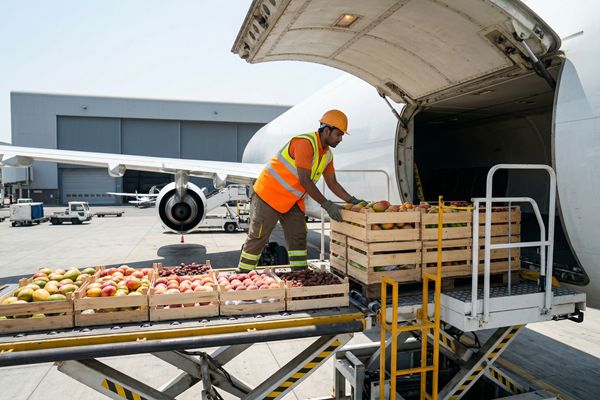
As war-risk premiums soar, airlines have curtailed or rerouted services, and multiple Gulf states have implemented tight airspace restrictions, leading to a sharp reduction in commercial traffic and long-haul diversions between Europe and Asia. Against this backdrop, Jazeera Airways has opened an alternative Chennai–Qaisumah–Kuwait air-and-road corridor to keep fresh fruit and vegetable supply moving from India into Kuwait, highlighting how conflict-driven aviation risk is restructuring regional agri-food logistics.
🌍 Immediate Market Impact
The closure or severe restriction of airspace across much of the Gulf has temporarily reduced available air cargo capacity into key hubs, especially the UAE, Bahrain and Qatar, disrupting established perishables flows that rely on fast transit via Dubai and other regional gateways. Reduced bellyhold capacity on passenger flights and curtailed freighter operations have raised spot airfreight rates and lengthened lead times for exporters in India shipping to Gulf markets.
For high-value, time-sensitive products such as fresh vegetables, tropical fruit and herbs, the risk is not only higher freight cost but also elevated spoilage and stock-outs in destination markets. The Chennai–Qaisumah–Kuwait corridor helps partially offset capacity losses on India–Kuwait lanes by using a secondary Saudi gateway and a short overland leg, bypassing the most exposed airspace while preserving acceptable transit times for perishables.
📦 Supply Chain Disruptions
Conflict-related strikes and air defence activity have created widespread aviation disruption, including mass flight cancellations at major Gulf airports and prolonged reroutings of long-haul services. Commercial advisories report that while the Strait of Hormuz has not been legally closed, perceived missile and drone risks have already deterred many vessels and aircraft from traditional routes, tightening logistics options for regional importers and re-exporters.
For Kuwait, whose food system is highly import-dependent, constraints on direct air links through neighbouring hubs raise the risk of intermittent shortages and higher costs for fresh produce. The new air-road corridor via Qaisumah mitigates some of this exposure but introduces new choke points: ground-handling capacity at a secondary Saudi airport, customs processing at the Saudi–Kuwait land border, and the need to maintain a reliable cold chain overland.
Indian exporters must now navigate more complex routing decisions, balancing uplift availability out of origin airports such as Chennai against longer routings, higher insurance premiums and variable ground conditions in Saudi transit points. Any deterioration in security conditions around the Saudi overland segment, or further tightening of regional airspace rules, could quickly erode the corridor’s reliability at scale.
📊 Commodities Potentially Affected
- Fresh vegetables (onions, okra, cucumbers, gourds) – Highly time-sensitive and a major component of India’s export basket to Kuwait and other Gulf states; vulnerable to airfreight disruption and transit delays, but supported by new corridors like Chennai–Qaisumah–Kuwait.
- Tropical fruits (mangoes, bananas, pomegranates, grapes) – Premium airfreight items where quality rapidly deteriorates with longer transit and handling; may see price spikes and more selective ordering by Gulf buyers.
- Fresh herbs and leafy greens – Extremely short shelf-life and heavily reliant on direct flights; even minor delays or extra handling can trigger rejection rates and wastage.
- Dairy and chilled animal products – Often move via regional hubs; disruptions in UAE and surrounding airspace can push more volume into alternative corridors or sea-air combinations, raising logistics costs.
- Dry foodstuffs and staples – Less time-sensitive, but shipping and insurance risk premia in the Gulf can still increase landed costs into Kuwait and neighbouring import-dependent markets.
🌎 Regional Trade Implications
The current conflict is encouraging a partial re-mapping of Gulf supply chains. For India–Gulf agri-food trade, this means less reliance on single-hub routings through highly exposed airports and more diversification via secondary Saudi or Omani gateways, as well as increased use of land corridors where security conditions allow.
India stands to reinforce its position as a key food security partner for Kuwait and other Gulf states if it can reliably service new corridors and adapt shipping patterns to evolving risk. Saudi Arabia may benefit as a logistical bridge, monetising its geography through transit, warehousing and cross-border trucking services, provided security at inland airports and land borders remains manageable.
Conversely, major trans-shipment hubs that are directly affected by missile or drone activity, or whose airspace remains tightly restricted, risk a temporary loss of perishables traffic to alternative corridors. For Kuwaiti importers, sourcing diversification within India and possibly from other South Asian suppliers may become a priority hedge against future route-specific disruptions.
🧭 Market Outlook
In the short term (next 30–90 days), volatility in airfreight capacity and pricing into the northern Gulf is likely to persist, with traders watching three factors closely: war-risk insurance premia for Gulf airspace, the stability of new corridors such as Chennai–Qaisumah–Kuwait, and any further escalation that could threaten inland Saudi logistics nodes.
If regional airspace gradually reopens and high-risk zones shrink, some traffic will likely revert to more direct routings via established hubs, putting pressure on the economics of longer air-road combinations. However, once tested, alternative corridors often remain part of shippers’ playbooks, providing optionality during future shocks.
For Indian exporters and Kuwaiti buyers, contract structures may increasingly incorporate flexible routing clauses and shared risk arrangements on freight and insurance costs, while inventory strategies may tilt towards slightly higher safety stocks for fast-moving fresh categories.
CMB Market Insight
The current Middle East conflict is reshaping regional aviation and logistics in ways that go beyond energy markets, exposing the vulnerability of Gulf food import systems to airspace and security shocks. The rapid deployment of an India–Saudi–Kuwait air-road corridor for fresh produce illustrates how agile routing can preserve critical agri-food flows, but it also underscores new dependencies on inland nodes and cross-border trucking.
Commodity market participants in India and Kuwait should treat this period as a real-time stress test of perishables logistics: monitoring corridor performance, benchmarking costs against pre-crisis airfreight, and reassessing route and supplier diversification strategies. Those who build resilient, multi-corridor options now will be better positioned to manage future geopolitical disruptions in the Gulf.