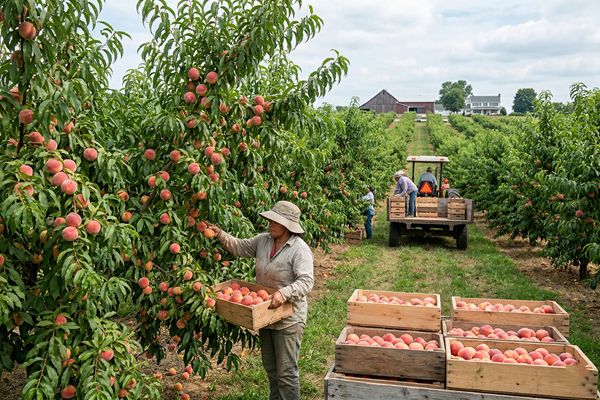
Titan Farms is signaling an on-time and broadly favourable 2026 US East Coast peach season, positioning itself as a reliable early-program supplier for retailers. Weather remains the key risk, but current conditions support expectations of solid volumes and consistent availability.
The company is leveraging its vertically integrated model in South Carolina to reassure retailers on supply reliability after several years of weather-related volatility in fresh fruit. With strong orchard conditions reported so far and a strategy centred on long-term retail partnerships, Titan Farms aims to underpin promotional activity from the opening weeks of harvest. However, the outlook still hinges on avoiding damaging late spring frosts across key East Coast growing areas, and no independent crop verification or hard volume data has yet been released.
📈 Prices & Market Setting
The announcement comes at a moment when US retailers remain highly sensitive to supply disruption and shrink in fresh stone fruit. While no explicit price indications were provided, a stronger and more reliable East Coast crop typically eases upward pressure on early-season peach prices and enables more aggressive promotional strategies.
Given recent tightness and volatility in other soft commodities, dependable domestic peach programmes from integrated growers like Titan Farms are likely to command a premium in terms of preferred shelf space and long-term contracts rather than through spot price escalation.
🌍 Supply, Demand & Titan Farms’ Position
Titan Farms reports favourable growing conditions heading into 2026, with a strong crop outlook and an expectation of starting the season on schedule. This should allow the company to support structured retail programmes and promotional volumes from the early harvest window, even though no specific yield or acreage data has been disclosed.
Operating on the US East Coast, Titan Farms serves major population centres in the Northeast and Mid-Atlantic during the summer. Its vertically integrated structure – from orchard through packing to distribution – gives it tight control over quality and timing, an important edge for peaches that are highly susceptible to bruising and have short shelf life.
📊 Vertical Integration & Retail Strategy
The grower emphasises a model built around long-term retail partnerships and category growth, rather than purely transactional sales. Branded product lines alongside standard offerings give retailers differentiated merchandising options, while tailored packaging and grading technology aim to reduce shrink and maximise sell-through.
By limiting handling points and managing the supply chain end-to-end, Titan Farms can respond quickly to shifts in retail demand during peak season. This agility, combined with programme-focused execution, is central to its value proposition at a time when retailers are prioritising reliability and waste reduction over opportunistic spot buying.
🌦 Weather Risk & Short-Term Outlook
In the broader market context, US retailers have faced several seasons of weather-related disruptions across fruit categories, increasing the value of dependable domestic supply programmes. Titan Farms’ optimistic outlook is grounded in current orchard conditions, but East Coast peaches remain exposed to late spring frost risk, which can sharply reduce yields even after a promising start.
Recent regional weather patterns in South Carolina point to generally warm conditions with some cooler nights but no immediate indication of severe frost episodes over the coming week, supporting the expectation of a normal seasonal start if this pattern persists. Nonetheless, the next 30–90 days will be critical, and buyers should continue to monitor temperature swings and potential cold snaps across the Carolinas and neighbouring production zones.
📌 Market Drivers & Global Context
The US fresh peach market is mainly supplied by domestic growers during the summer, with imports playing a limited off-season balancing role. South Carolina and Georgia remain key East Coast producing states, but long-term acreage decline driven by profitability pressures has increased reliance on established, efficient, vertically integrated operators.
Against this backdrop, Titan Farms’ strong crop message functions partly as a trade positioning statement, highlighting execution capability and retail focus rather than providing a quantified production forecast. The absence of third-party crop assessments means market participants should treat the outlook as optimistic but not yet independently verified.
📆 Forecast & Trading Outlook
Near term (next 30–90 days), if favourable growing conditions continue and frost risk remains contained, East Coast peach availability from Titan Farms is likely to be reliable for committed retail programmes from the start of harvest. This would support planned promotions and potentially more competitive consumer pricing relative to recent disrupted seasons.
Over the medium term (6–12 months), the broader US peach category could benefit if multiple East Coast growers report similarly good conditions, enabling stronger category promotion and volume-driven growth. However, any significant weather event before or during peak harvest could quickly tighten supply and reverse the current positive tone, making contingency sourcing strategies prudent.
🔎 Key Recommendations for Market Participants
- Retail buyers: Secure or reaffirm early-season programmes with Titan Farms, leveraging their integrated supply and shrink-reduction capabilities, but build contractual flexibility around potential weather-related volume adjustments.
- Importers and alternative suppliers: Maintain contingency options for late spring frost scenarios, particularly for the Carolinas and Georgia, to cover potential shortfalls during peak demand.
- Category managers: Plan promotional calendars assuming on-time East Coast supply, with scenarios ready for scaled-back activity if independent crop assessments later signal significant yield losses.
📉 3-Day Directional Outlook (Indicative, EUR Terms)
- US East Coast wholesale (early programme peaches, ex-packhouse): Stable in EUR terms over the next 3 days, with modest downside bias if favourable weather persists and confidence in the 2026 crop strengthens.
- Retail procurement levels (contracted programmes): Steady, as buyers hold positions but avoid aggressive additional spot commitments until frost risk further diminishes.
- Competing imported stone fruit: Slightly softer tone versus expected East Coast peaches, as retailers anticipate shifting more volume into domestic programmes once the season opens.