
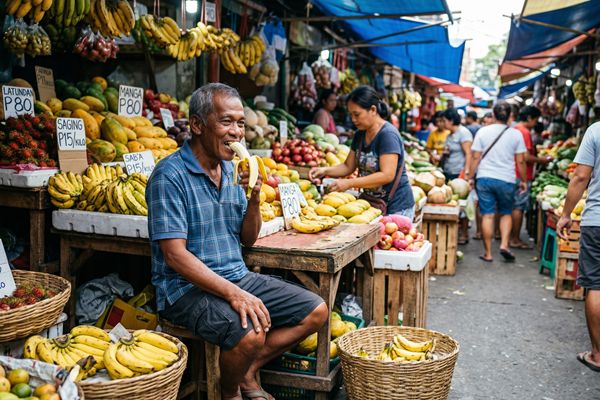
Philippine banana exporters are rapidly reorienting trade flows away from the Middle East toward Asian markets, leveraging proximity and competitive freight costs to defend export revenues. Short‑term losses are likely as up to roughly €185 million in annual export value is at risk, but stronger Asian demand and potential policy support could stabilize the sector.
The market is entering a volatile phase shaped by shipping disruptions in the Middle East, elevated freight prices and intensifying competition from Ecuador, Mexico and Vietnam. Exporters are suspending or curtailing shipments to Iran and GCC markets and reallocating volume to Japan and South Korea, where demand is structurally strong but tariff and competitive pressures are growing. Processed banana products, such as dried chips from the Philippines and Vietnam, show stable euro‑denominated prices in Europe and Asia, suggesting downstream buyers are so far shielded from the sharpest freight shocks.
Exclusive Offers on CMBroker

Banana dried chips
Chips, whole
FOB 3.43 €/kg
(from VN)

Banana dried chips
Chips, whole
FCA 2.88 €/kg
(from NL)

Banana dried chips
Chips, broken
FCA 1.85 €/kg
(from NL)
📈 Prices & Trade Flows
Export disruptions in the Middle East are hitting about 12% of the Philippines’ banana export value, previously worth around $193 million (approx. €185 million) last year, with Iran alone contributing roughly 8% of total revenues. Industry estimates indicate potential export revenue losses of up to $200 million (around €192 million) if disruptions persist.
At the same time, current offers for processed banana products suggest price stability in key trading hubs. Recent indicative prices for banana dried chips (converted to EUR) show no week‑on‑week changes, underlining that spot logistics shocks have not yet fully translated into end‑product quotations.
| Product | Origin | Location / Terms | Latest Price (EUR/kg) | 1M Trend |
|---|---|---|---|---|
| Banana dried chips, whole | Vietnam | Hanoi, FOB | 3.43 | Stable |
| Banana dried chips, whole (organic) | Philippines | Dordrecht (NL), FCA | 2.88 | Stable after early March uptick |
| Banana dried chips, whole | Philippines | Dordrecht (NL), FCA | 2.35 | Stable after early March uptick |
| Banana dried chips, broken | Philippines | Dordrecht (NL), FCA | 1.85 | Stable after early March uptick |
🌍 Supply, Demand & Geopolitics
Middle Eastern buyers, including Iran, Iraq and GCC countries, traditionally absorb a mid‑teens share of Philippine banana export value. Current disruptions to shipping lanes and trade finance into the region have prompted some exporters to suspend loadings, directly pressuring farm‑gate prices in Mindanao while freeing up exportable surplus.
In contrast, Asian demand remains resilient. Japan and South Korea continue to act as key anchors for Philippine bananas, and strong regional import needs provide a natural outlet for volumes diverted from the Middle East. Higher global freight costs are affecting all exporters, but the Philippines’ geographic proximity to North Asia and Southeast Asia helps keep landed costs relatively competitive versus Latin American origins.
📊 Fundamentals & Competitiveness
The export sector’s adjustment is occurring against a backdrop of structurally rising freight and input costs. Higher fuel prices are inflating ocean freight rates and squeezing margins along the value chain. Philippine producers are relatively advantaged in short‑haul Asian routes but face tighter spreads on longer‑haul shipments, reinforcing the strategic shift toward nearby markets.
Competition from Ecuador and Mexico is intensifying, particularly in markets where these origins can capitalize on scale and long‑term contracts. However, their freight disadvantage into Asia—especially under the current high‑cost environment—supports the Philippines’ role as a preferred nearby supplier. This is mirrored in processed segments: Philippine and Vietnamese dried banana chips are priced tightly together in Europe, reflecting a competitive but balanced landscape where logistics efficiency is crucial.
🏛️ Policy Response & Industry Strategy
Industry groups are pushing for targeted government support to cushion the impact of disrupted trade flows and elevated costs. Proposed measures include selective fee waivers, temporary suspension of export‑related charges and deferral of minimum wage hikes in key growing regions to stabilize labor‑intensive operations.
Concurrently, authorities are actively working on improving market access and tariff conditions in major Asian destinations, notably Japan and South Korea. A successful easing of tariff and non‑tariff barriers would help absorb displaced volumes from the Middle East and underpin investment in new plantings and disease management, thereby securing longer‑term export capacity.
📆 Short‑Term Outlook & Trading View
In the near term, Philippine banana exports are set to be rebalanced geographically rather than structurally reduced. Volumes to Iran and some GCC destinations are likely to remain subdued while trade routes and risk premiums adjust, but steady Asian demand should limit the downside for overall shipments, even if headline export revenues temporarily underperform due to lost Middle Eastern business.
Given stable euro‑denominated offers for dried banana chips over recent weeks, downstream buyers in Europe and Asia can expect relatively flat prices in the very short run. Any material price repricing in processed products will likely depend on how long elevated freight and insurance costs persist and whether new Asian demand fully offsets the Middle Eastern shortfall.
🎯 Trading Recommendations (next 1–4 weeks)
- Importers in Asia: Use the current reorientation of Philippine supply to negotiate improved terms or secure longer‑tenor contracts, especially for Q2–Q3 deliveries, while freight‑linked uncertainty remains elevated.
- European buyers of dried chips: With prices stable in EUR, consider modest forward coverage rather than aggressive stock‑building, as logistics risks are focused on Middle East routes rather than Europe.
- Philippine exporters: Prioritize high‑margin Asian markets and monitor evolving policy support; avoid deep discounts into disrupted Middle Eastern lanes until freight costs and insurance premiums normalize.
🕒 3‑Day Regional Price Indication (Directional)
- Philippine fresh export bananas (Asia‑bound, CFR): Largely steady in EUR terms; mild downside risk at farm‑gate level as volumes seek new buyers.
- Dried banana chips, Dordrecht (NL, FCA): Prices expected to remain flat around current levels over the next three days, with limited immediate impact from Middle East trade shifts.
- Dried banana chips, Hanoi (VN, FOB): Stable price outlook; competition with Philippine product is driven more by logistics and quality preferences than by short‑term price moves.
Related posts:
 Banana Chips Prices Hold Steady as PH Supply Recovers, VN Exports Cool
 Banana Chips Hold Firm as PH Export Rebound Meets Strong VN Competition
 Cameroon Banana Exports Surge as Market Power Concentrates in 2026
 Indian Banana Price Crash: Grower Crisis vs Stable Export Derivative Markets
 Banana Chips Hold Firm as PH Premiums Rise and Vietnam Stays Elevated