
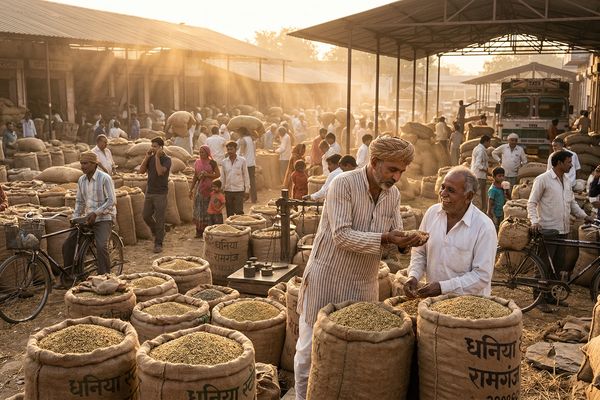
Indian coriander is entering a sharp bull phase as a significant production shortfall, depleted carryover and aggressive stockist buying tighten physical availability. Prices at Delhi wholesale and in export FOB markets are already elevated and are widely expected to move higher in the coming weeks, with European buyers facing direct upside risk in import costs.
Coriander has shifted from a relatively balanced spice to one of the most supply‑constrained markets this season. India’s output has fallen double‑digit year on year, while heat stress has further damaged yields and quality in key producing states. At the same time, Chinese import interest and speculative accumulation are absorbing limited top‑grade material. Without a clear path to supply recovery before the next growing cycle, the market is likely to stay structurally tight through the near to medium term.
Exclusive Offers on CMBroker

Coriander seeds
99,9%
FOB 1.05 €/kg
(from EG)

Coriander seeds
whole
FOB 2.10 €/kg
(from IN)

Coriander seeds
single parrot
FOB 1.17 €/kg
(from IN)
📈 Prices & Market Momentum
Badami‑grade coriander at the Delhi wholesale market has recently increased by roughly Rs 200–400 per quintal, trading around USD 127.53–130.71 per 100 kg. This equates to approximately EUR 1.43/kg at mid‑range, based on a simple currency conversion. Traders report steady day‑to‑day gains and still expect an additional Rs 5–10 per quintal in the very near term as arrivals underperform expectations.
Forward expectations are clearly bullish: badami coriander is widely anticipated to breach around USD 138.15–143.47 per quintal over the next two to four weeks, or roughly EUR 1.56/kg at the midpoint. Futures markets have already responded to the tightening fundamentals, reinforcing the upside in spot values. This price dynamic is unfolding while new‑crop stocks are well below normal, amplifying volatility risk for buyers who delay coverage.
🌍 Supply & Demand Balance
India’s total coriander production for the current season is estimated at about 386,000 tonnes, down from 441,000 tonnes last year. This represents a reduction in the order of 12–15%, a sizeable drop for a market that relies heavily on India as a key origin. The contraction is primarily linked to reduced sowing in Rajasthan, Madhya Pradesh and Gujarat, where planted area was already 12–15% lower after farmers rotated into garlic, oilseeds and cumin following poor price realisations in the previous season.
On top of lower acreage, heat stress in March across parts of Rajasthan and Gujarat has further reduced recoverable yield and hurt quality. New‑crop stocks are currently assessed at only 2–2.5 million 100‑kg bags, roughly half the 4–4.5 million bags seen in 2025. Carryover into this season is also described as meaningfully below last year. The result is a structurally undersupplied domestic balance sheet, in which even modest export or speculative flows can sharply tighten visible stocks.
External demand is exacerbating the squeeze. Weaker coriander harvests in competing origins have opened the door for higher Chinese buying interest in Indian material. This export pull is arriving precisely as domestic stockists and speculators build positions, creating a multi‑layered demand shock. European spice processors and food manufacturers sourcing both whole and ground coriander from India are thus competing with stronger Asian demand for a smaller, lower‑quality pool of product.
📊 Fundamentals & Price References (EUR)
The fundamental picture is one of constrained supply and firm to rising prices along the value chain. Physical tightness in India is mirrored in FOB offers for key origins and qualities, with only limited relief from alternative suppliers.
| Product | Origin | Spec / Type | Location / Term | Current Price (EUR/kg) | Previous Price (EUR/kg) | Last Update |
|---|---|---|---|---|---|---|
| Coriander seeds | Egypt | 99.9% purity | Cairo FOB | 1.05 | 1.03 | 2026-03-26 |
| Coriander seeds | India | whole, organic | New Delhi FOB | 2.15 | 2.20 | 2026-03-20 |
| Coriander seeds | India | single parrot | New Delhi FOB | 1.15 | 1.15 | 2026-03-20 |
FOB Egypt coriander at around EUR 1.05/kg has edged higher in late March, suggesting that alternative origins are also tightening and tracking the bullish tone out of India. Indian non‑organic qualities (e.g. EUR 0.93–1.30/kg for conventional New Delhi FOB) are firm but show only marginal changes in the latest available quotes, reflecting some time lag between domestic wholesale spikes and export price adjustments. Organic whole and powder grades around EUR 2.15–2.50/kg illustrate the premium segment’s sensitivity to Indian supply constraints.
🌦 Weather & Crop Conditions
Recent weather in major Indian coriander belts has been characterised by episodes of heat stress, particularly in March across parts of Rajasthan and Gujarat. These conditions have negatively affected grain filling and overall recoverable yield, cutting into the volume of top‑grade material. The timing of heat during late crop development is especially problematic, as it arrives after farmers have already committed inputs and acreage.
With the current season effectively locked in and new sowing still months away, there is limited scope for weather to materially improve near‑term supply. Even if conditions turn more benign, damage already done to the 2025 crop cannot be reversed. As a result, physical tightness from this season’s weather shock will continue to underpin prices until at least the next harvest window.
📆 Short-Term Outlook & Trading Strategy
Market sentiment is firmly bullish, underpinned by a rare combination of lower sowing, weather‑related yield losses, depleted carryover and strong buying by stockists, speculators and export customers. The self‑reinforcing cycle of rising prices and aggressive accumulation seen in recent weeks is unusual for coriander and signals that the market is in a classic supply‑driven rally. A meaningful easing of this tension is unlikely before the next growing season, barring an unexpected collapse in demand.
- European spice processors / food manufacturers: Consider advancing coverage for Q2–Q3 needs, especially for badami‑grade and higher qualities, to mitigate the risk of further Indian price escalation and tighter CIF supply.
- Importers / traders: Maintain a cautiously long bias in Indian origins, while selectively diversifying with Egyptian or other supplies where price‑competitive, to balance upside participation with origin risk.
- Retail and branded players: Begin evaluating potential price adjustments or pack‑size strategies, as sustained wholesale strength in coriander is likely to push up input costs for both whole and ground products over the coming months.
📍 3-Day Indicative Directional View (EUR)
- India, Delhi wholesale (badami grade, ex‑market): Mild upward bias from roughly EUR 1.43/kg towards the EUR 1.50/kg area as arrivals stay thin and speculative buying persists.
- India FOB New Delhi (conventional coriander seeds): Stable to slightly firmer around EUR 0.93–1.30/kg, with exporters gradually marking up offers in line with domestic gains.
- Egypt FOB Cairo (99.9% purity): Slightly firmer tone around EUR 1.05/kg, tracking Indian strength and reflecting limited surplus in alternative origins.
Related posts:
 Indian Mustard Seed Rally Tightens Global Cold-Pressed Oil Market
 Coriander FOB Cairo Edges Higher While Indian Grades Stay Soft
 Coriander drifts lower as fresh Indian crop caps prices
 Indian Dry Ginger FOB Steady but Firm as Export Demand Tightens
 Coriander Seeds: Softening FOB Levels in India and Egypt Amid Stable Supply
 Coriander finds a floor: fresh buying signals early recovery
 Ajwain exports surge: India tightens its grip on a niche global spice