
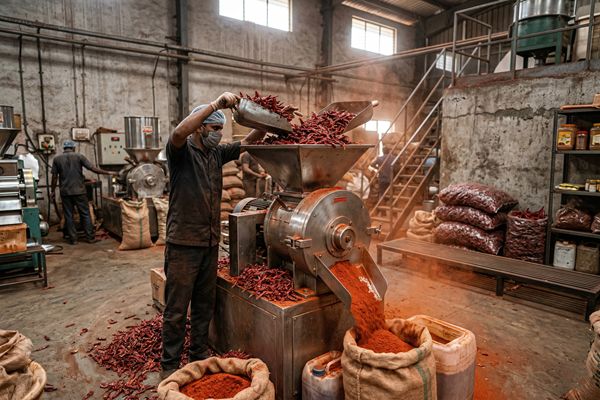
India’s chilli oleoresin segment is entering a period of structural pressure: raw chilli prices have nearly doubled year-on-year, while cheaper Chinese oleoresins and high stocks are discouraging fresh buying. Processors are reallocating capacity and capital to turmeric and curcumin, where demand and margins look more attractive.
Elevated chilli prices after reduced acreage in Andhra Pradesh, Telangana and Karnataka are tightening margins for extractors even as India’s overall spice oleoresin exports continue to grow in value and volume. At the same time, strong structural demand for natural colours and nutraceuticals is pulling processors toward turmeric, where farm-gate prices remain firm and extraction runs 30–40% above previous levels. Market participants report that many extraction units are avoiding new chilli procurement, leaving the chilli oleoresin value chain vulnerable to further demand loss if current economics persist.
Exclusive Offers on CMBroker

Chilli dried whole
bird eye, grade a
FOB 4.65 €/kg
(from IN)

Chilli dried
powder, grade a
FOB 4.40 €/kg
(from IN)

Chilli dried
flakes, grade a
FOB 4.35 €/kg
(from IN)
📈 Prices & current market tone
Indian chilli prices have almost doubled over the past year, driven by lower production after reduced acreage in key producing states and strong domestic and export demand. This has pushed raw material costs for oleoresin units to levels where extraction margins are thin or negative, particularly when competing with lower-priced Chinese extracts.
FOB offers from India in EUR terms indicate a firm but currently stable spot market: organic bird eye whole at about EUR 4.65/kg, organic chilli powder around EUR 4.40/kg, organic flakes near EUR 4.35/kg, and conventional whole stem or stemless at roughly EUR 2.15–2.16/kg. Over the past three weeks, these quotations have edged slightly higher but then plateaued, consistent with reports of processors stepping back from aggressive raw material buying while high spot prices ration demand.
| Product | Origin | Latest price (EUR/kg, FOB) | 1-week change |
|---|---|---|---|
| Chilli dried whole, bird eye, organic, grade A | New Delhi, IN | 4.65 | Stable vs 21 Mar 2026 |
| Chilli dried powder, organic, grade A | Andhra Pradesh, IN | 4.40 | Stable vs 21 Mar 2026 |
| Chilli dried flakes, organic, grade A | Andhra Pradesh, IN | 4.35 | Stable vs 21 Mar 2026 |
| Chilli dried whole, stemless, conventional | Andhra Pradesh, IN | 2.15 | Stable vs 21 Mar 2026 |
| Chilli dried with stem, conventional | Andhra Pradesh, IN | 2.16 | Stable vs 21 Mar 2026 |
🌍 Supply, demand & structural shifts
On the supply side, the key driver of today’s high chilli prices is reduced acreage in Andhra Pradesh, Telangana and Karnataka. Lower planting last season translated into smaller output just as quality demand from export and domestic segments stayed solid. This has tightened availability and contributed to the year-on-year price surge noted by industry participants.
However, for the chilli oleoresin segment, the main issue is not lack of physical chilli but poor processing economics. Market contacts highlight sizable carry-over stocks and existing inventory at many extraction units, which, combined with elevated replacement costs, curb appetites for additional procurement. At the same time, China has become an increasingly aggressive supplier of chilli oleoresins at lower prices, undercutting Indian offers and eroding export competitiveness.
In contrast, turmeric and curcumin extraction have become major demand centers. Processors report ramping up curcumin runs by 30–40%, backed by strong global interest in natural pigments and health-oriented ingredients, and by a regulatory shift in several markets away from synthetic additives. Turmeric farm-gate prices of about EUR 1.40–1.50/kg equivalent (converted from USD references) are above historical norms but still perceived as sustainable given robust downstream offtake.
📊 Fundamentals & export performance
India’s spice oils and oleoresins sector remains on a growth path despite the headwinds in chilli-based extraction. Export earnings rose to about USD 535.9 million in 2024–25 from USD 498.0 million the year before, while export volumes increased from roughly 17,000 tonnes to over 20,900 tonnes. This points to broad-based demand for Indian value-added spice ingredients, even as product mix shifts within the basket.
Within that mix, chilli oleoresin appears to be losing share to turmeric and possibly to other higher-margin extracts. Processors note that major plants have reoriented procurement strategies toward turmeric, with minimal or even zero chilli purchases in the current season. This suggests that future export growth from India is likely to be led more by curcumin and other natural colour/nutraceutical ingredients than by red chilli extracts, unless relative prices realign or new demand emerges.
🌦️ Weather & near-term crop backdrop
Recent conditions in core chilli regions such as Coastal Andhra Pradesh, Rayalaseema and Telangana have been mostly dry with generally normal rainfall patterns earlier in the season, limiting major weather-related disruptions to the harvested crop. Available agrometeorological updates for these sub-divisions indicate dry weather over late winter with temperatures close to seasonal norms, which is broadly neutral for post-harvest handling and drying of chilli stocks.
With the current crop largely harvested, short-term price risks are more linked to marketing dynamics and processor buying interest than to immediate weather shocks. Nonetheless, any abnormal heat or pre-monsoon rainfall spikes ahead of the next planting window could influence farmers’ acreage decisions between chilli, turmeric and alternative cash crops, and should be monitored by supply chain participants.
📆 Outlook & trading recommendations
Looking ahead, the chilli oleoresin segment is expected to stay under pressure in the near term. High raw material prices, strong competition from Chinese chilli extracts and sizeable existing stocks at Indian processors all argue against a quick revival in chilli-based extraction. Unless farm-gate prices ease or export realisations improve, processors are likely to maintain a cautious stance on new chilli purchases.
By contrast, turmeric and curcumin are set to remain in strategic focus. Structural demand for natural colours and health-related ingredients, coupled with regulatory moves away from synthetic curcumin and artificial dyes, provide a supportive backdrop for turmeric-based oleoresins. For chilli growers, the key medium-term risk is that prolonged displacement by turmeric and other crops could reduce dedicated demand from the extraction industry, reinforcing the need to stay closely aligned with quality-conscious export markets and diversified end-use channels.
📌 Strategic pointers for market participants
- Industrial buyers / extractors: Maintain lean chilli inventories and prioritise contractual flexibility, as high raw material prices and Chinese competition are compressing margins; consider forward-covering turmeric and curcumin needs where prices remain manageable relative to demand.
- Growers in AP, Telangana, Karnataka: Given that chilli prices have already nearly doubled year-on-year, avoid over-reactive acreage expansion; base planting plans on realistic demand from both the oleoresin and whole/powder markets and monitor any cooling in prices ahead of the next season.
- Exporters & traders: Focus on value-differentiated chilli segments (high colour, specific pungency profiles) where Indian origin can still command a premium versus Chinese competition, while simultaneously building stronger positions in turmeric and curcumin exports.
📉 Short-term (3‑day) price indication – India FOB
- Chilli dried whole, bird eye, organic (New Delhi): prices around EUR 4.60–4.70/kg FOB are expected to remain broadly steady over the next three days, with limited fresh buying from extractors.
- Chilli dried powder and flakes, organic (Andhra Pradesh): indicative EUR 4.30–4.45/kg FOB, likely range-bound as trade waits for clearer signals from both domestic demand and export inquiries.
- Conventional whole chilli (with or without stem, Andhra Pradesh): prices near EUR 2.10–2.20/kg FOB should hold firm in the very short term, supported by tight farmer selling but capped by cautious processor interest.
Related posts:
 Indian chilli prices stay near multi‑year highs as supply squeeze deepens
 Indian Chilli Prices Hold Firm at Peak Arrivals as Cyclone Losses Tighten Supply
 Indian Chilli Prices Steady at High Levels as Heat Builds in Andhra
 Indian Turmeric Prices Hold Steady as New Crop Pressure Meets Firm Export Demand
 Red Chilli Market Holds Firm: Stable Prices, Low Downside Risk
 Mustard seed market under pressure as mills step back and arrivals rise
 Mustard seeds under pressure as oil-mill demand cools but supplies stay comfortable