

India’s basmati rice market is being hit by a dual shock: export flows to West Asia have slowed sharply, freezing hundreds of millions of euros in payments, while surging energy and freight costs threaten to erode already thin margins. Near-term price action is slightly softer, but the bigger risk lies in liquidity stress for exporters and knock-on effects on farmers and allied industries.
The premium 1121 basmati segment is at the centre of the disruption, with large consignments held up at ports and payment channels to key West Asian buyers increasingly unreliable. This comes just as Indian FOB prices from New Delhi have eased modestly over March, reflecting weaker nearby export demand despite structurally tight global rice balances. If geopolitical tensions and shipping risks in and around the Strait of Hormuz persist, the market could transition from a price correction phase into a deeper funding and demand shock for India’s basmati value chain.
Exclusive Offers on CMBroker

Rice
all golden, sella
FOB 0.93 €/kg
(from IN)

Rice
all steam, pr11
FOB 0.43 €/kg
(from IN)

Rice
al ısteam, sharbati
FOB 0.60 €/kg
(from IN)
📈 Prices & Short-Term Moves
Indian FOB rice indications from New Delhi show a mild, broad-based softening over March, consistent with reports of slower basmati offtake from West Asia and greater hesitation from buyers.
| Origin | Type | Location | FOB Price (EUR/kg) | 1-week Change (EUR/kg) |
|---|---|---|---|---|
| India | 1121 steam (all steam) | New Delhi | 0.85 | -0.03 |
| India | 1509 steam (all steam) | New Delhi | 0.80 | -0.02 |
| India | Golden sella (all) | New Delhi | 0.95 | -0.02 |
| India | White basmati (organic) | New Delhi | 1.78 | -0.02 |
Non-basmati and speciality segments show a similar pattern of minor declines (around EUR 0.02/kg over the past week), suggesting that broader export sentiment is cautious, even though domestic fundamentals are not yet signalling surplus-driven price pressure. Vietnamese FOB benchmarks for long white, jasmine and japonica rice have also eased slightly, but Indian basmati is uniquely exposed to the current West Asia shock through its trade and payment linkages.
🌍 Trade Flows, Liquidity & Geopolitics
The central driver of the current market stress is severe disruption in basmati rice trade routes to West Asia, especially those transiting the Strait of Hormuz. Escalating regional conflict since late February and early March has led to vessel attacks, war-risk insurance hikes and an effective near-standstill in routine commercial shipping, forcing many cargoes to wait at Indian ports or seek longer, costlier alternative routes.
Industry participants estimate that payments equivalent to roughly EUR 220 million to over EUR 2.7 billion remain stuck, mainly for premium 1121 basmati shipments that are already loaded or ready for dispatch. Liquidity problems are now acute: traders report delayed settlements, reduced credit lines and rising working capital costs. Smaller exporters, labour contractors and logistics providers tied to the basmati export ecosystem are particularly exposed, as they have limited balance-sheet capacity to absorb prolonged delays.
The shock is magnified by India’s broader dependence on energy shipments through the same corridor. India sources nearly 85% of its crude oil imports and about half of its LNG via routes impacted by the West Asia conflict, and the Hormuz disruption has already produced the sharpest global energy supply shock since the 1970s. Brent prices have jumped well above USD 100 per barrel during March, lifting fuel and freight costs across sectors.
📊 Fundamentals & Spillover Risks
On the physical side, basmati availability in India has not changed materially in the very short term, but the export channel blockage effectively converts external demand into a temporary domestic overhang. With around three-quarters of basmati output typically exported to West Asia and other premium markets, longer-lasting trade disruption would likely build inventories at mills and traders, weighing on procurement prices paid to farmers later in the season.
The financial transmission channels may be more damaging than the physical surplus itself. Frozen receivables reduce the ability of exporters to roll new contracts, finance stocks or pay farmers on time. Rising energy costs feed through into milling, packing and transport expenses, squeezing margins even as headline FOB prices drift lower. If tensions persist, sectors such as fertilisers, packaging, tyres, chemicals and textiles—all heavily energy-dependent—face higher input costs, which will indirectly raise the cost base of rice production, storage and shipping.
At the macro level, the West Asia shock is pushing up India’s import bill and raising concerns about the rupee, which, if it weakens further, could partially offset international price declines in local-currency terms. Official responses so far include high-level inter-ministerial reviews chaired by the Defence Minister, signifying that authorities recognise the systemic risk posed by shipping and energy disruptions to food and agri-export chains, including basmati rice.
🌦️ Weather & Production Outlook (India Focus)
Weather is not the primary driver of the current basmati price and trade situation, but it will become increasingly important as the kharif planting window approaches. Short-range IMD guidance for North India, including Delhi and parts of Uttar Pradesh, points to scattered pre-monsoon showers and thunderstorms in the coming days, which may help soil moisture but are not yet decisive for yield outcomes.
Seasonal outlook tools from India’s climate forecasting systems indicate a close-to-normal to slightly volatile monsoon pattern, but detailed quantitative forecasts for the 2026 season are still being refined. At this stage there is no clear signal of a severe production shock for basmati-growing states, so market risk remains overwhelmingly skewed toward geopolitics, logistics and energy costs rather than weather-induced supply losses.
📆 Trading & Risk Management Outlook
- Exporters: Prioritise cash-flow preservation over volume growth. Renegotiate payment terms toward confirmed letters of credit, diversify exposure away from the most geopolitically sensitive buyers where possible, and avoid over-committing new 1121 basmati cargoes until clearer shipping and payment channels emerge.
- Importers in West Asia and beyond: Use current price softness to secure flexible-volume contracts rather than fixed large parcels. Build optionality into delivery windows, considering rerouted shipping paths via safer corridors even at higher freight costs.
- Producers and millers: Hedge against potential future input-cost inflation by locking in energy and packaging contracts where feasible, while being cautious about aggressively expanding planted area solely on historical basmati price strength.
- Financial investors and traders: Expect elevated basis risk between Indian basmati and broader Asian rice benchmarks. Short-term price downside from demand disruption coexists with medium-term upside if geopolitical tensions ease abruptly and delayed demand rushes back into the market.
📉 3-Day Directional Price Indication (EUR, FOB)
- India – New Delhi basmati (1121/1509, FOB, EUR/kg): Bias mildly lower to sideways over the next three days, as stranded cargoes and slow new bookings cap any rebound despite higher logistics costs.
- India – non-basmati white (FOB, EUR/kg): Sideways with a slight soft tone, tracking sentiment from basmati but better supported by diversified demand.
- Vietnam – long white & jasmine (FOB, EUR/kg): Largely stable to marginally softer, with limited direct exposure to the West Asia shipping shock but sensitive to broader global energy-driven freight costs.
Related posts:
 CBOT oats under pressure while Black Sea cash holds steady
 Ukrainian Sorghum Stagnates as Freight Surge Freezes Black Sea Exports
 Gulf Crisis Freezes Karnataka Rice Exports and Pressures Indian Prices
 Rice Market under West Asia Shock: Basmati Pressure vs Domestic Grain Stability
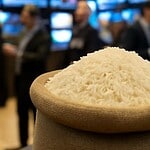 Basmati Under Pressure: How Weak Exports Are Reshaping the Rice Market
 India Basmati Rice: Stable Exports Under West Asia Stress