
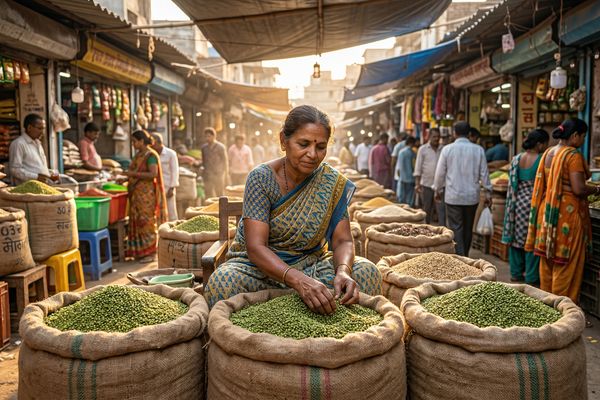
Indian-origin green gram, a key benchmark for the wider pulse complex, remains range‑bound as heavy government buffer stock sales offset seasonal demand. This policy‑driven ceiling on moong prices is indirectly limiting upside risks for global lentil procurement costs in the near term.
India’s steady arrivals, high public stocks and cautious mill buying are keeping pulse markets calm just ahead of the April–July wedding demand peak. Against this backdrop, lentil offers from China and Canada show only modest week‑on‑week moves in EUR terms, suggesting that importers still have time to cover forward needs selectively rather than chase the market higher.
Exclusive Offers on CMBroker

Lentils dried
small, green
99.5%
FOB 1.26 €/kg
(from CN)

Lentils dried
small, green
99.5%
FOB 1.17 €/kg
(from CN)

Lentils dried
Red football
FOB 2.58 €/kg
(from CA)
📈 Prices & Benchmarks
India’s green gram (moong), an important reference for South Asian pulse values, is trading broadly steady within a relatively narrow band. Depending on quality and location, recent quotes cluster between about EUR 62 and EUR 83 per quintal after FX conversion, with bold and chamki grades at the upper end of the range and ordinary grades at the lower end. Day‑to‑day moves have been small, confirming a consolidating market rather than a trending one.
Parallel to this, international lentil offers in EUR remain firm but not explosive. Latest FOB indications show Chinese small green lentils around EUR 1.17–1.26/kg (conventional vs. organic) and Canadian green and red types roughly EUR 1.67–2.60/kg, with only minor adjustments (±EUR 0.02/kg) over the past two weeks. This points to a gently firm but not overheated global lentil market.
| Product | Origin | Type | Latest price (EUR/kg, FOB) | 1–2 week change (EUR/kg) |
|---|---|---|---|---|
| Lentils dried | China | Small green, conv. | 1.17 | ~0.00 |
| Lentils dried | China | Small green, organic | 1.26 | +0.02 |
| Lentils dried | Canada | Eston green | 1.67 | +0.02 |
| Lentils dried | Canada | Laird green | 1.77 | +0.02 |
| Lentils dried | Canada | Red football | 2.60 | +0.02 |
🌍 Supply & Demand Dynamics
India’s green gram market currently reflects a delicate balance between adequate supply and seasonal demand. Arrivals from producing regions are steady, while dal mills are restricting purchases to immediate needs instead of building strategic stocks. This “hand‑to‑mouth” buying pattern mirrors a wider caution across pulses as traders move through the March financial year‑end.
The central government holds about 780,000 tonnes of green gram in buffer stocks, the largest among all pulses. Continuous releases from this buffer, alongside ongoing (but relatively limited) MSP procurement, are sending a strong anti‑speculation signal. This is effectively preventing tightness in moong and, by extension, dampening spill‑over bullishness into related pulse segments such as lentils in Asia and Europe.
On the demand side, India’s April–July wedding season is approaching, a period that typically lifts consumption of pulses in food service and catering. This should lend gradual support to moong and, indirectly, to lentil demand as buyers anticipate higher throughput in dhal, flour and snack applications. However, with large public stocks still in play, any demand‑led rally is likely to meet strong resistance from continued government sales.
📊 Fundamentals & Policy Backdrop
The defining fundamental at present is India’s active market management. By repeatedly auctioning green gram from its sizeable buffer and keeping MSP procurement only a fraction of arrivals, authorities are ensuring ample spot availability. This curbs the incentive for hoarding and speculative stockpiling across the pulse complex, including lentils.
For European and other importers of mung bean sprouts, mung flour and organic green gram, India’s stance is crucial. Because India is a dominant global supplier, its policy of capping moong prices indirectly caps input costs for value‑added products that compete with or complement lentils in retail shelves and food manufacturing. As long as buffer releases continue at the current pace, upside risk for short‑term lentil procurement into Europe appears limited.
In parallel, international lentil supply remains broadly comfortable, with Canada and China offering steady volumes and only incremental price adjustments in EUR. Recent anecdotal reports of heightened consumer attention to lentil prices in Canada point to demand sensitivity, but do not yet signal a structural supply squeeze. Overall fundamentals therefore argue for stability rather than a sharp repricing.
🌦 Weather & Crop Outlook
For now, the weather signal for key future lentil supply regions is neutral. In Canada’s Prairie provinces, where seeding typically begins later in spring, current conditions are seasonal with no major extremes reported in recent days that would force an immediate reassessment of 2026/27 lentil production potential. Planting‑window risks will become more relevant over the coming month.
In India, green gram arrivals are still dominated by earlier harvests rather than new weather‑driven surprises. With no acute weather shock in major pulse belts reported over the last few days, near‑term supply expectations for pulses, including lentils, remain broadly unchanged.
📆 Short‑Term Price Outlook (2–4 Weeks)
Green gram prices in India are expected to remain range‑bound over the next two to four weeks, roughly oscillating between the equivalent of EUR 62 and EUR 83 per quintal depending on grade and centre. The combination of sustained government buffer releases, steady arrivals and only gradually rising seasonal demand supports this sideways pattern.
For lentils, Chinese small green and Canadian green/red offers in EUR are also likely to trade sideways to modestly firmer, with current supplier quotations suggesting a gentle upward bias of only a few cents per kg at most. A pullback in Indian government moong sales or an unexpectedly strong demand surge from South and East India would be the key catalysts that could tighten regional pulse balances and spill over into higher lentil values.
📌 Trading Outlook & Strategy
- Importers (EU and MENA): Use the current stability in both moong and lentils to layer in coverage for Q2–Q3 on a staggered basis rather than front‑loading purchases. Focus on quality spreads, as bold and premium grades show wider differentials but limited volume risk.
- Processors: Maintain a neutral stance and avoid aggressive stock building while Indian buffer stocks are actively released. Secure immediate raw material needs and limited forward cover into the wedding season, but keep flexibility to benefit from any short‑lived dips.
- Producers & Exporters (Canada/China): Current EUR prices remain historically attractive but not extreme. Consider incremental forward sales, especially in premium green segments, while monitoring Indian policy signals for any shift in buffer‑stock strategy.
📉 3‑Day Directional View (EUR)
- India pulse complex (moong benchmark, EUR‑equivalent): Stable; intraday volatility limited, trading within the established range.
- FOB China, small green lentils: Steady to slightly firm around EUR 1.15–1.25/kg as buyers test offers but face no acute shortage.
- FOB Canada, green and red lentils: Stable with a mild upward bias near current levels (EUR 1.65–2.60/kg), tracking currency moves and incremental export demand.
Related posts:
 Lentils Market: Indian Green Gram Buffer Stocks Cap Global Upside
 Pigeon Pea Market Holds Mixed Tone as MSP Buffer Caps Upside
 Lentils Market Steady as Indian Green Gram Stocks Cap Upside
 Lentil Market Steady but Vulnerable to Pulse Policy Shifts and Asian Demand
 Lentil Market Treads Water as Indian Green Gram Sowing Surges
 Rangebound Black Gram Signals Subtle Support for Global Lentil Prices
 Pigeon Peas Under Pressure: Hand-to-Mouth Buying Caps Upside in India
 Indian Green Gram Overhang Keeps Global Lentil Market Capped