
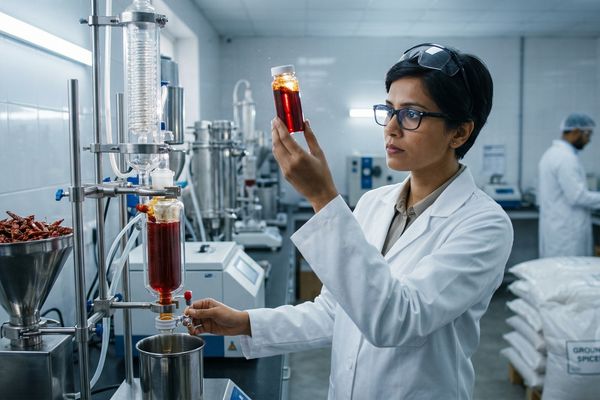
Indian red chilli prices have doubled year‑on‑year on acreage cuts, leaving raw markets firm while oleoresin processors retreat and pivot capacity into turmeric. This structural shift tightens availability of Indian chilli oleoresin for global buyers and cements China’s role as a low‑cost competitor.
The market is caught between tight farm‑level supply and weakening industrial offtake. Acreage reductions in Andhra Pradesh, Telangana and Karnataka after previous poor returns have sharply lifted raw chilli prices, while many Indian oleoresin manufacturers are relying on last season’s cheaper stocks instead of buying new crop. At the same time, they are expanding curcumin extraction, indirectly supporting turmeric prices. Exporters and food manufacturers, particularly in Europe, the US and Japan, face a more complex sourcing landscape as Indian chilli oleoresin output falls and Chinese supply grows.
Exclusive Offers on CMBroker

Chilli dried whole
bird eye, grade a
FOB 4.65 €/kg
(from IN)

Chilli dried
powder, grade a
FOB 4.40 €/kg
(from IN)

Chilli dried
flakes, grade a
FOB 4.35 €/kg
(from IN)
📈 Prices & market structure
Raw red chilli prices in India are roughly 100% higher than a year ago, driven mainly by reduced planted area. This tightness is visible in export‑oriented segments: recent FOB offers from India show dried whole stemless chilli around EUR 2.15/kg, with organic flakes and powder near EUR 4.35–4.40/kg and organic bird’s eye at about EUR 4.65/kg, all broadly stable but at historically elevated levels.
Despite high raw prices, downstream oleoresin demand is subdued. Several processors have effectively stopped fresh chilli procurement for the current season and are instead drawing down lower‑cost inventories built last year. The result is a firm primary market at origin but a softer tone in value‑added chilli oleoresin, where Indian exporters are under intense margin pressure.
🌍 Supply & demand dynamics
On the supply side, the key factor is a contraction in chilli acreage in Andhra Pradesh, Telangana and Karnataka, following poor farmer returns in previous seasons. Even as harvesting progresses, these structural cuts limit the scope for any near‑term price correction over the next two to four weeks. Comfortable carry‑over stocks at processor level are not sufficient to offset the tighter production base at farms.
Demand is bifurcated. Traditional spice trade and food processors continue to absorb raw material at higher prices, while oleoresin manufacturers have stepped back sharply due to eroded processing margins and the need for very large volumes to run solvent extraction efficiently. Internationally, India is losing cost competitiveness in chilli oleoresin to China, which has ramped up capacity at significantly lower cost, putting long‑standing Indian supplier relationships with buyers in Europe, North America and Japan at risk.
📊 Processing shift & export implications
The most important structural change is the pivot of Indian oleoresin producers from chilli toward turmeric curcumin extraction. Companies have increased curcumin output by an estimated 30–40%, purchasing turmeric aggressively at the farm gate to meet rising global demand for natural colorants and nutraceuticals. This shift absorbs processing capacity and capital that would otherwise support chilli oleoresin production.
India’s spice oleoresin and essential oil exports reached about USD 56.64 million in FY 2024‑25, up from USD 52.65 million the year before, with volumes growing from 16,997 tonnes to 20,940 tonnes. That growth is now jeopardised by the chilli cost‑price squeeze and intensifying Chinese competition. European food manufacturers relying on Indian chilli oleoresin as a natural colour and flavour source need to evaluate diversification strategies, balancing cheaper Chinese supply against potential quality and regulatory concerns.
🌦️ Short‑term outlook & weather context
In the immediate 2–4 week horizon, raw red chilli prices at major Indian producing markets are unlikely to ease meaningfully, given the reduced acreage and generally normal harvest progression. Weather in the key southern states is seasonally supportive rather than a major new driver, so structural factors – area cuts and trade flows – dominate the price outlook.
Oleoresin processor demand is expected to stay weak in this period, as most players have already adjusted their raw material strategy for the season and are focused on turmeric. This keeps a disconnect in place: tight farm‑gate markets and firm raw prices on one side, versus constrained output and cautious pricing in processed chilli oleoresin exports on the other.
📆 Trading & procurement outlook
- Food manufacturers (EU/US/JP): Secure medium‑term chilli oleoresin needs early and diversify origin where feasible. Consider trialling Chinese supply but maintain stringent quality and regulatory checks.
- Importers & traders: Avoid aggressive short positions in raw Indian chilli over the next month; acreage reduction and processor carry‑over limit downside. Focus on managing basis and quality spreads between grades.
- Oleoresin processors: For those still in chilli, prioritise efficiency and higher‑value contracts. The current economics favour continued emphasis on turmeric/curcumin until chilli prices normalise.
- End‑users of turmeric: Anticipate firmer turmeric prices as expanded curcumin production sustains demand; consider early coverage for 2026 requirements.
📍 3‑day price indication (directional)
| Product (FOB India) | Last quoted level (EUR/kg) | 3‑day directional view |
|---|---|---|
| Dried chilli, whole stemless, conventional | ≈ 2.15 | Sideways to slightly firm |
| Dried chilli flakes, organic, grade A | ≈ 4.35 | Sideways |
| Dried chilli powder, organic, grade A | ≈ 4.40 | Sideways |
| Dried bird eye chilli whole, organic | ≈ 4.65 | Sideways to firm |
Related posts:
 Indian Chilli Prices Hold Firm on Tight Quality Supply and Export Interest
 India chilli oleoresin under pressure as processors pivot to turmeric
 Indian chilli prices stay near multi‑year highs as supply squeeze deepens
 Indian Chilli Prices Hold Firm at Peak Arrivals as Cyclone Losses Tighten Supply
 Indian Chilli Prices Steady at High Levels as Heat Builds in Andhra
 Red Chilli Market Holds Firm: Stable Prices, Low Downside Risk