
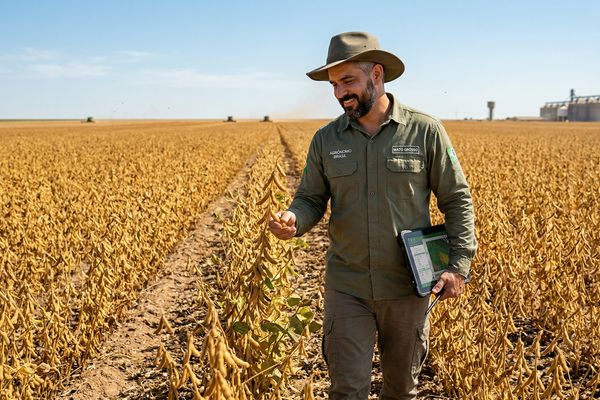
The soybean market is currently dominated by a record-sized 2025–26 Brazilian crop, exerting clear downward pressure on prices, while the Iran war-driven surge in fuel and fertilizer costs creates significant upside risk for the 2026–27 season onward. For now, global fundamentals are comfortably supplied, but the cost shock and potential acreage response in Brazil could plant the seeds of a tighter balance later in the decade.
Ample physical supply from Brazil, steady U.S. availability and soft import demand in parts of Asia are anchoring prices in a relatively subdued range. At the same time, logistics and input-cost uncertainty linked to the conflict around Iran and the Strait of Hormuz is starting to reshape producer margins and forward planting intentions. In India, an imminent decision on GM mustard and renewed income support schemes for soybean growers point to a more active oilseed policy stance, with important longer-term implications for the crushing sector and edible oil trade flows. European meal and oil buyers need to balance today’s comfort with tomorrow’s risks when locking in their 2026–27 coverage.
Exclusive Offers on CMBroker

Soybeans
sortex clean
FOB 0.99 €/kg
(from IN)

Soybeans
No. 2
FOB 0.59 €/kg
(from US)

Soybeans
FOB 0.34 €/kg
(from UA)
📈 Prices
International soybean benchmarks remain under pressure from abundant South American supply. Recent U.S. futures pricing points to a soft, sideways market, consistent with bank and industry outlooks that foresee subdued oilseed prices amid continued growth in Brazilian output.
Physical offers in key origins confirm this picture. Converted into EUR/tonne (assuming approximately 1 EUR = 1.10 USD), current FOB indications show a narrow, competitive band between major exporters, with India and China at a premium to U.S. and Black Sea origins.
| Origin | Specification | Location / Terms | Latest Price (EUR/tonne) | 1-week Change (EUR/tonne) |
|---|---|---|---|---|
| India | Sortex clean | New Delhi, FOB | ~900 EUR/t | Flat w/w |
| USA | No. 2 | Washington D.C., FOB | ~540 EUR/t | Flat w/w |
| Ukraine | Conventional | Odesa, FOB | ~310 EUR/t | Marginally lower w/w |
| China | Yellow | Beijing, FOB | ~640–700 EUR/t | Slightly higher w/w |
For European crushers and feed buyers, this translates into a buyer-friendly spot environment, with multiple origins competing for market share and basis levels under pressure.
🌍 Supply & Demand
Brazil remains the clear centre of gravity for global soybeans. Agroconsult has lifted its 2025–26 production forecast to 184.7 million tonnes, up 0.9% after extensive field surveys across 1,700 farms in 14 states. Planted area is seen at 49.1 million hectares, roughly 300,000 hectares above earlier expectations, with drought losses largely confined to Rio Grande do Sul.
This bumper soybean crop comes even as Brazil’s second corn (safrinha) crop is pegged 7.6% lower year-on-year at 114.5 million tonnes due to weaker yields. The relative resilience of soybeans versus maize underscores farmers’ continued preference for the oilseed and helps cement Brazil’s dominance in exportable supplies through 2026, reinforcing the bearish tone in near-term pricing.
On the demand side, some Asian importers are showing signs of caution in early 2026. Vietnam’s February soybean imports fell about 14% month-on-month, while China remains heavily supplied after record 2025 purchases from South America. Overall, however, global crush and feed demand are still expected to absorb most of the Brazilian surplus, albeit at lower prices that test producer margins rather than consumer affordability.
📊 Fundamentals & Policy Shifts
Despite today’s comfortable supply, the cost side of the balance sheet has become highly uncertain. The Iran war and the associated Strait of Hormuz crisis have already driven fertilizer prices up by as much as 40% since late February, with around a third of the world’s seaborne fertilizer flows passing through this choke point. Nitrogen prices are projected to potentially double from 2024 levels if disruptions persist, while phosphate costs could rise by roughly 50%.
Agroconsult’s management highlights that the 2026‑27 Brazilian soybean outlook is unusually opaque, citing the duration of the Iran conflict and tightening farm credit as key variables. Should high fertilizer and fuel prices persist into the second half of 2026, many Brazilian growers may cut input application rates or even reduce planted area. That would shift the global soybean balance from surplus toward a more finely balanced or even tighter scenario into 2027 and beyond, particularly if weather turns less benign.
In India, policy signals are turning more supportive for oilseeds. The government appears close to approving the domestically developed GM mustard hybrid DMH-11 after extensive biosafety testing. While this crop is separate from soybeans, such a decision would mark a notable softening in regulatory resistance to biotechnology in oilseeds, potentially paving the way for GM soybean varieties in future seasons. At the same time, Madhya Pradesh has reactivated the Bhavantar Bhugtan Yojana price-deficiency scheme for soybean farmers for the 2025–26 kharif season, helping stabilise grower incomes even in a lower-price environment.
🌦 Weather & Geopolitical Risks
Weather in Brazil’s main soybean belt has normalised after earlier localised drought in the south, allowing the large 2025–26 crop to be confirmed rather than merely projected. The more immediate risk is geopolitical: the Iran war has already disrupted tanker flows and raised freight and insurance premiums for fuel and fertilizer shipments out of the Gulf, with additional attacks on energy and gas infrastructure in South Pars and related facilities further undermining confidence.
The coming 3–6 months are therefore critical. A relatively quick de-escalation could see fertilizer prices moderate into late 2026, preserving much of Brazil’s acreage base. A protracted conflict, by contrast, would likely lock in structurally higher input costs during the next Brazilian planting window, increasing the probability of lower application rates, yield drag, and perhaps some acreage switching away from soybeans and corn.
📆 Trading & Procurement Outlook
- For crushers and feed buyers (EU and MENA): Use current price weakness and wide origin choice to extend coverage modestly into 2026‑27, but avoid fully front-loading purchases given elevated geopolitical uncertainty.
- For producers in the Americas: Lock in fertilizer and fuel where possible on price dips; consider partial hedging of 2026‑27 production given the risk that a future acreage pullback tightens the market.
- For Indian crushers: Monitor GM mustard approval closely as a signal of broader biotech acceptance; align medium-term investment plans in crushing and refining with a probable rise in domestic oilseed availability.
- For speculative traders: Near-term bias remains mildly bearish to sideways on confirmed Brazilian supply, but options structures that retain upside exposure to a 2027 tightening (via sustained Iran-related cost shocks) look increasingly attractive.
📉 3‑Day Price Direction Outlook
- CBOT / U.S. Gulf-linked values: Slightly softer to sideways as Brazilian export pressure continues and no major demand shocks are evident.
- Brazil export parity: Stable to marginally weaker, with premiums capped by intense competition and full pipelines.
- Black Sea / Ukraine FOB: Stable, tracking global benchmarks with some downside risk if freight conditions improve further.
- India & China FOB: Largely steady at a relative premium, supported by domestic policy, logistics and quality differentials.
Related posts:
 Strait of Hormuz War Chokes Gulf Oil Flows, Roiling Energy and Food Commodity Costs
 Soybeans Market: Nearby Futures Firm, Chinese Cash Under Pressure
 Soybeans under Geopolitical Strain but Supported by Strong Meal Demand
 Palm Oil Firms as War‑Driven Oil Shock Eases but Demand Signals Stay Mixed
 Soybeans stabilise as Brazil exports peak and biodiesel hopes support oilshare
 Soybeans under pressure: demand doubts, record crush and rising stocks
 Indian Soybean Complex Under Strain as War Chokes Oilmeal Exports