
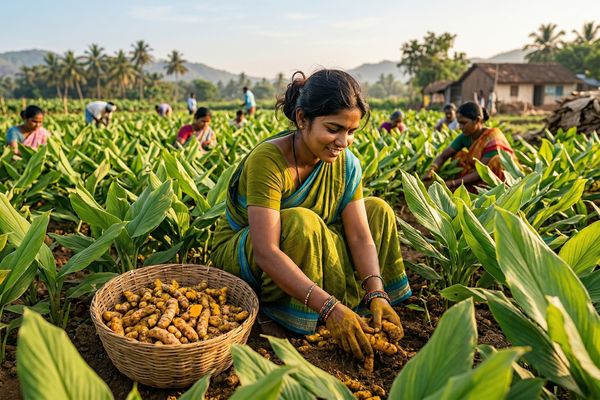
Turmeric prices remain elevated and structurally supported as global curcumin demand accelerates and oleoresin processors pivot away from expensive red chilli, keeping Indian turmeric firmly positioned as a high-value, multi-use spice.
The current season confirms turmeric’s shift from a cyclical spice to a strategically important ingredient for food, colour and nutraceutical chains. Domestic wholesale and farm-gate prices in India are holding well above historical norms, while export data point to broad-based demand growth. Large oleoresin manufacturers have stepped up buying in key producing states, absorbing fresh arrivals without the typical post-harvest price dip. With regulatory pressure on synthetic yellow colorants mounting and curcumin applications widening, the near-term outlook is for firm to slightly higher prices rather than a correction.
Exclusive Offers on CMBroker

Turmeric dried
finger nizamabad, double polished, grade A
FOB 1.44 €/kg
(from IN)

Turmeric whole
FOB 2.50 €/kg
(from IN)

Turmeric powder
FOB 3.34 €/kg
(from IN)
📈 Prices & Market Tone
At Jaipur’s wholesale spice market in Rajasthan, turmeric is trading around USD 163.67–182.68 per quintal, after a recent gain of USD 1.06 per quintal, signalling steady processor and stockist buying. At the farm gate, growers are receiving roughly USD 132.00–142.55 per kilogram, standing about USD 10–15 per kilogram above levels seen two years ago when prices hovered near USD 79.28–84.48 per kilogram. This persistent premium underlines a structural demand upgrade rather than a short-lived spike.
Export-oriented offers from India also reflect the firm tone. Indicative FOB levels for conventional dried turmeric fingers from Telangana are around EUR 1.40–1.60/kg for top grades, while organic whole turmeric and organic powder out of New Delhi are near EUR 2.55/kg and EUR 3.38/kg respectively. Despite minor week‑to‑week adjustments, these quotes remain comfortably above pre-rally norms, consistent with the stronger farm-gate and wholesale benchmarks.
🌍 Supply, Demand & Structural Drivers
The key demand engine is curcumin, the yellow pigment extracted from turmeric. Oleoresin manufacturers have expanded curcumin output by an estimated 30–40% this season, redirecting capacity from red chilli oleoresins, which have become prohibitively costly as a colour source. This has triggered large, programmatic purchases at origin markets in Andhra Pradesh, Telangana and Maharashtra’s Sangli belt, underpinning local prices even as new-crop volumes arrive.
On the demand side, two parallel trends are reinforcing each other. Food manufacturers, particularly in Europe, are navigating stricter rules and consumer pressure against synthetic colourants, turning to turmeric-derived curcumin as a cost-effective, natural yellow. At the same time, nutraceutical and functional food applications are proliferating as clinical work continues to validate curcumin’s anti-inflammatory profile. Together, these forces have broadened and diversified the demand base beyond traditional culinary usage.
Farmer and trader sentiment is notably stronger than in many other Indian spices. Initial fears of harvest-time pressure have not materialised: institutional oleoresin buying, combined with steady retail and industrial offtake, has absorbed arrivals without triggering discounts. Farmers who delayed sales in anticipation of better returns have found ready buyers at current levels, keeping market liquidity healthy and encouraging continued engagement with turmeric as a remunerative crop.
📊 Fundamentals & Trade Flow
Recent export statistics underscore turmeric’s upgraded role within India’s spice basket. From April to January of the 2025–26 marketing year, India’s total spice exports reached about 1,454,925 tonnes valued near USD 3.35 billion, up 8% in volume and 3% in value year-on-year. Turmeric is a key contributor within this broader expansion, helped by its dual identity as both a culinary staple and a functional ingredient in high-growth health categories.
Quality and compliance dynamics are also evolving in favour of Indian origins. Curcumin content, grading practices and traceability are improving as the processing and export industry consolidates around larger, compliance-focused players. This is particularly attractive for European buyers who must balance stricter additive rules with retail demands for clean labels and verifiable supply chains, reinforcing India’s position as the default supplier for natural yellow colour solutions.
📆 Short-Term Outlook & Weather Context
Over the next two to four weeks, turmeric prices are expected to remain firm, broadly holding in a band equivalent to roughly USD 130–185 per quintal at origin, with export offers in EUR mirroring that strength. The market currently appears well-balanced: there is no clear sign of aggressive stock liquidation by farmers, nor of demand rationing by processors. Instead, moderate, steady buying for curcumin extraction and food use is maintaining a constructive tone.
Weather-related risks for stored stocks are limited in the near term, with the key variable shifting to policy and regulation rather than climate. Any fresh regulatory moves in Europe or North America further restricting synthetic yellow colorants or tightening clean-label standards would add another layer of structural support to turmeric and curcumin demand. In the absence of such shocks, the base case is for sideways-to-firm pricing as buyers secure coverage but avoid overstocking at elevated levels.
💡 Trading & Procurement Recommendations
- Food and beverage buyers (EU/US): Consider extending coverage modestly into Q2–Q3 at current EUR-based offers, focusing on higher-curcumin grades and suppliers with strong compliance and traceability, as these segments are most exposed to regulatory tailwinds.
- Oleoresin and nutraceutical processors: Maintain staggered procurement from origin over the next month rather than waiting for a correction that may not materialise; structural demand and regulatory support limit downside risk in raw material prices.
- Producers and farmer groups: Use current price strength to lock in margins and manage on-farm stocks prudently; avoid excessive hoarding given already elevated multi-year price levels, but remain engaged with quality improvements to capture curcumin-related premiums.
- Traders and stockists: Bias positions slightly long but disciplined, favouring high-curcumin regions such as Telangana and Sangli, with predefined exit levels should regulatory newsflow or demand indicators soften unexpectedly.
📍 3-Day Indicative Price Outlook (EUR)
| Market / Product | Term | Indicative Level (EUR/kg) | 3-Day Bias |
|---|---|---|---|
| Telangana – dried turmeric fingers (conv.) | FOB | ≈ 1.40–1.60 | Sideways to slightly firm |
| New Delhi – whole turmeric (organic) | FOB | ≈ 2.50–2.60 | Sideways |
| New Delhi – turmeric powder (organic) | FOB | ≈ 3.30–3.40 | Sideways to slightly firm |
Near-term, origin and FOB markets are expected to track within current ranges, with incremental upside possible if additional regulatory or demand-positive headlines emerge for natural yellow colourants and curcumin-based health products.
Related posts:
 Indian Turmeric Prices Ease Slightly as New Crop Arrivals Build
 Indian Organic Rosemary FOB New Delhi: Flat Prices Amid Firm Spice Demand
 Turmeric prices ease on weak demand, but medium‑term fundamentals stay bullish
 Indian Turmeric Prices Hold Steady as New Crop Pressure Meets Firm Export Demand
 Hibiscus Turns Strategic: From Niche Herb to Fast-Growing Global Ingredient
 Turmeric quietly turns bullish as demand firms and arrivals stay controlled