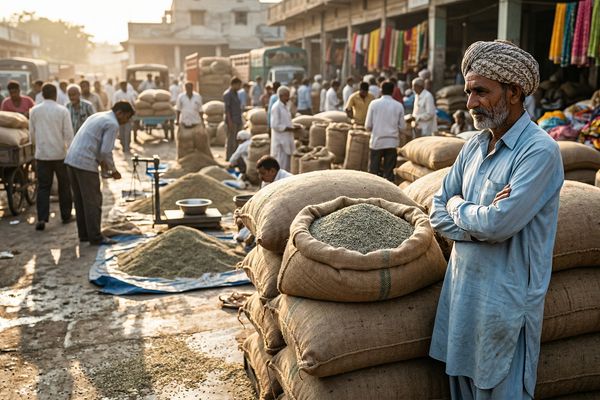
Indian cumin is trading in a narrow but nervous range as farm-level tightness collides with a sudden freeze in export demand via Dubai, driven by the escalating Iran–US–Israel conflict. Prices have rebounded modestly after a brief correction, but upside is capped until Gulf buyers re-enter the market.
India’s spot markets reflect this push-and-pull. At Unjha, the key global benchmark, prices firmed by about USD 2.11 per quintal to roughly USD 243–244 per 20 kg on restocking by local traders, while Delhi wholesale values edged higher to around USD 244–247 per quintal. Farmers are deliberately withholding product despite record new-crop arrivals, while Dubai’s re-export pipeline has gone quiet as traders assess operational and financial risks from ongoing strikes across the Gulf. In this environment, prices are expected to oscillate rather than trend strongly over the next weeks.
Exclusive Offers on CMBroker

Cumin seed
99%
FCA 2.07 €/kg
(from IN)

Cumin seeds
grade - A
99%
FCA 2.20 €/kg
(from IN)
📈 Prices & Short-Term Trend
Unjha, the world’s largest cumin trading hub, has seen prices recover after a brief setback, gaining about USD 2.11 per quintal in the latest session. Values are now around USD 243.40–244.46 per 20 kg, supported by local stockists stepping in after the correction. Delhi wholesale prices mirror this firmness, trading near USD 244.46–246.57 per quintal, also up by roughly USD 2.11 per quintal from the prior session.
Converted to export-equivalent levels, recent commercial offers suggest Indian Grade-A cumin seeds from New Delhi are currently indicated around EUR 2.05–2.15/kg FCA/FOB, while Unjha-origin 98–99% purity seeds are close to EUR 2.00–2.10/kg FOB. European buyers also see Syrian cumin seeds delivered in the Netherlands near EUR 3.50–3.60/kg FCA, with powder closer to EUR 4.30–4.40/kg. This confirms India’s price advantage but also its current dependence on restoring export channels via Dubai.
| Product / Origin | Location / Term | Latest Price (EUR/kg) | Trend vs mid-March |
|---|---|---|---|
| Cumin seeds 99% IN | New Delhi, FCA | ≈ 2.05–2.10 | Stable to slightly softer |
| Cumin seeds 98–99% IN | Unjha, FOB | ≈ 2.10–2.20 | Sideways after pullback |
| Cumin seed SY | Dordrecht, FCA | ≈ 3.50–3.60 | Mostly stable |
| Cumin powder SY | Dordrecht, FCA | ≈ 4.30–4.35 | Flat |
🌍 Supply & Demand Balance
On the supply side, India enters 2026 with structurally tighter fundamentals. Gujarat’s cumin sown area has fallen by about 14–15% to roughly 4.07 million hectares, and traders expect production to decline by around 25% year-on-year; research agency estimates still point to a notable 15% drop. New-crop arrivals at Unjha have been strong, cumulatively approaching 55,000 bags before the latest session, but farmers have sharply pulled back sales, leaving daily arrivals nearer 40,000–45,000 bags now.
This deliberate farmer withholding reflects expectations of better prices later in the season and effectively prevents the market from building a comfortable surplus. At the same time, India’s April–January 2025–26 exports have slipped to about 166,900 tonnes, down roughly 15% in volume and 28% in value year-on-year. High Indian prices, combined with more competitive offers from Turkey, China, Iran and Afghanistan, are eroding India’s dominance, even as buyers still prefer Indian quality for premium applications.
The demand shock is concentrated in Dubai, traditionally a key re-export hub into the Middle East and Europe. As the Iran war has widened, Dubai and other UAE ports and airports have been repeatedly targeted or threatened by Iranian missiles and drones, forcing traders to reassess logistics, insurance, and payment risks. Recent data confirm sustained Iranian strikes on the UAE and a broader Strait of Hormuz crisis since late February 2026, which has disrupted normal trade flows and raised regional risk premiums for all cargoes, including spices.
📊 Fundamentals & Geopolitical Drivers
Fundamentally, India remains the key price setter, but the global cumin balance is less tight than it appears from Indian farm data alone. Turkey and Syria together contribute around 35,000 tonnes annually, albeit at generally lower quality, while China’s new crop is estimated near 1.6 million tonnes, providing an increasingly significant alternative for price-sensitive buyers. Syria’s output continues to be constrained by conflict, but Iran and Afghanistan are emerging as competitive suppliers, especially into nearby regional markets.
In India, the closure of the Unjha wholesale market until 1 April 2026 for financial year-end further reduces near-term liquidity and price discovery. With farmers reluctant to sell and the main benchmark closed, volatility is artificially dampened, but this may store up price risk for April if either export demand suddenly recovers or if global risk aversion deepens. For now, the combination of high farmgate expectations and constrained export demand is keeping prices effectively range-bound.
Geopolitics remains the primary external swing factor. The ongoing US–Israel–Iran confrontation has triggered repeated strikes on Iranian energy infrastructure and retaliatory attacks across the Gulf, escalating fears about shipping safety and insurance in and around the Strait of Hormuz. While this has dramatically affected oil and freight markets, for cumin the more direct channel is the temporary freeze of Dubai-based re-export activity as traders pause fresh commitments until operational clarity improves.
🌦 Weather & Crop Outlook
Weather is not the dominant driver in the current phase; acreage decisions and farmer marketing strategies are more important. The key Indian cumin-growing belts in Gujarat and Rajasthan are now largely past the critical weather window for the 2025–26 crop, and no major late-season weather disruptions have been reported in the last few days. Looking ahead into April, normal seasonal conditions would support harvest completion and internal logistics, but they are unlikely to materially change the already-established production shortfall.
In competing origins, available information points to a reasonably progressing new crop in China and a constrained but ongoing recovery in parts of the Turkish and Syrian supply base. There are no indications of acute weather stress there in the immediate term, so incremental supply from these regions is likely to remain available, especially if Indian offers stay at a premium.
📆 Price Outlook (2–4 Weeks)
Given the current mix of tight Indian farm supply, subdued export demand and heightened geopolitical risk, cumin prices are expected to remain range-bound rather than trend strongly up or down. For the next two to four weeks, benchmark Indian cumin is likely to oscillate in the region of USD 230–250 per quintal, implying export-equivalent prices around EUR 2.00–2.20/kg for standard qualities, assuming stable FX.
A rapid diplomatic de-escalation in the Middle East that restores Dubai’s operational normality could quickly revive export inquiries and trigger a sharp, short-covering-led rally in Indian prices. Conversely, a further intensification of attacks on UAE ports or an extension of the Hormuz crisis could prolong the freeze in Dubai buying, forcing Indian sellers to compete more aggressively with Turkish, Chinese, Iranian and Afghan origins and putting mild downward pressure on the upper end of the current price band.
💡 Trading & Procurement Recommendations
- European and Middle Eastern buyers: Use current range-bound conditions to secure partial coverage for Q2–Q3 at near the lower half of the USD 230–250 per quintal band, while retaining flexibility to add in case of a geopolitical-led price break.
- Indian exporters: Focus on quality differentiation and timely shipment commitments to loyal customers; aggressive pricing alone may not overcome Dubai logistics constraints until risk perceptions ease.
- Food industry users: Consider limited origin diversification (e.g., partial coverage from Turkey, China or Egypt) as a hedge against renewed disruptions in Indian exports, but maintain Indian cumin as the core for premium blends.
- Producers and stockists in India: While withholding has provided near-term support, be cautious about assuming a sustained rally; monitor the reopening of Unjha and Dubai shipping conditions closely to avoid missing demand windows.
📍 3-Day Regional Price Indication (Directional)
- India – Unjha (spot, conventional cumin): Sideways to slightly firm within the established band, limited by market closure until 1 April but supported by farmer holding.
- India – New Delhi (wholesale/export parity): Mildly stable; FCA/FOB offers around EUR 2.05–2.15/kg expected to hold with only marginal day-to-day moves.
- EU – Netherlands (Syrian cumin, FCA Dordrecht): Largely steady near EUR 3.50–3.60/kg for seeds and around EUR 4.30–4.35/kg for powder, reflecting higher freight and risk premia but no immediate supply shock.