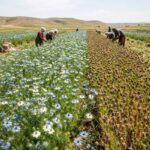
Nigella seed prices have softened in the near term as buyers step back from the market, despite elevated geopolitical risks around Iranian supply. The combination of India’s financial year-end lull and uncertainty over alternative origins is keeping trading thin, but the Iran corridor disruption is likely to establish a price floor once fresh buying resumes in April.
Nigella now trades slightly lower at Delhi’s wholesale kiryana market, where prices retreated by about $5.30 per quintal in the latest session, to roughly $211–216 per quintal, on weak buying interest. This mild correction contrasts with the sharp rally in saffron, underlining nigella’s more substitutable role in end-use applications even though both commodities share exposure to Iran and the wider Middle East trade route. Structurally, medium-term demand remains intact, led by Europe and traditional Middle Eastern bakery and spice use, but the market is paused ahead of the new Indian fiscal year and the reopening of the Unjha centre in April.
Exclusive Offers on CMBroker

Nigella seeds
Sortex
99.5%
FOB 2.30 €/kg
(from EG)

Nigella seeds
Machine Clean
99.80%
FOB 2.25 €/kg
(from IN)

Nigella seeds
Kalonji Sortex
99%
FOB 2.14 €/kg
(from IN)
📈 Prices & Short-Term Trend
At Delhi’s physical market, nigella has eased modestly on the day, reflecting cautious buying rather than any clear improvement in fundamentals. The pullback follows a period of firmness earlier in March and is taking place against a backdrop of heightened freight and geopolitical risk through the Iran–Middle East corridor, which has not yet translated into an immediate price spike for nigella.
Export offers indicate a similar, slightly softer tone. Recent FOB indications for conventional nigella seeds show a mild week‑on‑week decline in both Egyptian and Indian origins, consistent with the described weakness in domestic Indian wholesale trade.
| Origin / Type | Location & Terms | Latest Price (EUR/t) | Prev. Price (EUR/t) | Change | Last Update |
|---|---|---|---|---|---|
| Egypt, Sortex 99.5% | Cairo, FOB | ≈ 2,300 EUR/t | ≈ 2,320 EUR/t | ▼ ~20 EUR/t | 26 Mar 2026 |
| India, Machine Clean 99.8% | New Delhi, FOB | ≈ 2,250 EUR/t | ≈ 2,280 EUR/t | ▼ ~30 EUR/t | 20 Mar 2026 |
| India, Kalonji Sortex 99% | New Delhi, FOB | ≈ 2,140 EUR/t | ≈ 2,160 EUR/t | ▼ ~20 EUR/t | 20 Mar 2026 |
🌍 Supply & Demand Balance
India plays a dual role in the nigella complex as both a key producer and an important importer. Domestic cultivation is concentrated in Rajasthan, Uttar Pradesh, and West Bengal, while Iran, Egypt, and Turkey remain critical global suppliers. The current conflict-driven disruption to Iranian shipping and trade flows has introduced real uncertainty around future import availability, but for now the nigella market is responding with reduced activity rather than panic buying.
On the demand side, medium-term fundamentals are constructive. European buyers have steadily integrated nigella as a functional food and health-oriented ingredient, and demand from Middle Eastern bakery and spice channels remains structurally strong. However, the March financial year-end in India typically reduces trading velocity as traders and processors work through balance-sheet housekeeping ahead of the new fiscal year on 1 April, muting spot demand even as downstream usage remains broadly stable.
📊 Fundamentals & External Drivers
The key fundamental question in the coming weeks is how long Iranian supply disruptions persist and how effectively importers can rebalance towards Egypt, Turkey, and Indian domestic crop. Any sustained difficulty in moving product out of Iran could tighten the global nigella pipeline and underpin higher prices into the second quarter, especially once European and Middle Eastern buyers move from watchful waiting to active coverage.
Weather risks for Indian-origin nigella appear seasonally manageable at this stage. Late-March conditions in Rajasthan, Uttar Pradesh, and West Bengal are trending toward a hotter-than-usual summer, with intermittent pre-monsoon showers in parts of North India, but no acute, crop-specific threat has emerged in the latest regional updates. Broader cost pressures from elevated energy and freight markets, linked to the wider Gulf conflict and disruptions around the Strait of Hormuz, remain an upside risk for logistics and, indirectly, for nigella prices through higher transport and input costs.
📆 Short-Term Outlook (2–4 Weeks)
Over the next two to four weeks, market participants should expect nigella to move from the current sideways-to-soft phase toward a clearer directional trend as the Unjha market reopens and new-season buying programs begin in April. The current combination of thin liquidity and unresolved supply questions argues for a firming bias once financial year-end effects fade and importers reassess coverage.
European buyers of nigella for health food, bakery, and ethnic food segments should monitor developments in Iran and regional shipping carefully. A prolonged disruption could quickly tighten prompt availability, not only from Iran but across origins, as buyers turn to Egypt, Turkey, and India for replacement volumes, potentially lifting prices across the board into Q2.
📌 Trading Guidance
- European and Middle Eastern buyers: Use the current mild dip and thin market to layer in partial cover for Q2, especially for higher-purity grades, while retaining flexibility for further geopolitical escalation.
- Indian processors and exporters: Consider holding back aggressive selling ahead of Unjha’s reopening and clearer signals on Iranian exportability; current levels may represent a short-term floor if disruptions persist.
- Importers relying on Iranian origin: Begin origin diversification toward Egypt and India, even at a modest premium, to hedge against prolonged corridor constraints and freight volatility.
🧭 3-Day Market Indication
- Delhi wholesale (India): Slightly soft to sideways; limited downside as year-end effects run their course and dealers position for April.
- FOB New Delhi (India): Stable to mildly firmer; offers likely to harden if renewed export interest emerges early next week.
- FOB Cairo (Egypt): Sideways with an upward bias, tracking logistics costs and regional risk premiums rather than local crop pressure.