
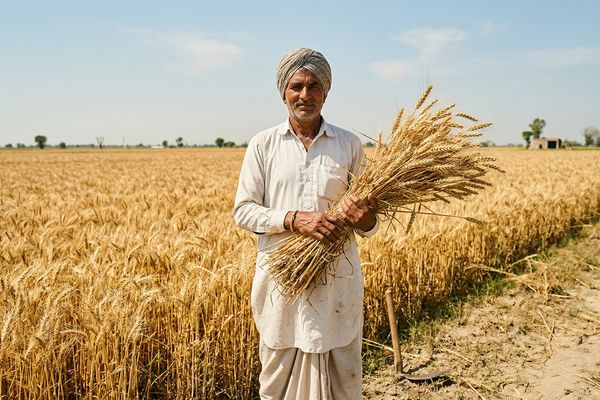
Indian wheat prices are losing upward momentum as early rabi arrivals and a strong production outlook meet thinner year-end demand, limiting scope for any sustained rally in the coming months.
India’s physical wheat market briefly firmed in the week to 29 March but quickly reversed as new-crop selling emerged and seasonal year-end account closing curbed buying. At the same time, official estimates point to another large harvest, while global benchmarks on Euronext and CBOT remain subdued, reinforcing a broadly bearish to sideways tone for the second quarter. Against this backdrop, government procurement at the minimum support price (MSP) is set to become the key stabiliser for domestic values.
Exclusive Offers on CMBroker

Wheat
protein min. 11.50%
98%
FCA 0.24 €/kg
(from UA)

Wheat
protein min. 11.50%
98%
FCA 0.25 €/kg
(from UA)

Wheat
protein min. 9,50%
98%
FCA 0.24 €/kg
(from UA)
📈 Prices & Market Tone
India’s wheat market traded in a two-sided but ultimately softer pattern in the week ending 29 March. Old-crop values, which had rallied earlier in the week to around EUR 25.30 per quintal (approximate conversion from USD 27.72), slipped back as fresh new-crop offers appeared near EUR 25.30 per quintal, signalling emerging harvest pressure even before peak arrivals. Cautious buying around Delhi’s Lawrence Road hub, linked to March financial year-end account closing, further dampened volumes and exaggerated the downside move.
International prices mirror this loss of momentum. May milling wheat on Euronext in Paris closed near EUR 203 per tonne on 29 March, flat on the week after a modest pullback, while CBOT wheat futures were described as choppy with limited direction as traders focused on macro risk and positioning ahead of key USDA data releases. In Black Sea-linked physical markets, Ukrainian wheat export and FCA prices around EUR 180–250 per tonne equivalent suggest ample competition for Indian exporters, although India’s policy remains focused on domestic food security.
🌍 Supply, Demand & Policy Drivers
India’s Ministry of Agriculture now pegs 2025–26 wheat output at roughly 120 million tonnes, up from about 118 million tonnes last year. This incremental gain, if realised, would consolidate India’s status as largely self-sufficient and significantly curb the potential for a prolonged domestic price uptrend despite wider grain market tightness in parts of the region. Market participants expect arrivals from Punjab, Haryana, Madhya Pradesh and Uttar Pradesh to build steadily through April, with peak flows likely to trim spot values by roughly EUR 0.90–1.80 per quintal versus late March levels.
Seasonal behaviour is also shaping near-term dynamics. Traders report that demand typically thins sharply in the final sessions of March as firms prioritise book-closing over inventory building, a pattern already evident in Delhi’s wholesale markets. This calendar effect is temporarily depressing volumes and may be overstating underlying softness. From 1 April, formal government procurement in key producing states such as Haryana is scheduled to begin, with a sizeable purchase target that will effectively place a floor under farmer returns through the MSP mechanism.
📊 Fundamentals & Weather Outlook
Structurally, India’s fundamentals are leaning comfortable. The second advance estimates underscore a solid production base despite pockets of weather-related concern. While recent reports highlight that late-February heat and localised rains and hail have trimmed yield expectations in some belts, overall national output is still seen higher year-on-year, and crop conditions across the core rabi states remain broadly favourable. Parallel strength in corn and millet prices into Haryana and Punjab points to general tightness in regional grain balances, but this is likely to ease as the wheat harvest scales up.
Weather-wise, March has brought unusual rainfall episodes across parts of North India, including the Delhi region, with forecasts indicating further showers in the near term. These events may briefly disrupt fieldwork and logistics but can also support soil moisture and grain filling where not accompanied by damaging hail. At present, there is no evidence of a widespread weather shock comparable to previous years; instead, the overarching narrative remains one of adequate supply with manageable localised risks.
📉 International Context & Competitiveness
Globally, wheat markets are characterised by improved crop outlooks in several Northern Hemisphere producers, which has helped pull international prices lower in recent weeks. This aligns with India’s own production optimism and reinforces a ceiling on domestic upside, particularly in the absence of a renewed export push. Euronext milling wheat ending the week broadly unchanged despite geopolitical jitters and macro uncertainty signals a market more focused on forthcoming US acreage and stocks data than on immediate supply stress.
Price indications from Ukrainian and French origins confirm a broadly competitive export landscape. Recent FCA values for Ukrainian wheat near EUR 230–260 per tonne for different qualities and FOB offers below EUR 200 per tonne suggest that Black Sea sellers retain a freight and cost advantage into many traditional import markets. By comparison, indicative US FOB values linked to CBOT remain somewhat higher on a EUR basis, leaving European and Black Sea wheat as the primary price-setters at the margin.
🧭 Trading Outlook & Risk Scenarios
- Near term (next 2–4 weeks): Domestic Indian prices are likely to drift modestly lower as arrivals accelerate, with an anticipated easing of roughly EUR 0.90–1.80 per quintal as physical supplies from the rabi crop reach wholesale markets in volume.
- Medium term (Q2 2026): With a projected 120 million tonne crop and stable global benchmarks, the base case is for a sideways-to-soft range, bounded on the downside by MSP procurement and on the upside by resistance from cheap Black Sea and EU origins.
- Key upside risks: A significant weather disruption during late harvest, a sharp escalation in regional geopolitical tensions disrupting trade routes, or policy shifts that tighten domestic availability could all spark short-covering rallies.
- Key downside risks: Faster-than-expected harvest progress, stronger-than-planned government procurement discipline, and further declines in global futures would amplify harvest pressure and deepen spot discounts to MSP.
📆 3-Day Price Indications (Directional, EUR)
| Market / Contract | Latest Level* | 3-Day Bias | Comment |
|---|---|---|---|
| India physical, old-crop (wholesale) | ≈ EUR 25–26 / qtl | Slightly lower | Early harvest selling and thin year-end buying dominate. |
| India physical, new-crop offers | ≈ EUR 25 / qtl | Stable to lower | Harvest pressure offsets MSP floor ahead of full-scale procurement. |
| Euronext milling wheat (May) | ≈ EUR 203 / t | Sideways | Range-bound trade as market awaits fresh US and EU data. |
| Black Sea export offers (Ukraine FOB) | ≈ EUR 180–200 / t | Sideways to soft | Comfortable supply and competitive pricing continue to cap rallies. |
*All levels are approximate, converted to EUR for comparability.
Related posts:
 Chinese Millet Prices Hold Steady as Weather Turns Seasonally Mild
 Indian Wheat at a Weather-Driven Turning Point for Global Buyers
 Wheat Tariff Shock in South Africa: Floating Formula Turns Against Farmers
 Wheat under pressure as better crop prospects offset geopolitical risks
 India’s Corn Market Turns Higher as Supply Tightens and Ethanol Demand Returns
 India Corn Turns Export-Positive as Record Crop Meets Regional Demand
 Basmati Strength vs. Wheat Softness: Rice Market Splits on Export Demand