
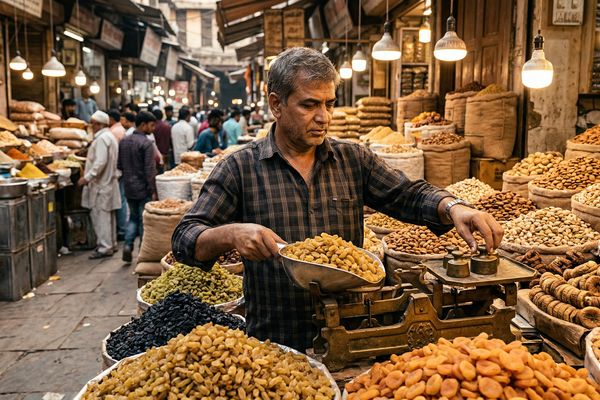
Raisin prices in India have logged one of their sharpest weekly rises in years, as war-related disruptions to Afghan and Iranian supplies collide with steady demand, keeping the market tight and biased higher in the near term.
Geopolitical conflict involving the United States, Israel and Iran has abruptly choked key raisin trade corridors into India, especially from Afghanistan and Iran. Importers are pulling back from forward offers amid uncertainty over shipment timing and sharply higher freight and insurance costs linked to the broader Strait of Hormuz crisis. At the same time, domestic Indian supply cannot fully replace premium imported grades, while demand from confectionery, bakery and religious uses remains resilient. This combination is driving a broad-based firm tone across the dried fruit complex and underpins a bullish short-term outlook for both Indian and European buyers.
Exclusive Offers on CMBroker

Raisins
brown, grade aa
FOB 1.86 €/kg
(from IN)

Raisins
golden, grade aa
FOB 2.31 €/kg
(from IN)

Raisins
black, grade aa
FOB 1.80 €/kg
(from IN)
📈 Prices & Key Moves
During the week ending 29 March, India’s raisin market saw exceptional gains across multiple grades:
- Kandhari (Afghan-origin golden): up about $26.62 per 40 kg, now around $314.03–$345.37 per 40 kg, reflecting acute reliance on Afghan supply.
- Indian yellow raisins: up roughly $15.97 per 40 kg to about $207.76–$218.38 per 40 kg, as buyers substitute away from disrupted imports.
- Indian green raisins: trading firmer at approximately $223.72–$250.27 per 40 kg, supported by spillover demand and limited premium supply.
- Gola variety (round, sun-dried, used in baking): higher by around $10.65 per 40 kg, reaching about $351.44–$361.96 per quintal on stronger confectionery buying.
Converted to export indications, recent offers for Indian origin raisins (FOB New Delhi) cluster roughly in the €1.65–€2.10/kg range for mainstream grades, while premium golden types sit at the top end of this band. European warehouse prices for imported sultanas and specialty raisins currently span approximately €1.80–€2.65/kg, with Turkish and Chinese sultanas and Chilean flame jumbos anchoring the upper part of the range.
| Origin / Type | Location & Terms | Latest Price (EUR/kg) |
|---|---|---|
| India, brown AA | New Delhi, FOB | ≈ €1.86 |
| India, golden AA | New Delhi, FOB | ≈ €2.31 |
| India, black AA | New Delhi, FOB | ≈ €1.80 |
| Turkey, sultanas type 9 A | Malatya, FOB | ≈ €2.35 |
| China, sultanas no. 9 AA | NL warehouse, FCA | ≈ €2.18 |
| Chile, flame jumbo | NL warehouse, FCA | ≈ €2.48 |
🌍 Supply & Demand Drivers
The key market driver is a sudden tightening of imported raisin supply into India. Afghanistan and Iran normally dominate premium raisin inflows into the country, including the Kandhari variety, which has effectively no domestic equivalent. Intensifying conflict around Iran and the Strait of Hormuz has led to severe logistics disruption, higher war-risk insurance, and rerouted or delayed vessels across Gulf trade corridors, amplifying the strain on dry fruit supply chains.
Domestic Indian raisins from Maharashtra and Karnataka offer only partial relief. While they can substitute some volume for bakery and mass-market uses, they cannot fully replicate the quality segment supplied by Afghan and Iranian origins. As a result, the premium end of the market is disproportionately impacted, but the shortage is now cascading into broader grades as buyers switch origins and grades where possible.
On the demand side, usage in confectionery, bakery, muesli, health foods and religious functions continues at a steady pace. There are no clear signs of demand destruction despite the sharp price move, partly because raisins are often a small but non-substitutable input in finished products. This inelastic demand profile means that higher costs are more likely to be passed along the value chain than to curb underlying usage in the short run.
📊 Fundamentals & External Context
The broader macro and geopolitical backdrop reinforces the firm tone in the raisin market. The ongoing Iran war and effective closure or restriction of key shipping lanes has pushed up global freight, insurance and energy costs, with multiple reports highlighting surging war-risk premiums and disrupted shipping flows across the Gulf region. These higher logistics costs directly hit the landed cost of raisins and other dried fruits moving from or through the Middle East to South Asia and Europe.
For India, dependence on Afghanistan and Iran for premium raisin imports has long been a structural vulnerability. The current crisis has crystallised that risk: Afghan-origin Kandhari raisins, which previously benefitted from relatively short trade routes and competitive pricing, now face uncertain transit times and elevated risk premiums. Parallel disruptions in other dry fruit categories (such as nuts) reinforce a broad-based tightness in the dried fruit complex, narrowing substitution options for buyers.
European importers are also indirectly exposed. A significant share of Indian raisin exports flows into European bakery and cereal industries. With Indian exporters now facing tighter domestic availability and more expensive replacement costs, European buyers should anticipate firmer Indian offer levels and potential delays in shipment scheduling, especially for higher-value cleaned and processed lots destined for branded food segments.
☁️ Weather & Crop Outlook (Key Origins)
Weather conditions in major Indian grape-growing states (Maharashtra, Karnataka) are not currently the main driver of price action; the immediate spike is overwhelmingly geopolitical and logistics-driven. Nonetheless, near-term weather-related quality losses or harvest delays would compound existing tightness, particularly if drying conditions for the current raisin-making campaign turn unfavourable.
For alternative suppliers such as Turkey, China and Chile, no large, weather-induced shocks have surfaced in the last few days that would materially change short-term export capacities. However, any new disruption in the Turkish sultana belt or Chinese producing regions during the upcoming growing and drying season would quickly translate into further upside risk, given already strained global logistics and energy markets.
📆 4–6 Week Market & Trading Outlook
Given the depth of the current geopolitical disruption, the base case is for elevated raisin prices across all key grades to persist for at least the next four to six weeks. A meaningful correction would likely require a visible easing of tensions and a normalisation of freight and insurance conditions in Gulf and Iranian trade corridors. Absent this, importer inventories will gradually thin, lending further support to spot prices and limiting the availability of discounted parcels.
Risk is skewed to the upside: any further escalation affecting additional ports or transit routes, or fresh sanctions complicating payments and insurance, could tighten availability of Afghan and Iranian-origin raisins even more. Conversely, a rapid diplomatic breakthrough or the creation of secure alternative corridors could temper the rally, but this scenario currently appears less probable in the immediate term.
💡 Trading Recommendations
- European importers: Consider advancing purchases of Indian and Turkish raisins for Q2–Q3 needs, prioritising contract volumes for premium and specialty grades where substitution is hardest. Price risk is to the upside if importer stocks draw down further.
- Indian buyers (bakery, confectionery): Lock in near-term supply via staggered contracts rather than relying on spot. Where product specifications allow, blend lower-cost domestic grades with scarce Afghan/Iranian-origin lots to manage input costs.
- Exporters from India: Revisit offer structures and validity periods, building in higher freight and insurance costs and shorter quotation windows. Prioritise long-standing customers and higher-margin markets to navigate constrained availability.
- Food manufacturers globally: Review product formulations and pack sizes to accommodate higher raisin input costs, and plan for potential second-round price adjustments if the conflict and logistics disruptions persist beyond early Q2.
📉 Short-Term Price Indication (Next 3 Days)
- India – FOB New Delhi (brown, golden, black AA): Prices in the region of €1.80–€2.30/kg are expected to hold firm to slightly higher, with limited discounting and cautious new offers.
- Turkey – FOB Malatya sultanas: Sultana prices around €2.20–€2.65/kg are likely to remain stable to firm, supported by spillover demand from disrupted Middle Eastern routes.
- Northwest Europe – warehouse FCA: For Chinese, Turkish and Chilean raisins, indications near €2.00–€2.60/kg should stay broadly steady, with an upward bias if freight and insurance rates rise further.
Related posts:
 Turkish Raisins: Quiet Spot Market, Growing Frost and Policy Risks
 Taiwan’s Chiayi Pineapples Target Japan with Premium, Relationship-Driven Push
 Hormuz Shock to Port Glut: India’s Imported Apple Market Unravels
 Alphonso Shock: Konkan Crop Collapse Set to Ignite Mango Prices
 Indian Raisin Arrivals Surge, Forcing Sharp Price Correction and Reshaping Trade Margins