
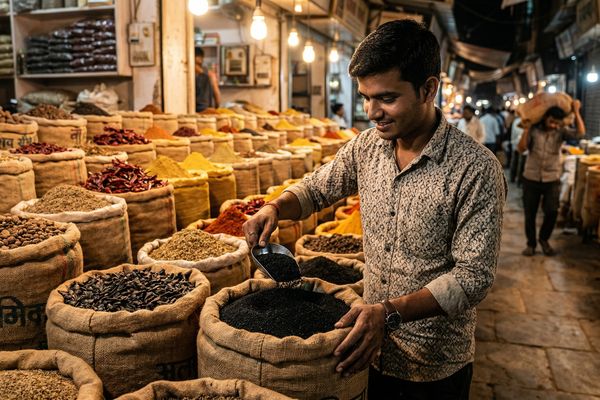
Nigella seeds reversed lower in late March as Indian stockists moved from accumulation to liquidation, triggering a sharp but technical correction after an extended rally. Despite the setback, export demand from Europe and the Middle East and a broadly firm spice complex are likely to limit downside and create selective re-entry opportunities for buyers.
Nigella — traded as kalonji in India and black seed/black cumin in Europe — ended the week to 29 March under clear pressure, losing about $26.62 per quintal to settle around $213–$218 per quintal. The move contrasts with strength in other Indian spices, where supply constraints and import disruptions supported cardamom, coriander and saffron. In nigella, however, fresh arrivals and profit-taking by well-stocked traders outweighed demand, exposing the market’s sensitivity to positioning. Absent any major crop or policy shock, the current phase looks more like a sentiment-driven reset than the start of a structural downturn.
Exclusive Offers on CMBroker

Nigella seeds
Machine Clean
99.80%
FOB 2.25 €/kg
(from IN)

Nigella seeds
Kalonji Sortex
99%
FOB 2.14 €/kg
(from IN)

Nigella seeds
Sortex
99.5%
FOB 2.30 €/kg
(from EG)
📈 Prices & Market Direction
During the week ending 29 March, nigella prices in India fell sharply by roughly $26.62 per quintal, closing in a band of $213.05–$218.38 per quintal. This marks a decisive break from the preceding uptrend and signals that a short-term top is likely in place after an extended period of elevated prices.
Converted into EUR and on a per‑kg basis, this range corresponds to approximately EUR 1.95–2.00/kg (assuming a broadly stable USD/EUR rate). Recent export offers reinforce this picture: Indian FOB New Delhi nigella for high machine‑clean quality is indicated around EUR 2.25/kg, with 99% Kalonji Sortex near EUR 2.14/kg, while Egyptian 99.5% Sortex stands close to EUR 2.30/kg FOB Cairo. Taken together, spot levels indicate a modest softening rather than a collapse.
| Origin / Type | Quality | Location / Terms | Latest Price (EUR/kg) | 1–3 week Trend |
|---|---|---|---|---|
| India – Machine Clean | 99.8% | New Delhi, FOB | 2.25 | Slightly lower vs early March |
| India – Kalonji Sortex | 99% | New Delhi, FOB | 2.14 | Slightly lower vs early March |
| Egypt – Sortex | 99.5% | Cairo, FOB | 2.30 | Softening from 2.35–2.37 |
🌍 Supply, Demand & Trade Flows
Fundamentals remain broadly constructive. Nigella cultivation in India is concentrated in Rajasthan and Madhya Pradesh, with supplementary supply from Ethiopia and Egypt. No major production issues or new policy changes have been reported in connection with the current price decline, suggesting that physical availability is adequate but not burdensome.
On the demand side, exports to Europe and the Middle East are structurally firm. The seed is well-entrenched in bakery and cheese applications and is gaining traction in health supplement formulations. However, short-term domestic pricing in India is heavily influenced by stockists and traders. Their recent shift to selling after accumulating at higher levels has temporarily overwhelmed buyer interest, driving the current correction despite healthy underlying export pull.
📊 Market Structure & Technical Picture
The latest move appears primarily technical and sentiment-driven. Stockists who had built long positions during the earlier rally used the recent high levels to take profits, turning into active sellers once momentum stalled. This behaviour is typical near a short-term peak in thinly traded niche spices where speculative inventory plays a disproportionate role.
The decline is notably out of sync with the broader Indian spice complex, where cardamom, coriander and saffron found support from tighter supply and import disruptions. Nigella’s divergence underlines its vulnerability to positioning rather than pointing to a fundamental demand problem. As a result, the recent pullback is best viewed as a corrective phase within an otherwise supported market, rather than the onset of a prolonged bear trend.
⛅ Weather & Crop Outlook
With key Indian growing regions in Rajasthan and Madhya Pradesh now largely past the most sensitive stages of the current cycle, near-term weather is not the dominant driver for prices. No significant weather-related production disruptions have been linked to the latest correction.
Over the coming weeks, standard seasonal conditions should be sufficient to maintain current crop expectations. Any marginal weather-related yield adjustments are likely to be overshadowed by shifts in trader sentiment and export buying programs, especially ahead of summer demand in Europe and the Middle East.
📆 Short-Term Forecast (2–3 Weeks)
Looking ahead, prices are expected to stabilise within a band of roughly EUR 1.85–2.05/kg (equivalent to about $200–$220 per quintal). This consolidation zone reflects a balance between ongoing export demand and the tail end of stockist liquidation.
A rebound toward the equivalent of roughly EUR 2.20–2.30/kg (around $240 per quintal) is plausible if export demand from Europe and the Middle East accelerates into the summer buying window. Conversely, if stockist selling persists or intensifies, the correction could briefly extend toward an effective floor near EUR 1.75/kg (about $190 per quintal) before value buying re-emerges.
💡 Trading Outlook & Strategy
- Importers in Europe & MENA: View the current dip as an opportunity to secure part of Q3 needs, especially for high-purity Indian and Egyptian origins, but stagger purchases to benefit from any additional near-term softness.
- Indian stockists: With much of the technical correction already realised, aggressive additional selling at current levels risks locking in low margins; consider holding core inventory while using rallies toward the upper end of the forecast band for selective liquidation.
- Industrial users (bakeries, dairies, supplement makers): Hedge a portion of forward requirements now, focusing on quality differentiation (e.g., 99.8% machine clean vs. 99% Kalonji) as the premium between grades remains moderate.
📉 3-Day Price Indication (Directional)
- India (FOB New Delhi, EUR/kg): Machine clean and Kalonji qualities likely to trade sideways to slightly softer in the 2.10–2.30 range as the market digests recent selling.
- Egypt (FOB Cairo, EUR/kg): 99.5% Sortex expected to remain around 2.25–2.35 with a mild downward bias in sympathy with Indian levels.
- Overall tone: Consolidation with a modest downside risk near term, but growing value interest from export buyers should limit further declines.
Related posts:
 Nigella Seeds Under Pressure as Iran Supply Risks Meet Year-End Lull
 Nigella (Kalonji) Prices Hold Firm as Indian FOB Premium Over Egypt Narrows
 Nigella Seeds FOB Egypt–India: Mild Softening Amid Weather Risks
 Nigella Market Softens as Delhi Stockists Sell Into Weak Demand
 Cumin market cools as Indian buyers step back and stockists sell into weakness
 Egyptian Peppermint FOB Cairo Eases Slightly as Buyers Turn Cautious
 Cumin Market Poised for Breakout as Demand Firms and Sellers Hold Back