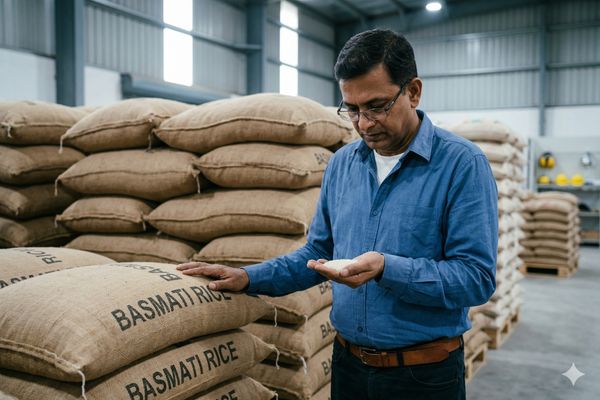
Export prices for Indian Basmati 1121 rice have dropped sharply from earlier-season highs, squeezed by West Asia’s ongoing crisis, weaker Iranian demand and rising logistics costs. Exporters are now pushing for a lower floor price to stay viable, while traders report margin compression and increased contract friction with key buyers.
India’s flagship Basmati 1121 segment, long supported by consistently strong West Asian demand, is undergoing a rapid reset. Prices that comfortably held above the USD 1,100/tonne mark for much of the current season have slipped back toward levels only slightly above domestic mill-gate values. Freight rates and operational frictions linked to regional tensions are eroding exporter profitability, prompting more cautious procurement and a wait-and-see stance on new offers. The next few months will hinge on West Asian order flows, especially from Iran, and any relief in shipping and policy uncertainties.
📈 Prices & Margins
Export quotations for Basmati 1121 have fallen to about USD 1,038–1,044/tonne in late March 2025, from roughly USD 1,200/tonne earlier in the season. Converted at an indicative rate of 1 EUR ≈ 1.08 USD, this implies:
| Price Point | USD/tonne | EUR/tonne (approx.) |
|---|---|---|
| Current export quotations | 1,038–1,044 | ~962–968 |
| Earlier-season benchmark | ~1,200 | ~1,111 |
| Domestic mill-gate (Feb) | 1,008–1,056 | ~933–978 |
| Exporter floor target | ≥ 950 | ≥ ~880 |
Domestic mill-gate prices in February stood at INR 84,000–88,000/tonne (roughly USD 1,008–1,056), leaving only a narrow margin versus current export offers. Exporter profit margins, which were around 20% earlier in the marketing cycle, have compressed to roughly 10%, tightening room to absorb further price cuts or freight shocks.
Logistics costs are a key drag: freight and handling now add about INR 4,100–4,400/tonne (around USD 49–53, or ~EUR 45–49) to export parity. With export quotations retreating and costs elevated, exporters are lobbying for a minimum workable floor of about USD 950/tonne (~EUR 880) to preserve basic operational viability.
🌍 Supply, Demand & Trade Flows
West Asia remains the core destination for Basmati 1121 exports, but the regional crisis has disrupted normal trade patterns. Demand from Iran, a key buyer, is estimated to be down by roughly 20%, directly weighing on India’s high-value basmati shipments. This demand loss is significant enough to depress spot prices by around USD 50–80/tonne relative to earlier benchmarks.
Port-level disruptions and heightened risk in shipping lanes serving Gulf and Red Sea ports are extending transit times and complicating logistics planning. American buyers have not fully offset the softness: negotiations now often stretch over two to three rounds of price bargaining before contracts are concluded, reflecting buyer caution and resistance to earlier high price levels.
Around 4,700 tonnes of basmati stocks are currently exposed to this volatility, forcing traders to balance inventory holding risks against the prospect of a price rebound if regional tensions ease. Processors, in turn, are hesitant to commit to fresh paddy purchases at prevailing farm-gate levels given compressed export margins.
📊 Policy & Structural Drivers
The West Asia conflict is the central driver behind the current correction. Elevated risk premia on routes through the Gulf and Red Sea have raised freight and insurance costs, undermining the traditional pricing advantage of Indian Basmati 1121 in its core markets. Importers are reacting by trimming order sizes, spacing out shipments and pressing harder on price during negotiations.
On the policy side, technical issues in the AIOCDTPF support scheme are adding uncertainty around subsidy flows and minimum price guarantees. With scheme implementation perceived as unreliable, exporters are less willing to sign forward contracts at aggressive prices, preferring to keep offers limited until the policy environment is clearer.
Globally, the rice balance remains relatively tight, which under normal circumstances would support premium basmati prices. However, in the current episode, regional risk and logistics frictions are outweighing the supportive global backdrop, leading to lower realized export values even against a firm underlying fundamentals picture.
📆 Market Outlook
In the next 30–90 days, Basmati 1121 export prices are likely to stay under pressure, with downside risk if West Asian tensions escalate or if freight rates rise further. Traders will closely track three key indicators: the pace of West Asian buying (particularly Iran), freight and insurance costs on key shipping lanes, and any clarifications or improvements in India’s export support mechanisms via APEDA and related schemes.
A recovery toward about USD 1,100/tonne (~EUR 1,020) is feasible if Red Sea and Gulf logistics stabilize and Iranian demand normalizes. In that scenario, buyer confidence could return quickly, allowing exporters to rebuild margins from current compressed levels. Over a 6–12 month horizon, prospects are cautiously positive but heavily conditional on geopolitical developments and freight dynamics.
India’s next kharif season (June–October) will be pivotal for medium-term supply. If acreage and yields remain robust, the market may face continued competition among exporters, keeping margins thin unless logistics costs normalize or demand expands meaningfully. Conversely, any supply-side disappointment could tighten availability and underpin higher basmati premiums.
🧭 Trading & Risk Management Outlook
- Exporters: Prioritize price protection around the USD 950/tonne (~EUR 880) floor; avoid deep discounts that erode already compressed margins. Consider staggered sales and shorter-tenor contracts to manage freight and policy risk.
- Millers/Processors: Be cautious in building high-cost paddy inventories until clearer signals emerge from West Asian demand and freight markets; focus on efficiency and quality differentiation to maintain realizations.
- Importers (West Asia & US): The current soft patch in prices offers an opportunity for phased coverage, but geopolitical and shipping risks argue for diversified shipment windows and flexible delivery terms.
- Speculative participants: Near-term sentiment is fragile; any signs of de-escalation or policy support could trigger a sharp rebound from current price levels.
📍 3-Day Directional Price Indication (EUR)
- India FOB, Basmati 1121 (export grade): Stable to slightly weaker; indicative range ~EUR 960–970/tonne, with sellers reluctant to move below the implicit EUR 880/tonne floor equivalent.
- Domestic mill-gate (north India): Broadly steady around ~EUR 935–980/tonne equivalent, reflecting resistance from processors to lower paddy intake prices while export demand remains uncertain.
- Key West Asia CIF indications: Slight downside bias as buyers test lower bids amid ongoing logistics and geopolitical uncertainties, though extreme discounts are unlikely while global rice fundamentals remain tight.