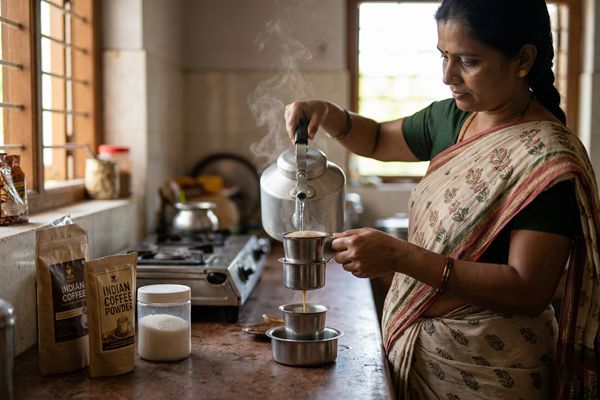
Organic coffee is consolidating its position as one of the fastest-growing segments in the global coffee market, supported by premium consumer perception and sustainability narratives, while structurally higher production costs and agronomic risks keep prices under upward pressure.
Organic coffee is increasingly at the core of brand differentiation strategies, linking chemical‑free cultivation with traceability, ethical sourcing and single‑origin storytelling. Demand growth is strongest in Asia-Pacific and Europe, while Latin America and Africa drive supply. In India, more smallholder and tribal growers are entering the segment, attracted by export prospects and domestic premium niches. At the same time, structurally lower yields, weather and pest vulnerability, and costly certification are constraining supply elasticity, suggesting that the organic premium over conventional coffee will remain resilient despite short‑term volatility in global futures.
📈 Prices & Market Mood
Headline ICE arabica and robusta futures have been volatile in March, with recent sessions showing a rebound on tighter farmer selling in Brazil and continued speculative interest. For organic coffee, these moves overlay an already higher base price level, reflecting production costs and certification premiums. While spot quotes vary strongly by origin and grade, organic arabica typically captures a significant markup over conventional beans in both green and roasted form.
Given the 8.7% projected CAGR for global organic coffee between 2024 and 2030, wholesale organic prices are likely to trend structurally above the broader coffee complex. Local anecdotal evidence from India suggests that domestic specialty and organic prices remain sticky even when international benchmarks ease, as tight internal demand, limited certified supply, and quality segmentation weaken pass‑through from commodity markets to premium lots.
🌍 Supply & Demand Shifts
The organic coffee market, valued around USD 7.92 billion in 2024, is projected to grow at about 8.7% annually through 2030, clearly outpacing the conventional segment. Asia-Pacific already accounts for the largest share of demand, driven by rising middle‑class incomes, café culture expansion and the rapid penetration of ready‑to‑drink formats. Europe remains a key growth engine on the import side, supported by strong retailer and consumer focus on certification, traceability and lower chemical footprints.
On the supply side, Latin America and Africa are consolidating their role as core production hubs for organic beans, leveraged by cost advantages and large existing coffee areas that can be converted or managed under organic standards. However, conversion periods, limited access to organic inputs and technical know‑how, and fragmented smallholder structures slow the ramp‑up. This mismatch between fast demand growth and gradual supply expansion underpins a firm pricing environment and keeps the market sensitive to weather, disease outbreaks and logistics shocks.
India is emerging as a noteworthy niche player in organic and specialty coffee. Participation by smallholder and tribal communities is expanding, as producers seek to tap into both export opportunities and a growing domestic specialty café and e‑commerce market. Recent trade data show Indian coffee exports are on course for strong performance in FY 2025/26, highlighting robust external demand. The new India–EU FTA, signed in January 2026, is expected over time to lower tariff and non‑tariff barriers, which should be supportive for Indian organic shipments into Europe once fully ratified and implemented.
📊 Fundamentals & Production Economics
Organic coffee is largely produced by smallholder farmers using labour‑intensive methods, with a strong focus on natural ecosystem management and preserving intrinsic flavour profiles. This fits neatly with single‑origin and specialty strategies, where limited batch sizes, storytelling on farm practices, and distinct cup profiles command clear premiums in export and retail markets. Ready‑to‑drink organic products (e.g. cold brew cans) are adding an incremental demand channel, combining convenience with premium positioning.
However, the economics on the farm are challenging. Organic systems typically deliver lower yields per hectare than conventional plantations, are more exposed to pest and disease pressure, and demand higher manual labour input. Certification adds additional fixed and variable costs, from compliance documentation to periodic audits. These factors translate directly into higher floor prices for organic beans and increase the financial risk borne by growers when weather shocks, disease or demand swings occur.
In India and other origin countries, official projections indicate only modest growth or even slight declines in total green coffee exports in 2025/26 as compared with 2024/25 , underlining that output growth is not keeping pace with global value‑added demand. In this context, the organic share can rise within a relatively flat total crop, reinforcing the price premium but also concentration of risk on smaller, more vulnerable producers.
🔁 Trade Structure & Quality Differentiation
Organic coffee is increasingly embedded in direct‑trade and relationship‑based value chains. Roasters and importers are building direct partnerships with producers, focusing on transparency, pre‑harvest financing, agronomic training and shared quality standards. These relationships often support experimentation with fermentation and processing (e.g. extended fermentation, honey processing, anaerobic techniques) that generate distinctive sensory profiles and further justify higher price points within the specialty segment.
For Indian growers, this shift toward direct trade is particularly relevant: closer collaboration with specialty roasters in Asia, Europe and North America can partially offset scale disadvantages and logistics costs by locking in longer‑term contracts and stable premiums. However, it also heightens expectations on consistency, traceability and documentation, which can be resource‑intensive for scattered smallholder and tribal producers.
Industry experts increasingly stress that while the organic label itself carries strong marketing power, true quality and price resilience depend on a combination of farming practices, processing discipline and roasting expertise. Organic certification is therefore best understood as a necessary but not sufficient condition for capturing the full specialty premium.
🌦️ Weather & Regional Outlook (India Focus)
Most of India’s coffee production is concentrated in the Karnataka–Kerala–Tamil Nadu belt, including Kodagu and Chikmagalur districts in Karnataka and key highland zones in Kerala and the Nilgiris. Recent agro‑meteorological bulletins from Kerala point to generally benign short‑term weather conditions, with only light rainfall expected in the immediate term and no severe anomalies flagged for plantation crops. For organic growers, such stable but relatively dry pre‑monsoon conditions reduce immediate disease pressure but heighten the importance of soil moisture management and mulching.
Globally, earlier in the year, above‑average rains in Brazil weighed on prices by reinforcing expectations for a bumper crop. More recently, reduced farmer selling in Brazil has supported a rebound in ICE coffee futures. For organic markets, these swings matter mainly as reference points, as physical premiums on certified, high‑quality lots tend to be more stable and less sensitive to short‑term speculative flows than conventional commodity grades.
📆 Short-Term Price Direction (3-Day View)
Given the very short time horizon, fundamental shifts in organic coffee supply or demand are unlikely. Instead, market focus will remain on movements in benchmark futures, Brazil selling behaviour, and currency dynamics. Recent strength in ICE arabica and robusta futures suggests a slightly firmer tone in the underlying market into early April.
| Region / Market | 3-Day Directional Outlook* | Comment (Organic / Specialty Focus) |
|---|---|---|
| ICE arabica (reference, EUR-equivalent) | Mildly bullish | Recent rebound and reduced farmer selling in Brazil point to a slightly firmer short‑term tone. |
| ICE robusta (reference, EUR-equivalent) | Sideways to mildly bullish | Tightness in robusta and substitution effects support prices, with limited downside expected. |
| India export offers (organic arabica/robusta, EUR FOB equivalent) | Stable to slightly firmer | Sticky domestic specialty demand and strong export interest likely keep organic premiums intact. |
*Directional outlook is qualitative and expressed in EUR terms, based on current futures and FX levels. It is indicative only and not a guarantee of performance.
🎯 Trading & Procurement Outlook
- Roasters & retailers: Maintain or modestly increase forward coverage for certified organic and high‑scoring single origins, especially from India, Latin America and East Africa. Focus on relationship‑based sourcing to secure consistent quality and storytelling value.
- Importers & traders: Prioritise pipeline management of organic lots, as conversion constraints and certification bottlenecks limit rapid supply response. Consider blending strategies that combine organic and high‑sustainability conventional beans where regulations and labelling allow.
- Producers (India focus): Use the current firm price environment and supportive export prospects to invest cautiously in on‑farm quality improvements and documentation capacity. Avoid over‑leveraging on expectations of indefinitely rising premiums; focus on cost control and risk‑sharing contracts where possible.
- Foodservice buyers: Expect organic coffee costs in EUR terms to remain elevated relative to conventional offerings. Consider menu engineering and portion strategies to preserve margins while maintaining organic credentials.
Overall, the organic coffee market remains structurally bullish from a demand perspective, but its long‑term stability will hinge on improving farm‑level resilience, sharing value more equitably along the chain, and integrating organic certification into broader quality and sustainability frameworks rather than treating it as a stand‑alone solution.