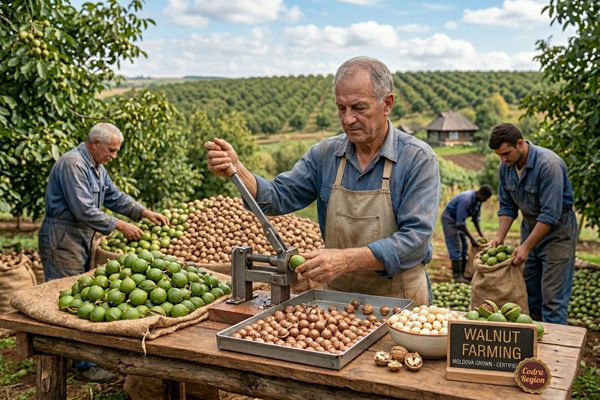
Moldova’s walnut industry is shifting decisively from bulk, volume-driven exports to a premium, quality-led model, just as global kernel prices show a mild firming trend. Tightening alignment with EU standards, rapid orchard modernization and investments in post-harvest technology are positioning Moldovan origins at the higher end of the walnut value chain.
Supported by strong European demand and improving logistics competitiveness, Moldova is consolidating its role as a reliable supplier of high-quality kernels and, increasingly, fresh walnuts. Against this structural backdrop, spot kernel offers from major suppliers signal a slightly firmer tone, while premium organic origins command a notable price spread. For buyers, this combination of structural quality upgrades and modest price strength argues for more strategic, longer-term supply relationships.
Exclusive Offers on CMBroker

Walnut kernels
light quarter
FOB 3.35 €/kg
(from CN)

Walnut kernels
light amber pieces, 8-12 mm
FOB 2.30 €/kg
(from CN)

Walnut kernels
light pieces, 8-12 mm
FOB 2.85 €/kg
(from CN)
📈 Prices & Market Tone
Recent offer indications show a mildly firmer walnut kernel market. Chinese FOB Dalian kernels currently hover around EUR 2.30–3.35/kg depending on grade, up about EUR 0.05/kg versus mid-March for several segments, while organic light halves from the US and India trade significantly higher, near EUR 4.55–5.35/kg FOB. This confirms a stable-to-firm bias and a clear premium for certified organic and high-spec product.
The modest upward move since mid-March reflects steady demand in Europe and Asia, while logistics and energy costs remain elevated. For Moldova, whose exports are mainly directed to European destinations, this environment favours well-differentiated, premium kernels over low-margin bulk shipments.
| Origin / Type | Location / Terms | Latest Price (EUR/kg) | 1-week Change (EUR/kg) |
|---|---|---|---|
| CN walnut kernels, light quarter | Dalian, FOB | 3.35 | +0.05 |
| CN walnut kernels, light pieces 8–12 mm | Dalian, FOB | 2.85 | +0.05 |
| CN walnut kernels, light amber pieces 8–12 mm | Dalian, FOB | 2.30 | +0.05 |
| CN walnut kernels, light broken 4–8 mm | Dalian, FOB | 2.95 | +0.05 |
| US walnut kernels, light halves, organic | London, FOB | 4.55 | +0.05 |
| IN walnut kernels, light halves, organic | New Delhi, FOB | 5.35 | +0.05 |
🌍 Supply & Demand Dynamics
Moldova has emerged as a structurally important player in the international walnut trade, ranking 11th globally in total walnut export value and 9th in kernel exports in 2024. More than 80% of its shipments are directed to the EU, with Romania, France, Germany, Switzerland and the UK as core destinations. This strong European orientation is reinforcing a shift toward strict quality, traceability and food-safety compliance.
On the supply side, about 25,000 hectares of walnut orchards increasingly feature modern, high-value varieties such as Chandler, Fernor and Lara. As these plantings enter full bearing, they are delivering more stable yields, larger and more uniform kernels and a higher proportion of export-grade quality. Demand-side pull from EU buyers is concentrated on standardized, high-quality kernels, supporting a premium positioning for compliant Moldovan product relative to more variable origins.
📊 Fundamentals & Value Chain Transformation
The core fundamental change lies in rapid modernization across the Moldovan walnut value chain. Producers are investing in advanced sorting and grading equipment, improved packaging and enhanced traceability systems. Leading firms like Pomul Regal operate fully integrated orchards (around 165 hectares) and AI-based grading technology, enabling consistent kernel quality and tighter control from orchard to packed product.
Pomul Regal alone can ship 1,000–1,500 tonnes of in-shell walnuts annually, with volumes expected to rise as its orchards reach full productivity. Sector-wide, these investments are moving Moldova away from bulk, mixed-quality exports toward repeatable, premium contracts, including for the emerging fresh walnut segment, where early demand signals are visible in Western Europe. This diversification into fresh product offers an additional revenue stream and risk hedge beyond kernels.
🚢 Competitiveness & EU Linkages
Moldova’s geographical proximity to its main buyers underpins its competitive edge versus overseas suppliers. Shorter transit times, lower freight costs and logistical flexibility help offset any cost disadvantages in production and encourage just-in-time deliveries of sensitive, high-value kernels. This is particularly relevant when freight and energy markets are volatile.
Deepening integration with the EU framework, including the existing free trade area and progressive regulatory alignment, further supports Moldova’s role as a preferred European-origin supplier. As Brussels places greater emphasis on sustainability and traceability in agri-food chains, Moldova’s rapid adoption of modern orchard management and post-harvest systems positions it well to capture future high-end demand.
📆 Short-Term Outlook & Weather
In the very short term (next 3–7 days), no major weather shock is expected in key European consuming markets or in India that would materially affect near-term walnut demand; trade flows remain driven mainly by existing contracts and logistics. With Northern Hemisphere orchards still largely in pre- or early-season stages, weather risk for the 2026/27 crop remains a medium-term consideration rather than an immediate market driver.
Given the structural tightening in premium-quality supply and firm EU demand, the near-term price tone for high-grade kernels is expected to remain stable to slightly firmer. Lower grades and non-standardized lots may see more competitive pricing, but the overall spread in favour of certified and well-sorted product should persist.
🧭 Trading Outlook & Strategy
- Buyers in the EU and India: Secure a portion of Q2–Q3 needs via forward or medium-term contracts from modern Moldovan suppliers to lock in quality and mitigate upside risk in premiums.
- Roasters and processors: Consider blending strategies, combining competitively priced Chinese pieces with higher-quality Moldovan or US kernels to manage costs while maintaining product standards.
- Moldovan exporters: Prioritise long-term partnerships with key European clients, emphasising traceability, standardized kernels and the ability to supply both kernels and, where feasible, fresh walnuts.
- Indian importers: Monitor currency and freight volatility carefully; the price gap between organic and conventional kernels suggests room to differentiate retail offerings, especially in premium urban segments.
📉 3-Day Price Direction (Indicative)
- FOB Dalian (CN) kernels: Stable to slightly firm over the next 3 days, reflecting steady overseas demand and recent small upticks in offer levels.
- FOB New Delhi (IN) organic kernels: Stable at elevated levels, with limited downside given niche demand and higher production and certification costs.
- Moldovan export parity to EU: Stable with a mild upside bias for premium, well-sorted kernels as EU buyers increasingly prioritise quality and origin over lowest-cost alternatives.