
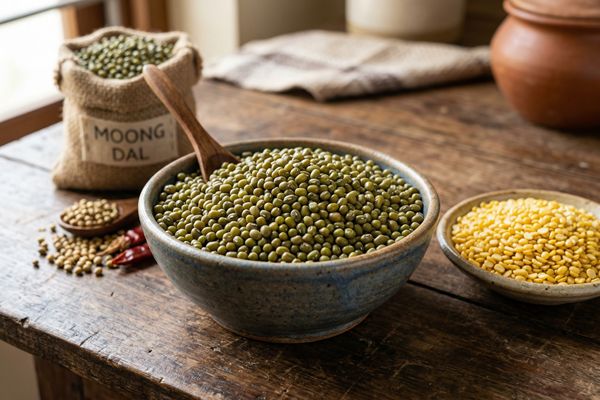
Indian green gram (moong) prices are edging firmer on sowing shortfalls in Gujarat, while a sizeable government buffer stock and mostly steady international lentil offers are containing any sharp rally for now.
The lentil complex is entering a period of quietly supportive fundamentals. In India, moong prices in key mandis are firm-to-stable as the market digests a near 9% year-on-year sowing deficit in Gujarat and a modest undershoot versus the three‑year average. Meanwhile, Canadian and Chinese export offers for key lentil types have drifted slightly lower over March in EUR terms, suggesting comfortable nearby availability. The combination points to limited downside but also caps near‑term upside, with more pronounced price risk likely to surface into the June–August window as India’s new kharif crop prospects become clearer.
Exclusive Offers on CMBroker

Lentils dried
Red football
FOB 2.58 €/kg
(from CA)

Lentils dried
Laird, Green
FOB 1.75 €/kg
(from CA)

Lentils dried
Eston Green
FOB 1.65 €/kg
(from CA)
📈 Prices & Short-Term Trend
In Delhi wholesale markets, Rajasthan-line green gram (moong) strengthened on Monday, trading around the equivalent of EUR 63–78 per quintal depending on grade, while prices at major producing centres such as Jaipur, Indore, Akola and Jalgaon remained broadly stable. Superior chamki grades in Rajasthan and Maharashtra are holding a premium but have not broken to fresh highs, indicating firm but orderly trade.
On the international side, FOB Ottawa offers for Canadian lentils as of 28 March show a mild softening over the past week in EUR terms: red football lentils are roughly EUR 2.40/kg, while Laird and Eston green lentils are around EUR 1.63/kg and EUR 1.54/kg respectively. In China, small green lentils FOB Beijing are quoted near EUR 1.09/kg for conventional and EUR 1.17/kg for organic, with only marginal week‑on‑week moves. Overall, the price picture remains range‑bound with a slight downward bias for export origins and a modest upward tilt in India’s moong market.
🌍 Supply & Demand Balance
The most important development is on the supply side in India. Gujarat, the country’s largest green gram producer, has reported sowing of only 48,400 hectares through 30 March, down 9.13% from 53,264 hectares a year earlier and about 4.57% below the three‑year average of 50,766 hectares. Saurashtra dominates current plantings with 32,300 hectares, led by Porbander, Gir Somnath, Junagadh, Devbhoomi Dwarka and Rajkot, while Middle, South and North Gujarat jointly contribute just over 15,000 hectares.
This acreage shortfall raises medium‑term concerns about new kharif‑season moong availability (India’s summer‑sown crop harvested June to October). However, near‑term supply is cushioned by substantial government-held stocks: the central pool is estimated to hold around 780,000 tonnes of moong, the largest buffer among pulses. Dal mills are therefore buying only on a need‑based basis, moderating private demand and preventing any immediate supply squeeze from translating into a sharp price spike.
📊 Fundamentals & Key Drivers
- Government buffer stock: The sizeable central pool inventory acts as a strong ceiling on short‑term price rallies, as any acute tightness can be alleviated through public stock releases.
- Sowing deficit in Gujarat: The roughly 9% year‑on‑year decline in area, and smaller undershoot versus the three‑year average, is a clear bullish signal for the 2026 kharif crop balance if not offset by higher acreage or yields elsewhere.
- Steady dal mill demand: Consumption demand from processing units is described as steady, not weak, meaning that while mills are cautious buyers today, underlying offtake lends a floor to prices.
- Global availability: Slight week‑on‑week easing in Canadian and Chinese lentil FOB values in EUR indicates that international supply for green and red lentils remains comfortable, reducing import‑driven upside pressure for now.
🌦️ Weather & Crop Outlook
The immediate driver for Indian moong is sowing, which is already showing a deficit in Gujarat. Weather during the upcoming pre‑monsoon and monsoon period (June–September) will be crucial for yield realisation in Saurashtra and the rest of Gujarat. Any monsoon delays or erratic rainfall over the peninsula could exacerbate the current acreage shortfall, tightening the 2026/27 balance sheet.
For now, markets are focused less on current weather and more on planted area and policy. As updated rainfall and planting data emerge through late May and June, the risk profile for June–August prices will sharpen, with a higher probability of sustained firmness if deficits persist or expand to other states.
📆 Market & Trading Outlook
Traders broadly agree that a large near‑term rally in moong is unlikely given the heavy central buffer, but the Gujarat sowing deficit and steady end‑use demand also limit downside. Over the next two to four weeks, the market is expected to trade in a firm‑to‑stable band, with more asymmetric upside risk emerging into June–August as clarity on the new crop develops.
- Importers / Buyers: Use current range‑bound conditions to secure part of Q3 needs, staggering purchases rather than front‑loading, as government stock policy may cap rallies in the short run.
- Exporters / Producers: For Canadian and Chinese origins, consider locking in forward sales on any modest price rebounds, as current offers suggest comfortable global supply but Indian fundamentals could lend support later in the season.
- Dal mills / Processors: Maintain need‑based buying but prepare for firmer replacement costs from June onward if Indian acreage deficits are not offset by weather or area gains in other regions.
📉 3‑Day Price Indication (Directional)
| Market / Product | Current level (approx.) | Currency | 3‑day bias |
|---|---|---|---|
| Delhi moong (Rajasthan-line, mandis) | EUR 63–78 / qtl | EUR | Firm to stable |
| Canada red lentils FOB Ottawa | ~EUR 2.40 / kg | EUR | Slightly softer / sideways |
| Canada green lentils (Laird/Eston) FOB Ottawa | ~EUR 1.54–1.63 / kg | EUR | Sideways |
| China small green lentils FOB Beijing | ~EUR 1.09–1.17 / kg | EUR | Stable |
Related posts:
 Indian Black Gram Rally Tightens Pulse Complex, Steadies Global Lentil Sentiment
 Black Gram Strength Tightens Global Lentil Balance
 Lentil Markets Steady as Indian Green Gram Policy Caps Global Upside
 Indian Green Gram Overhang Keeps Global Lentil Market Capped
 Indian Lentil Jitters: Duty Risk Meets Heavy Global Supply