
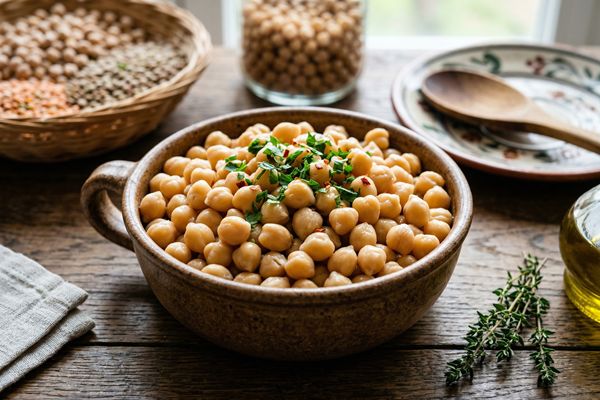
Indian chickpea prices are easing from recent highs as fresh rabi crop arrivals begin to build and speculative stockists unwind positions, while global supply, particularly from Australia, remains comfortable. The near-term balance points to mild further downside in spot chana, but with a price floor emerging as government procurement steps up and central reserves stay well stocked.
Chickpeas, India’s largest pulse crop, have turned softer across major mandis at the start of the peak March–May harvest window. Processors are deliberately limiting purchases to hand-to-mouth coverage, betting that heavier arrivals from Madhya Pradesh and Rajasthan will further pressure prices. At the same time, adequate imported stocks at ports and a sizeable central pool reduce the risk of sharp spikes. For international buyers, Indian-origin chickpeas remain competitively priced in EUR terms, but strong Australian availability is capping any export premium.
Exclusive Offers on CMBroker

Chickpeas dried
count 42-44, 12 mm
FCA 0.97 €/kg
(from IN)

Chickpeas dried
count 44-46, 11 mm
FCA 0.94 €/kg
(from IN)
📈 Prices & Spreads
In Delhi, new Rajasthan-origin chickpeas slipped by about EUR 0.73 per tonne to roughly EUR 65.50–65.80 per 100 kg, while Madhya Pradesh-line chana eased by around EUR 0.48 per tonne to about EUR 64.90–65.20 per 100 kg. Jaipur-line delivery values softened by roughly EUR 0.73 per tonne to around EUR 61.70–62.00 per 100 kg. At Indore, various grades traded in a broader band near EUR 57.80–61.90 per 100 kg, indicating a clear discount to Delhi’s benchmark levels.
Finished chickpea dal in Delhi’s wholesale market is quoted around EUR 48.70–51.80 per 100 kg for the split product, reflecting some downstream margin compression as raw-seed prices have only just begun to ease. Recent export and FCA price indications from North India reinforce this softening trend: New Delhi FCA offers for dried chickpeas range roughly from EUR 0.79–0.97 per kg (EUR 79–97 per 100 kg), with the finer 42–44 count segment at the upper end. Mexican origins, by contrast, command a higher FOB range of about EUR 0.81–1.28 per kg, keeping Indian supplies competitive for cost-sensitive destinations.
| Market / Product | Grade / Type | Price (EUR/100 kg) | Trend (recent) |
|---|---|---|---|
| Delhi mandi | Rajasthan-origin chana | ≈ 65.5–65.8 | Softening by ~1% |
| Delhi mandi | Madhya Pradesh-line chana | ≈ 64.9–65.2 | Mildly lower |
| Indore mandi | Various grades | ≈ 57.8–61.9 | Soft, wider range |
| Delhi wholesale | Chickpea dal (split) | ≈ 48.7–51.8 | Stable to slightly easier |
| India FCA New Delhi | Dried chickpeas 42–44 cnt | ≈ 95.0 | Off recent highs |
| Mexico FOB | Dried chickpeas 42–44 cnt | ≈ 128.0 | Steady at premium |
🌍 Supply & Demand Drivers
Madhya Pradesh and Rajasthan, which together account for the bulk of India’s chickpea output, are entering the peak of the rabi harvest. Sown area in the current season is reported higher than last year, underpinning expectations for a strong crop in both states. Early arrivals from Gujarat, Karnataka, and Maharashtra into Ahmedabad and Rajasthan wholesale markets are described as lower than in the previous period, but this is viewed as a timing effect rather than structural tightness, with a surge in supplies expected over the coming weeks.
Dal mills are clearly in wait-and-see mode, procuring only to cover immediate processing needs instead of rebuilding stocks. This tactical demand slowdown is amplifying the downward pressure from anticipated larger arrivals. At the same time, imported chickpea inventories at Indian ports are assessed as adequate, providing an additional buffer against any localised shortfalls. Government agencies have already procured about 100,000 tonnes under the Minimum Support Price scheme, and with the central pool reportedly holding around 300,000 tonnes of chickpeas, official intervention capacity remains significant if prices overshoot to the downside.
📊 Global Context & External Influences
Internationally, Australia’s chickpea supply remains robust, giving buyers in Europe and the Middle East ample choice and limiting the premium that Indian origins can achieve. Forecasts for 2025/26 point to higher Australian pulse output, including chickpeas, translating into a sizeable exportable surplus targeting South Asia and traditional Mediterranean demand hubs. This competitive backdrop narrows arbitrage for Indian exporters, especially on larger-sized kabuli segments, and encourages Indian sellers to remain price-agile in EUR terms.
Broader macro conditions for agriculture are mixed. Fertiliser and energy markets are experiencing renewed volatility due to conflict in West Asia, driving up natural gas and urea costs globally and threatening higher input prices for the next sowing cycle. For the current Indian chickpea harvest, however, crop conditions are largely determined, and the immediate impact on yield is limited. The main channel through which these shocks may affect chickpeas in the short run is via freight and logistics costs on export routes to the Middle East and Europe, marginally eroding FOB competitiveness but not yet enough to reverse the present soft tone.
⛅ Weather & Crop Outlook
Across India’s chickpea belt, the rabi season has broadly progressed under favourable conditions, with harvesting now accelerating through March and expected to remain brisk into April and early May. No major, widespread weather shocks have been reported that would seriously undermine the strong production expectations in Madhya Pradesh and Rajasthan. Localised unseasonal showers cannot be ruled out but, at this stage, are more of a quality than a volume risk in late-maturing fields.
Given higher sown area and generally supportive weather, the production outlook for 2025/26 remains comfortably above last year’s levels. Combined with adequate port stocks and a sizeable central pool, this underpins a market structure where supply-side risks are skewed toward surplus rather than shortfall, validating the current mildly bearish bias in spot prices. Any sharp downside, however, is likely to trigger stronger state and central procurement activity around the Minimum Support Price, helping to stabilise farmer realisations.
📆 Short-Term Price Outlook
The two-to-four-week outlook points to continued mild softness as harvest arrivals gain momentum and mills persist with cautious, just-in-time buying. Market participants see a likely near-term floor in the vicinity of EUR 61–63 per 100 kg (equivalent to roughly USD 55–57 per quintal), where government procurement is expected to intensify, absorbing part of the surplus. Above this range, selling pressure from farmers and stockists is likely to remain strong as they monetise fresh crop and earlier long positions.
Globally, the combination of strong Australian availability and higher logistics costs into the Gulf is likely to cap upside for Indian FOB values in EUR terms. Indian chickpeas should retain a cost advantage into some nearby markets, but buyers have alternative origins and therefore bargaining power. Overall, the base case for April is for a gently downward-to-sideways price path in India, with only brief technical rebounds if arrivals pause or mills step in opportunistically.
💡 Trading & Risk Management Recommendations
- Importers / European & MENA buyers: Use current softness in Indian offers (EUR 79–97 per 100 kg range ex-North India) to secure nearby and early Q3 coverage, but avoid overcommitting given robust Australian supply and ongoing freight volatility.
- Indian processors (dal mills): Maintain hand-to-mouth procurement in the near term; consider layering in additional coverage if mandi prices approach the projected EUR 61–63 per 100 kg floor or if evidence emerges of slower arrivals than expected.
- Farmers in key producing states: Stagger sales between private trade and MSP procurement channels to manage downside risk; avoid aggressive stockholding in expectation of a quick post-harvest rebound given the strong production outlook and ample central reserves.
- Speculators and traders: Bias strategies toward selling rallies rather than buying dips, with tight risk controls near the estimated floor zone where government intervention is likely to increase.
📍 3‑Day Regional Directional View (EUR Terms)
- Delhi & Northern mandis: Slightly lower to stable; modest further softening as more Rajasthan and Madhya Pradesh crop arrives.
- Central India (Indore, MP belt): Mild downside bias; discounts to Delhi likely to persist given strong local supply and cautious mill demand.
- Export/FCA New Delhi: Stable to marginally softer in EUR, tracking domestic mandi levels and subdued international buying appetite.
Related posts:
 Pigeon Pea Market Firms as Indian Mills Step Up Buying and Imports Tighten
 Indian Chickpea Market Finds a Floor as New Crop and Imports Build Pressure
 Lentil Market Faces Heavy Supply and Cautious Buying as Indian New Crop Arrives
 Chickpea Rally Tests Its Limits as Indian Harvest and State Buying Ramp Up
 New Indian Crop Pressures Chickpea Prices as MSP Support Looms
 Indian Chickpea Market Firms as MSP Buying Ramps Up, Imports Cap Upside
 Chickpea Prices Steady but Supported as Indian Procurement Ramps Up
 Chickpea Market Softens: Indian Desi Chana Under Demand Pressure