
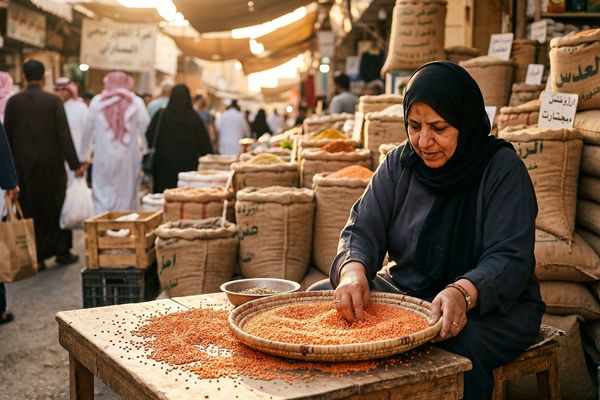
Indian lentil prices are extending a short-term rally, driven above all by a sharply weaker rupee and underwhelming new-crop arrivals, while global FOB values show mild softness. The domestic squeeze is concentrated in key consuming belts and is amplifying India’s reliance on imports from Canada and Australia. Unless the rupee recovers or fresh arrivals surprise to the upside, prices are likely to remain supported through April, with processors forced to chase limited supplies.
India’s lentil complex is being pulled in two directions. At origin, Canadian FOB prices in euro terms are slightly softer month‑to‑date, but this relief is more than offset by currency-driven import inflation in India. At the same time, the government’s buffer stocks and limited MSP procurement are doing little to cool spot markets amid strong seasonal demand in eastern states. Traders face a market where fundamentals justify firmness, but where chasing the rally too aggressively carries clear currency and supply‑side reversal risks.
Exclusive Offers on CMBroker

Lentils dried
Red football
FOB 2.58 €/kg
(from CA)

Lentils dried
Laird, Green
FOB 1.75 €/kg
(from CA)

Lentils dried
Eston Green
FOB 1.65 €/kg
(from CA)
📈 Prices & Currency Dynamics
Domestic lentil prices in India have risen for a second consecutive session. In New Delhi, values firmed by about $0.27 per 100 kg, reaching roughly $73.47–73.74 per quintal, while imported Canadian and Australian container cargoes gained around $0.53 per quintal. Portside Canadian lentils at Mundra are also higher, though Hazira remains broadly steady, and Indore bilti rates are flat, indicating a rally concentrated in key consuming and trading hubs rather than a uniform nationwide spike.
The core driver is currency: the rupee has weakened to around 94 per USD, significantly raising the landed cost of every tonne of imported lentils. Even where dollar-denominated offers are stable or slightly easier, the FX move converts into higher local-currency replacement costs. This is forcing domestic buyers to lift bids to secure nearby coverage, especially where stocks are thin.
🌍 Supply & Demand Balance
On the supply side, new-crop arrivals from Madhya Pradesh and Uttar Pradesh are lagging expectations. Market participants increasingly assume a smaller crop from Uttar Pradesh, tightening available domestic supplies just as demand from eastern states such as Bihar, Bengal, and Assam enters a seasonal high. The central buffer of about 400,000 tonnes is not yet being deployed aggressively enough to cap prices, and MSP procurement remains modest, limiting state-led relief.
Demand is firm but not yet panicked. Dal mills are largely buying hand‑to‑mouth, seeking to avoid heavy coverage at elevated prices. However, with import parity worsening and local arrivals disappointing, processors will likely need to re-enter the market more assertively in the coming weeks to maintain throughput, which points to continued underlying support for prices into late April.
📊 Global Fundamentals & External Signals
Internationally, Canada remains India’s dominant lentil supplier, with crop variability there a critical swing factor. Any tightening of Canadian export availability would quickly magnify India’s domestic squeeze, given the current FX headwinds. Australia’s container shipments are also edging higher in price in dollar terms, reinforcing the broader uptrend seen in India’s CIF replacement values.
Recent FOB offers (converted approximately into EUR) indicate that Canadian red lentils still command a notable premium over green types. At the same time, Chinese small green lentils show mixed moves, with organic grades inching higher while some conventional lines ease slightly. Overall, overseas prices alone do not explain India’s rally; rather, they interact with the rupee’s depreciation and India-specific supply concerns to produce a more pronounced domestic price response.
| Product | Origin | Location | Latest FOB price (EUR/t) | 1-week change (EUR/t) |
|---|---|---|---|---|
| Lentils dried, Red football | Canada | Ottawa, FOB | ≈ 2.58 | −0.02 |
| Lentils dried, Laird Green | Canada | Ottawa, FOB | ≈ 1.75 | −0.02 |
| Lentils dried, Eston Green | Canada | Ottawa, FOB | ≈ 1.65 | −0.02 |
| Lentils dried, small green (organic) | China | Beijing, FOB | ≈ 1.26 | +0.02 |
| Lentils dried, small green | China | Beijing, FOB | ≈ 1.17 | −0.01 |
🌦️ Weather & Short-Term Outlook
Weather in India’s key lentil belts is currently a secondary driver compared with currency and arrivals. With the bulk of the rabi crop already in, short‑term rainfall or temperature shifts are less likely to materially change the production outlook. Instead, the market’s focus is on the pace and quality of deliveries from Madhya Pradesh and Uttar Pradesh into major mandis and on any potential policy moves affecting buffer stock releases.
Globally, the upcoming seeding season in Canada and weather expectations there will gain importance later in Q2, but for the next two to four weeks, India’s domestic fundamentals and FX trajectory dominate. In this window, the probability skews toward stable-to-firmer prices, with corrections likely to be shallow unless driven by a sharp rupee rebound or sudden improvement in arrivals.
📆 Trading & Risk Management Outlook
- Importers into India: Avoid overextending coverage at current elevated rupee-equivalent prices. Consider staggering purchases, but maintain minimum nearby coverage given firm seasonal demand and uncertain arrivals.
- Processors and dal mills: Maintain disciplined, rolling procurement. Be prepared to accelerate buying if evidence emerges of further supply shortfalls in Uttar Pradesh or if the rupee weakens again.
- Exporters (Canada, Australia, China): Current Indian strength offers an opportunity to lock in sales, but factor in FX risk and the potential for a policy or currency correction that could soften import demand later in Q2.
📉 3‑Day Price Direction (Indicative)
- India (key mandis & ports): Slight upward bias or at least steady at firm levels, as rupee weakness and tight arrivals continue to support bids.
- FOB Canada (red & green lentils, EUR basis): Broadly stable to marginally softer, with global demand steady but no major fresh bullish catalyst in the very short term.
- FOB China (small green lentils, EUR basis): Mixed but overall range‑bound, with small quality and organic premiums persisting.
Related posts:
 Indian Moong Tightens While Global Lentil Prices Stay Range-Bound
 Rupee Slide Lifts Indian Lentil Prices as Supply Underperforms
 Indian Black Gram Rally Tightens Pulse Complex, Steadies Global Lentil Sentiment
 Lentil Markets Steady as Indian Green Gram Policy Caps Global Upside
 Indian Green Gram Overhang Keeps Global Lentil Market Capped
 Indian Lentil Jitters: Duty Risk Meets Heavy Global Supply