
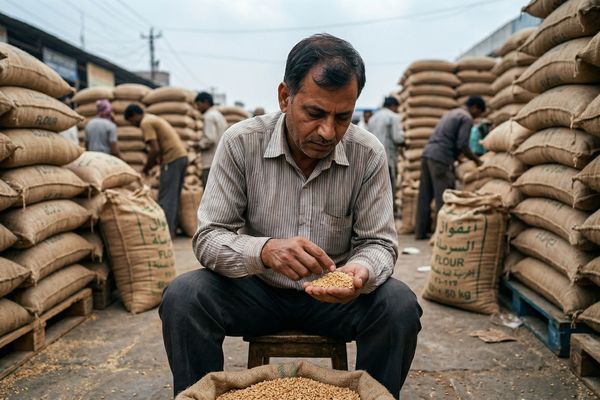
Wheat markets are easing in India as New Delhi prices retreat on thin holiday trading and structurally weaker demand from local roller flour mills, while global benchmarks stay capped by comfortable supply and improving crop outlooks.
In North India, wheat trading around New Delhi is currently shaped more by domestic milling economics and logistics than by international benchmarks. Holiday-related closures and March financial year-end effects have temporarily depressed volumes, but the more important shift is structural: lower-cost wheat and processing capacity in Uttar Pradesh, Bihar, Madhya Pradesh, and Rajasthan are eroding Delhi’s role as a milling hub. At the same time, global prices have softened on better crop signals, even as weather risks and geopolitical tensions keep volatility elevated.
Exclusive Offers on CMBroker

Wheat
protein min. 11.50%
98%
FCA 0.24 €/kg
(from UA)

Wheat
protein min. 11.50%
98%
FCA 0.25 €/kg
(from UA)

Wheat
protein min. 9,50%
98%
FCA 0.24 €/kg
(from UA)
📈 Prices & Spreads
At Lawrence Road, New Delhi’s key grain hub, new-crop wheat from Madhya Pradesh, Rajasthan, and Haryana slipped by roughly USD 0.32–0.43 per 100 kg to about USD 26.84–26.89 per quintal, while old-crop wheat held firmer near USD 27.10–27.16 per quintal. The premium for old stock reflects tighter nearby availability and quality preferences, even as overall demand is subdued.
In surrounding centres, the weak tone is consistent but nuanced: Hapur in Uttar Pradesh saw prices ease to around USD 26.05–26.16 per quintal on softer flour mill buying, while Hisar in Haryana was comparatively stable at USD 26.21–26.52 per quintal. These differentials underline Delhi’s diminishing pricing power as mills relocate procurement and processing to lower-cost origins. Internationally, export-oriented wheat offers remain relatively steady in euro terms, with milling wheat indications around EUR 0.18–0.29/kg depending on origin and protein, highlighting a broadly capped global price environment.
🌍 Supply, Demand & Structural Shifts
Physical arrivals into New Delhi remain seasonally thin, with only about 10–11 truckloads reported at Lawrence Road, but this tight flow has not translated into price strength because mill demand is muted. Roller flour mills in Delhi are cutting utilisation as they lose margin to competitors in Uttar Pradesh, Bihar, Madhya Pradesh, and Rajasthan, where cheaper milling wheat and lower cost structures allow atta, maida, and suji to be produced more competitively.
The most striking signal of margin compression is the inversion of flour product prices: for the first time, refined white flour (maida) has traded slightly below wholemeal atta in Delhi, with maida quoted around USD 14.85–14.99 per 50 kg versus atta at USD 14.99–15.09 per 50 kg. Semolina (suji), in contrast, rose to roughly USD 16.32–16.44 per 50 kg as reduced mill utilisation curtailed suji output and tightened spot supplies, underscoring how output cuts are reshaping internal product spreads.
📊 Global Context & Weather Signals
Globally, wheat is trading in a comparatively comfortable supply environment. Recent international assessments point to robust 2025/26 wheat production among major exporters and mildly improving trade flows, keeping a lid on rallies despite pockets of weather risk. Chicago wheat futures have edged higher only modestly in recent sessions, supported mainly by ongoing dryness in key US Plains winter wheat areas rather than any broad-based supply shock.
For India, the immediate focus is on late-season weather across the northern belt. Unseasonal rains and hailstorms have recently hit parts of Haryana and Punjab just ahead of harvest, with further western disturbances forecast to bring more rain and gusty winds across Punjab, Haryana, Delhi, Rajasthan, and Uttar Pradesh in early April. This raises localised yield and quality risks, particularly lodging of ripe wheat, but overall national output is still expected to be relatively solid compared with prior years, implying that any upside price impact may be constrained and regionally concentrated.
📉 Short-Term Outlook (1–3 months)
With new-crop arrivals from Madhya Pradesh, Rajasthan, and Haryana set to accelerate over the next 2–4 weeks, Delhi wheat prices are likely to stay under mild downward pressure. The temporary demand drag from Mahavir Jayanti closures and financial year-end effects will fade, allowing some recovery in trading volumes, but Delhi’s roller mills are expected to keep operating cautiously as structural cost competition from outlying states persists through the first quarter of the new financial year.
Global benchmarks, meanwhile, face a tug-of-war between generally comfortable exporter supplies and mounting weather and geopolitical risks, including ongoing dryness in parts of the US Plains and broader fertiliser and freight uncertainties linked to regional conflicts. For Indian prices, however, the dominant drivers will remain domestic: logistics, policy decisions on procurement and stocks, and the relative cost advantage of extra-Delhi milling centres.
🧭 Trading Outlook & Strategy
- For domestic mills and buyers: Use current softness in New Delhi as an opportunity to extend short-term coverage, particularly for suji where tighter availability is already evident. Prioritise flexible sourcing from Uttar Pradesh, Bihar, Madhya Pradesh, and Rajasthan to capture lower raw material costs.
- For farmers and local traders: Consider staggered sales in regions facing weather uncertainty, but avoid excessive stockpiling in Delhi where structural demand is weakening. Quality protection and timely harvest ahead of forecast rains are critical to preserve premiums.
- For international traders: Maintain a cautiously bearish-to-neutral bias on global wheat, with a focus on weather headlines and policy signals. India’s largely domestically driven price formation implies limited direct import demand in the near term, reducing upside risk from this market.
📆 3-Day Directional Outlook (Key Hubs, in EUR)
| Market | Current Level* (EUR/kg) | 3-Day Bias | Comment |
|---|---|---|---|
| New Delhi (milling wheat, spot) | ≈0.24–0.25 | ⬇ to ⬇⬌ | Weak mill demand and rising new-crop arrivals keep tone soft. |
| Ukrainian wheat FCA (Kyiv/Odesa) | 0.23–0.25 | ⬌ | Recent offers stable in EUR; no major fresh shocks visible. |
| EU wheat FOB (Paris) | ≈0.29 | ⬌ to ⬇ | Global supply outlook comfortable; weather and demand watched. |
*Indicative, converted to EUR at approximate market FX; intended for directional guidance, not as firm quotations.
Related posts:
 Wheat Market Caught Between Strong Crops, US Drought Fears and War-Driven Cost Shock
 Poland’s wheat market under pressure from record stocks and weak demand
 Wheat Market Under Pressure as Oil Shock Threatens Farm Margins
 Poland’s Wheat Market Under Pressure: Stocks Swell Ahead of Harvest
 Wheat under macro pressure as Russian exports surge and EU yields soften
 Wheat under pressure as better crop prospects offset geopolitical risks
 Wheat under Pressure: Rising Supply Keeps Market on the Defensive
 Oats Lose Altitude: CBOT Futures Ease While Black Sea Cash Firms