
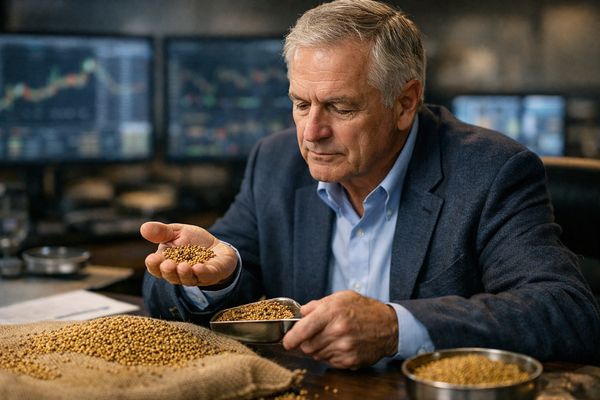
India’s mustard seed market is trading well above fundamental value as the Iran–Israel–US conflict and a sharply weaker rupee overpower an otherwise bumper domestic crop. Spot and oil prices have risen briskly over the past month, tracking the spike in global energy and edible oil markets and reflecting tighter physical availability.
India’s large 2025/26 mustard crop and expanded sowing should, on paper, cap prices. Instead, freight and risk premia linked to the closure and disruption of the Strait of Hormuz, together with elevated Brent crude above €105–115/bbl, are making imported edible oils far more expensive for India and supporting domestic mustard values. Daily arrivals have dropped sharply, stockists are trapped in uncomfortable length, and mustard oil remains firm across key consuming centres. Export offers ex-India in EUR are broadly steady, suggesting the current rally is primarily domestic and geopolitical rather than export-led.
Exclusive Offers on CMBroker

Mustard seeds
yellow, bold, sortex
99.95%
FOB 0.99 €/kg
(from IN)

Mustard seeds
yellow, micro, sortex
99.95%
FOB 0.89 €/kg
(from IN)

Mustard seeds
brown, micro, sortex
FOB 0.82 €/kg
(from IN)
📈 Prices & Market Snapshot
New-crop mustard seed (42% oil) at Jaipur has climbed from a seasonal low of roughly €65.5 per 100 kg to about €72.9 per 100 kg in the latest session, using an indicative FX of 1 USD ≈ 0.92 EUR. Mustard prices at Hapur in Uttar Pradesh have similarly strengthened to around €68.4–€69.4 per 100 kg, confirming a broad-based domestic uptrend.
Mustard oil at Jaipur expeller mills is quoted near €14.8 per 10 kg, while premium kachi ghani oil trades around €15.5 per 10 kg in Kolkata and about €14.9–€15.0 per 10 kg in Adampur (Haryana). Export-oriented offers from New Delhi show FOB prices broadly stable through March 2026, with yellow bold sortex mustard at about €0.99/kg and brown bold sortex near €0.73/kg, underlining that the sharpest moves have been in domestic wholesale markets rather than in export quotes.
| Product | Location / Term | Current Price (EUR) | Unit | Recent Trend |
|---|---|---|---|---|
| Mustard seed, 42% oil | Jaipur, wholesale | ~72.9 | per 100 kg | Up from ~65.5 earlier this month |
| Mustard seed, yellow bold sortex | New Delhi, FOB | 0.99 | per kg | Stable vs mid-March |
| Mustard seed, brown bold sortex | New Delhi, FOB | 0.73 | per kg | Unchanged in March |
| Mustard oil (expeller) | Jaipur | 14.8 | per 10 kg | Firm |
| Kachi ghani mustard oil | Kolkata | 15.5 | per 10 kg | Firm |
🌍 Supply & Demand Balance
India’s mustard fundamentals are, in isolation, clearly bearish. Official estimates put sown area near 8.0 million ha (about 5% higher year on year), while farmer assessments suggest up to 9.0 million ha. Total production is projected around 11.9 million tonnes, comfortably above last year’s output and implying abundant domestic availability.
However, marketable supply in the near term is constrained. Daily arrivals in producing markets have fallen from about 1.1 million bags ten days ago to roughly 500,000 bags now, tightening spot availability and amplifying the price response to geopolitical shocks. Stockists who had anticipated a classic bumper-crop sell‑off are now sitting on long positions accumulated at relatively high prices, while some small oil mills and traders are holding costly inventories purchased earlier in the rally, limiting their willingness to sell aggressively into the current strength.
📊 External Drivers & Macro Backdrop
The dominant driver of mustard prices is the Iran–Israel–US conflict that erupted in late February, which has severely disrupted shipping through the Strait of Hormuz and triggered a historic spike in global crude and LNG prices. Brent has surged well above €100/bbl, with recent levels around €105–115/bbl as tanker traffic remains constrained and additional threats to Red Sea and Gulf infrastructure emerge.
This energy shock feeds directly into global edible oil and freight markets, lifting palm oil and soybean oil futures and making imported vegetable oils significantly more expensive at Indian ports. Malaysian palm oil futures and Chicago soyoil have both firmed in recent sessions, reinforcing the bullish edible oil complex supporting Indian mustard. At the same time, the rupee’s slide to roughly 94 per dollar magnifies the local currency cost of imports, further enhancing the relative attractiveness of domestically produced mustard seed and oil.
Broader agricultural markets are also feeling the squeeze from higher energy and fertilizer costs as the Hormuz disruption hampers shipments of fuel and nutrients, prompting fears of a wider food-price upturn. In this environment, mustard seed, as a key feedstock for edible oil and a relatively efficient domestic oilseed option, benefits disproportionately from any substitution away from costlier imported oils.
⛅ Weather & Crop Conditions
Current pricing is being driven far more by geopolitics and currency than by weather, given that the Indian mustard crop is already harvested or near completion. Recent weather across India’s key mustard belts in Rajasthan, Haryana and Uttar Pradesh has not introduced a new production shock; yields are broadly in line with, or slightly above, earlier expectations, consistent with the higher output estimates.
Looking ahead, weather will matter primarily for planting intentions and input costs for the next season, rather than for the current crop. The more immediate risk factor for prices is any weather‑related disruption to shipping or logistics in the Gulf and Red Sea, which could further tighten global energy and freight markets and indirectly support mustard seed values.
📆 Market Outlook (Short Term)
The near‑term trajectory for mustard prices hinges almost entirely on developments in the Middle East. If hostilities persist or intensify and the Strait of Hormuz remains effectively constrained, energy and edible oil prices are likely to stay elevated, underpinning further modest upside in Indian mustard despite the heavy crop. In this scenario, domestic spot markets could grind higher, particularly if farmer selling remains cautious and arrivals stay depressed.
Conversely, a credible ceasefire or meaningful de‑escalation that restores confidence in Gulf shipping lanes would quickly shift market focus back to India’s ample supplies and high carryover. Under that outcome, mustard seed could face a sharp correction from current levels as stockists and mills rush to offload long positions in anticipation of softer edible oil benchmarks and easing import costs. The risk–reward balance at present therefore appears skewed to the downside once geopolitical risk premia begin to unwind.
🧭 Trading & Procurement Strategy
- Traders / Stockists (India): Use current strength to book profits and lighten long positions rather than adding fresh length at elevated levels. Consider scaling out on further spikes linked to headline risk from the Middle East.
- Oil millers: Avoid aggressive forward coverage of seed at current prices; instead, maintain only essential working stocks and be prepared to hedge downside via futures or options in anticipation of a potential post‑ceasefire correction.
- Importers / International buyers: With FOB export offers from India in EUR relatively stable, evaluate opportunistic purchasing of Indian mustard seed, but remain cautious on freight and insurance costs tied to Gulf shipping routes.
- End‑users & food manufacturers: Where feasible, lock in a portion of near‑term mustard oil needs to hedge against further geopolitical spikes, while keeping flexibility to benefit from any rapid price normalization if a diplomatic solution emerges.
📉 3‑Day Price Direction Outlook (EUR)
- India, Jaipur spot mustard seed: Slight upside bias or sideways, with intraday volatility driven by Middle East headlines and daily arrival flows.
- India, Hapur & other North Indian mandis: Mildly firm tone expected as long as arrivals remain around current reduced levels and stockists refrain from heavy selling.
- Export FOB New Delhi (yellow & brown mustard): Broadly stable in EUR terms over the next three days, with any moves more likely via FX swings than outright USD price changes.
Related posts:
 Indian Mustard Seed Market Firms as New Crop Arrivals Build
 Indian mustard seed rally underpinned by strong mill demand and firmer vegoils
 Indian Mustard Seed Rally Tightens Global Cold-Pressed Oil Market
 Mustard Seed Market: Seed Weakness vs. Firm Oil Prices Creates Window for Buyers
 Indian Black Pepper Holds Firm as Geopolitics Cap Upside
 Geopolitics Push Indian Mustard Seed Higher While Export Offers Lag
 Indian Mustard Seed FOB Prices Ease Slightly as New Crop Arrivals Build
 Indian Mustard Seed FOB Prices Ease Slightly as New Crop Arrivals Build