
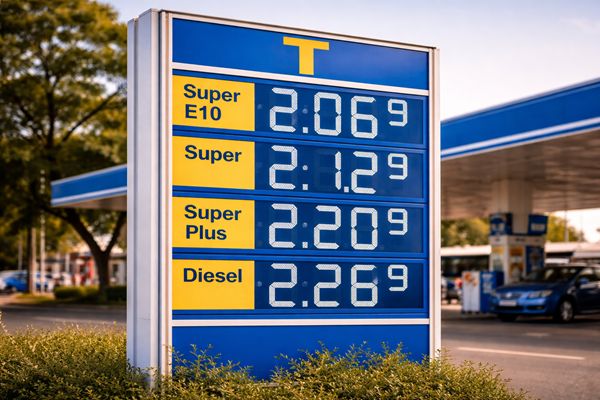
Germany’s new “fuel price brake” limits petrol stations to one price increase per day at 12:00, with reductions allowed at any time. The rule, effective April 1, 2026, targets consumer price spikes driven by the Iran war–related oil rally and intense intraday volatility at the pump. While the measure reshapes retail pricing behaviour, its direct impact on crude and wholesale refined product markets is expected to be modest and mainly micro-structural.
For commodity and energy traders, the reform primarily affects intraday margin management, demand timing, and pricing transparency in one of Europe’s largest fuels consumer markets. Broader effects on gasoline and diesel crack spreads, seaborne product flows, and refinery runs are likely to be second-order and will depend on whether the regulation materially compresses retail margins or shifts purchasing patterns.
Introduction
From April 1, 2026, petrol stations across Germany are allowed to raise gasoline and diesel prices only once per day at 12:00 local time, though they remain free to cut prices as often as they wish. The measure, passed by the Bundestag in late March, responds to sharp retail fuel price increases following the escalation of conflict in Iran and associated oil market tensions.
According to Germany’s Federal Cartel Office, fuel stations previously adjusted prices on average around 20 times per day, and up to 50 times at some locations, generating pronounced intraday price cycles and consumer uncertainty. The new rule, inspired by the Austrian model where fuel price hikes are similarly restricted to noon, is accompanied by stronger competition-law powers for the Cartel Office to intervene against suspected overpricing in the fuel sector.
🌍 Immediate Market Impact
The once-daily price increase cap primarily alters the timing and transparency of retail fuel prices rather than the underlying supply of gasoline and diesel into Germany. Wholesale rack prices, refinery gate prices and import parity economics are still determined by international crude benchmarks, refined product futures and spot markets. However, the rule may narrow or stabilise intraday retail margins, influencing how marketing divisions manage inventory and price risk.
Consumer groups and the ADAC auto club welcome greater price predictability but question whether average pump prices will fall, echoing Austrian experience where prices initially dipped then reverted toward prior levels. Early commentary suggests traders should view the measure as a market-design change in the downstream retail segment, rather than a structural intervention in crude or product pricing.
📦 Supply Chain Disruptions
No immediate physical disruptions to Germany’s fuel logistics chain have been reported following the law’s entry into force. Refinery operations, pipeline flows, barge and truck deliveries into service stations continue under existing contracts and scheduling.
However, station operators may adjust delivery timing and stock management to align inventory levels with the daily noon reset. Larger integrated companies with sophisticated pricing algorithms could seek to maximise margin capture around the single permitted increase, while independents may become more sensitive to wholesale price moves prior to noon. Over time, this could influence load scheduling from depots, creating minor shifts in intra-day truck transport patterns but not in overall volumes.
📊 Commodities Potentially Affected
- Gasoline (petrol): Directly affected at the retail level through constrained intraday price increases. Possible short-term smoothing of intraday German gasoline demand as motorists adapt to predictable noon resets, with limited impact on overall monthly demand or import volumes.
- Road diesel: Similar retail dynamics as gasoline, with commercial fleets potentially adjusting fueling times to capture lower prices before noon, marginally affecting daily drawdown patterns at stations but not aggregate diesel consumption.
- Biofuel blends (e.g., biodiesel, ethanol in E10): Blended into road fuels sold at stations; any sustained compression of retail margins could feed back into negotiations on bio-component sourcing and blending economics, though no regulatory changes to blend mandates are involved.
- Oil product derivatives and cracks: If, over time, the rule contributed to structurally lower or more stable German retail margins, it could marginally influence regional gasoline and diesel crack spreads versus crude, although current evidence and expert commentary suggest neutral to limited impact.
🌎 Regional Trade Implications
Germany remains a core European hub for refined product consumption and cross-border flows. The new rule does not cap absolute retail prices or wholesale levels; it restricts only the frequency and timing of increases. As such, incentives for imports from ARA, Scandinavia or Mediterranean refineries into Germany are unchanged in the near term.
Austria’s long-standing noon price rule did not fundamentally alter its role within regional product trade, and early German commentary similarly points to unchanged structural supply and demand but altered price cycles. However, if political pressure later leads to broader price-control mechanisms or tax adjustments, there could be knock-on effects on cross-border refuelling (e.g., motorists shifting volumes to neighbouring countries) and on the competitiveness of German refining and storage assets.
🧭 Market Outlook
In the short term, traders should watch for behavioural adjustments in German retail fuel demand, particularly whether motorists concentrate purchases in the late morning ahead of the noon reset, as observed at times in Austria. This could slightly reshape high-frequency consumption patterns but is unlikely to move aggregate demand or crack spreads at the weekly or monthly horizon.
Key variables to monitor include: the evolution of average retail margins under the new regime; potential legal challenges or refinements to the rule; and any additional government measures, such as tax tweaks or targeted subsidies, if Iran-related supply risks push oil and product prices higher. For now, price discovery in global crude and refined product markets remains driven primarily by geopolitical risk, OPEC+ policy, freight, and refinery outages rather than Germany’s retail pricing framework.
CMB Market Insight
Germany’s once-daily fuel price increase rule is a notable experiment in downstream market design within a large European economy. It aims to dampen intraday price “churn” and address public concern over war-driven pump price spikes, but evidence from Austria and early expert assessments suggest only modest effects on average price levels.
For commodity market participants, the regulation is more relevant for understanding intraday demand timing, retail margin management and potential future regulatory trajectories than for immediate shifts in physical flows. Unless accompanied by broader fiscal or supply-side interventions, the rule should be seen as a micro-structural adjustment that leaves the fundamental drivers of oil and refined product prices largely intact.