Poland’s New CPN Fuel Price Cap Rewires Margins and Transport Costs Overnight
Poland’s CPN fuel price package, including maximum retail prices and tax cuts, has entered into force, triggering immediate pump price reductions of around PLN 1.2/litre but sharply compressing filling-station margins. While motorists and transport operators benefit in the short term, the new cap changes the economics of fuel retail and freight in one of Central Europe’s key agricultural and food logistics hubs.
The cap is likely to support short-term diesel demand and ease cost pressure for farmers, food processors and road hauliers, but it also increases regulatory risk and margin volatility for fuel suppliers and franchise operators. Commodity and freight market participants with exposure to Poland should expect a period of price distortion, changing trade incentives and potentially elevated spot volatility in related energy and logistics markets.
Introduction
On 31 March 2026, Poland implemented the core of its “CPN – Ceny Paliwa Niżej” package, introducing nationwide maximum retail prices for petrol and diesel alongside temporary VAT and excise cuts. The price cap is set daily by the energy ministry using a formula based on average wholesale prices, taxes, a fuel surcharge and a fixed retail margin of PLN 0.30 per litre.
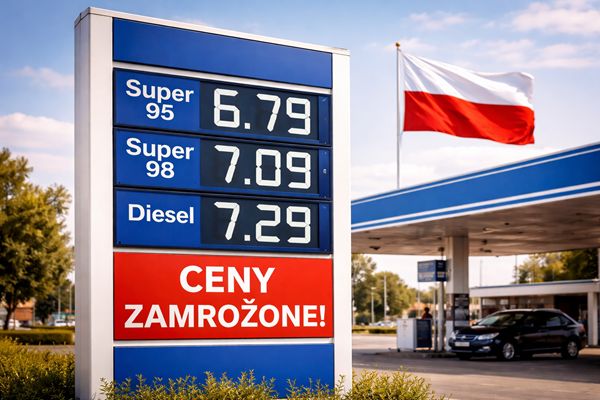
For Tuesday’s launch, the cap was set at PLN 6.16/litre for 95-octane petrol and PLN 7.60/litre for diesel, implying immediate reductions close to the government’s target of PLN 1.2/litre from recent highs. For agricultural commodity markets, where diesel is a key input for fieldwork, grain transport and cold-chain logistics, the move reshapes cost structures and hedging strategies precisely as global oil prices surge on Middle East tensions and the disruption of flows via the Strait of Hormuz.
🌍 Immediate Market Impact
The immediate effect is a sharp, policy-driven fall in Polish pump prices, decoupling retail fuel levels from fully market-based dynamics for the duration of the measure. VAT on fuels has been reduced from 23% to 8% until at least 30 April, while excise was cut to the minimum allowed by EU rules, reinforcing the downward move at the pump.
For traders and industrial users, the key shift is in the cost base of road transport. Lower diesel prices reduce inland freight costs for grains, oilseeds, sugar, feed and processed foods within Poland and on export routes via Baltic ports and land corridors to Germany, Czechia and Slovakia. However, as the cap embeds a fixed PLN 0.30/litre retail margin, station operators report margin compression versus previous business plans that assumed roughly PLN 0.40/litre, placing financial pressure on independent and franchise outlets.
📦 Supply Chain Disruptions
In the short term, the CPN package aims to prevent the kind of run-on-pumps and rationing seen in other regulated fuel systems by resetting prices daily and explicitly building a minimal positive margin into the formula. This design should limit outright shortages, which is crucial for planting and early-fieldwork operations in Poland’s spring season.
Nonetheless, compressed profitability at the retail level raises the risk of selective station closures, deferred maintenance or reduced service in less profitable rural locations. Franchise networks such as AVIA, operated by Unimot, estimate several million zloty of quarterly margin impact, with effects cascading to smaller franchisees that serve agricultural regions. Any thinning of the rural retail network could create micro-level bottlenecks in fuel availability for farms and food processors, especially during peak seasonal demand.
📊 Commodities Potentially Affected
- Grains and Oilseeds – Lower diesel costs reduce farm operating expenses and internal transport costs for wheat, corn and rapeseed, supporting margins for Polish producers and potentially encouraging greater marketing activity from on-farm storage.
- Fertilizers and Crop Inputs – Cheaper road transport for imported fertilizers and crop chemicals eases delivered-cost pressure to inland depots and farms, though global energy-driven production costs remain elevated.
- Meat, Dairy and Processed Foods – Reduced distribution and cold-chain fuel costs may temporarily cushion consumer price inflation for meat, dairy and packaged foods distributed across Poland and into neighbouring markets.
- Biodiesel and Vegetable Oils – Distortions between capped retail diesel prices and market-based biodiesel feedstock costs could narrow incentives for blending and affect demand for rapeseed oil in fuel applications.
- Road Freight and Containerized Agri Trade – Polish trucking capacity serving grain, feed and food corridors into Germany, Czechia and the Baltic ports gains a short-term competitiveness boost from lower fuel costs.
🌎 Regional Trade Implications
Poland’s move effectively lowers domestic fuel costs relative to neighbouring EU states that have not yet implemented comparable caps or tax cuts. This could temporarily enhance the competitiveness of Polish-origin agri and food exports by reducing delivered costs into nearby markets, particularly Germany, Czechia, Slovakia and Baltic states.
At the same time, cheaper fuel may attract additional cross-border fuel shopping by foreign drivers, increasing domestic fuel demand without a corresponding rise in Polish commodity output. Authorities have already signalled they are monitoring cross-border flows and may follow regional precedents where countries have restricted fuel purchases by non-residents to limit arbitrage.
For importers of agricultural inputs through Polish ports and terminals, the cap cushions inland haulage costs but introduces policy risk: if the mechanism is adjusted or withdrawn in response to fiscal strain or supply issues, freight costs could jump abruptly, affecting CIF and delivered-pricing structures.
🧭 Market Outlook
Near term, the CPN package should moderate domestic transport inflation and support fuel-intensive activities, including farming and logistics, even as global crude and diesel benchmarks remain highly volatile due to the Iran conflict and restricted Hormuz transit. Traders should anticipate a temporary divergence between Polish retail fuel costs and international benchmarks, complicating basis relationships for energy and freight-linked contracts.
Key variables to monitor include: daily adjustments to the cap level; the financial health and behaviour of station networks; any emerging local shortages or service reductions; and signals from Warsaw about the duration of VAT and excise relief beyond 30 April. If wholesale prices continue to rise while the fixed retail margin remains at PLN 0.30/litre, pressure from retailers for a revision of the formula may intensify.
CMB Market Insight
The introduction of Poland’s CPN fuel price cap is a structurally important event for regional commodity markets: it redefines transport cost curves, shifts margin risk from consumers to the state and retail operators, and creates a new layer of regulatory uncertainty in a core EU agricultural exporter.
For agricultural traders, processors and logistics providers with Polish exposure, the strategic response should combine short-term optimisation of cheaper domestic fuel with heightened attention to policy timelines, potential network disruptions in rural fuel supply, and the risk of abrupt re-alignment of prices when the cap or tax cuts are modified. Active monitoring of freight spreads and flexible contract structures will be essential to navigate this new, policy-driven phase of the fuel-cost cycle in Poland.