
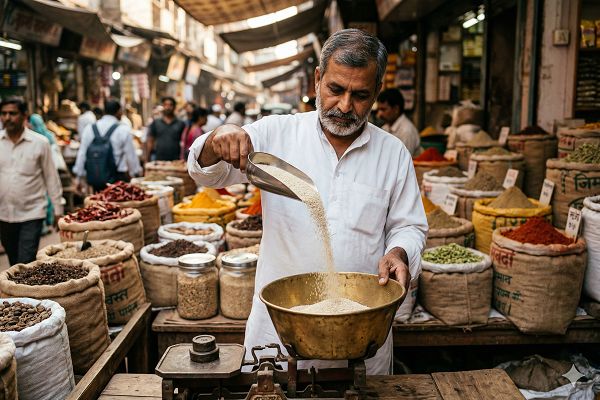
Indian poppy seed prices are holding at elevated levels as the 2025–26 rabi harvest winds down, with traders seeing little scope for downside given rigid licensing and constrained imports. European reference offers show only marginal softening, keeping global benchmarks broadly supported and confirming a structurally tight, but not panicked, market.
India’s market remains the central price driver: domestic cultivation is tightly regulated, seeds are a byproduct of opium latex production, and more than 30% of edible demand must still be met by imports. At the same time, strong culinary, confectionery and nutraceutical demand continues to absorb available volumes. Against this backdrop, exporters and industrial users in Europe and Asia should view current levels as a floor rather than a ceiling for the coming weeks.
Exclusive Offers on CMBroker

Blue poppy seeds
morphin < 20 ppm
99,9
FCA 1.92 €/kg
(from CZ)

Blue poppy seeds
morphin < 20 ppm
99,9
FCA 1.90 €/kg
(from CZ)

White Poppyseeds
morphin < 20 ppm
99,9
FCA 2.90 €/kg
(from CZ)
📈 Prices & Spreads
Across key Indian wholesale markets, poppy seed (khaskhas) was quoted in late March 2026 at around USD 1,196 per 100 kg, with a range of roughly USD 1,100–1,455 per 100 kg depending on grade and location. Converting at an indicative 1 USD = 0.92 EUR, this implies an average of about EUR 1,100 per 100 kg, or roughly EUR 11.00 per kg, with a band of about EUR 10.10–14.00 per kg.
Southern Indian markets command a visible premium: in Pune and Bengaluru, comparisons indicate notional levels well above the national average, reflecting strong local culinary and confectionery demand. European FCA offers from Czechia for blue and white poppy seeds at end-March 2026 are in the EUR 1.90–2.90/kg range, slightly softer than mid-March, and still significantly below current Indian wholesale prices for comparable edible quality.
| Market / Product | Price (local) | Price (EUR) | Date / Note |
|---|---|---|---|
| India wholesale avg (khaskhas) | USD 1,196.26 / 100 kg | ≈ EUR 1,100 / 100 kg (≈ 11.0 €/kg) | Late Mar 2026 |
| India low–high range | USD 1,099–1,455 / 100 kg | ≈ EUR 1,010–1,340 / 100 kg | By grade & region |
| CZ blue poppy seeds (FCA Vysoké Mýto) | – | 1.92 €/kg | 30 Mar 2026 |
| CZ blue poppy seeds (FCA Chropyně) | – | 1.90 €/kg | 30 Mar 2026 |
| CZ white poppy seeds (FCA Chropyně) | – | 2.90 €/kg | 30 Mar 2026 |
🌍 Supply, Regulation & Demand
India’s poppy sector is one of the most tightly controlled in the world. For the 2025–26 crop year, licences were issued to around 121,000 farmers in designated tracts of Madhya Pradesh, Rajasthan and Uttar Pradesh, marking the largest expansion of legal opium poppy cultivation in decades. However, seeds remain a secondary byproduct of latex extraction, so edible poppy seed supply is structurally capped even as licensed area grows.
India relies on imports for more than 30% of its edible poppy seed needs, with Turkey and Czechia among key origin countries. Imports are canalised through strict country lists, mandatory registration with the Central Bureau of Narcotics, and quantitative ceilings per importer. These layered controls, combined with the byproduct nature of seed output, significantly limit the market’s ability to respond quickly to demand shocks, keeping the domestic balance tight.
On the demand side, three channels dominate: food industry (bakery, confectionery, traditional sweets and beverages), regional cuisines such as Bengali fish and sweet preparations, and a steadily expanding nutraceutical and health-food segment targeting urban and export customers. With rabi harvesting largely completed and government procurement absorbing the licensed crop, meaningful new spot supply is unlikely before the next licensing cycle, leaving import flows and stock management as the key buffers.
📊 Global Context & Weather
Globally, poppy seed consumption remains underpinned by stable European bakery and confectionery demand, especially in Germany, Austria and Czechia, where per-capita use is among the highest worldwide. European origin, particularly Czech blue and white poppy seeds, currently trades at a discount to Indian domestic levels, supporting steady export interest into price-sensitive destinations, including India when import windows are open.
In Turkey, a major producer of both edible seeds and pharmaceutical raw material, meteorological services and local reports point to generally seasonally normal to slightly warmer-than-usual spring conditions, with adequate rainfall in key inland regions. This weather backdrop does not currently signal major production stress for the 2026 crop, suggesting global availability should remain broadly stable barring policy or logistical shocks.
📆 Short-Term Outlook (April–May 2026)
With India’s rabi harvest essentially concluded and the new-season licensed crop already committed within the government framework, little additional seed is expected to reach free-market channels in the next two months. Trade participants in key hubs such as Delhi report active buying on dips and limited seller willingness to concede, underscoring a firm undertone.
Baseline expectations are for Indian wholesale prices to consolidate in roughly the equivalent of EUR 10–14/kg through April and May 2026, with upside risk if import registration norms tighten or individual country caps are reduced. In Europe, modest recent easing in Czech FCA offers indicates some post-harvest pressure, but the premium commanded by white over blue seeds and by high-purity, low-morphine lots should remain intact.
💡 Trading & Procurement Strategy
- Indian food and spice users: Treat current levels as a working floor; consider locking in Q2 requirements via staggered purchases rather than waiting for a correction unlikely to materialise without a policy shift.
- European industrial buyers: With FCA Czech prices slightly below mid-March levels, use this window to extend coverage, especially for white and low-morphine specifications, before summer demand picks up.
- Exporters to Europe and the US: Indian-origin poppy seed at appropriate quality can leverage zero or reduced tariffs in some partner markets, but elevated domestic prices mean margins will hinge on efficient logistics and timely contract execution.
- Speculative participants: The combination of rigid licensing, controlled imports and steady demand makes sharp downside moves unlikely in the near term; risk is skewed modestly to the upside on any import or weather surprise.
📍 3-Day Directional View (EUR Terms)
- India wholesale hubs (Delhi, major mandis): Stable to slightly firmer in EUR terms as tight physical supply meets steady demand.
- Pune & Bengaluru (premium southern markets): Firm, with continued premium over northern centres driven by food-service and confectionery buying.
- Czech FCA (blue & white poppy seeds): Broadly stable around 1.9–2.9 €/kg over the next three trading days, with only minor intra-day moves expected absent fresh macro or policy news.
Related posts:
 Czech Blue and White Poppy Seeds Edge Lower as Buyers Stay Cautious
 China Sunflower Market: Weak Demand Keeps Prices Under Pressure Despite Ample Supply
 Sunflower Market Squeezed by Rising Seed Costs and Softer Oil Prices
 Oil Futures Retreat from War Highs but Forward Curve Stays Firmly Backwardated
 Czech Poppy Seeds Ease Lower as Mild Weather Calms Supply Fears
 Sunflower market: stable seed prices, upside risk from surging energy and oilseeds
 Tight Chia Seed Supply Keeps European Prices Firm as Weather Risks Rise
 Poppy Seed Market Under Pressure as New Indian Arrivals Weigh on Prices