
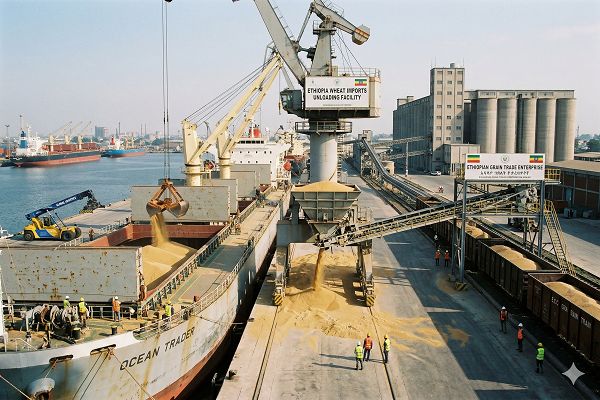
Ethiopia’s wheat market will remain structurally import-dependent even as domestic production rises, with Black Sea origins retaining a key role in covering the supply gap. Strong consumption growth, high local costs and FX constraints anchor imports around 1.4 million tonnes in 2026/27, limiting downside for regional export prices.
Ethiopia is emerging as a steady, structurally tight wheat demand center in East Africa. Production gains from irrigation, improved seeds and mechanization are meaningful, but they lag behind rapid urban-led consumption growth and persistent supply-chain and FX bottlenecks. Private traders, sourcing mainly from Black Sea exporters via Djibouti, remain central to market functioning. Policy measures are steering demand away from imported flour toward locally milled grain, while the state maintains a stabilizing role through strategic wheat procurement and buffer stocks.
Exclusive Offers on CMBroker

Wheat
protein min. 11.50%
98%
FCA 0.24 €/kg
(from UA)

Wheat
protein min. 11.50%
98%
FCA 0.25 €/kg
(from UA)

Wheat
protein min. 9,50%
98%
FCA 0.23 €/kg
(from UA)
📈 Prices & Trade Flows
Domestic Ethiopian wheat prices remain structurally above international benchmarks due to high input and logistics costs, FX scarcity and risk premia along internal supply chains. This keeps imports economically attractive despite currency weakness, particularly for competitively priced Black Sea origins.
Current physical export offers underline this competitiveness: Ukrainian wheat for FCA Kyiv and Odesa is broadly stable at around EUR 240–250/t for 11.5% protein and about EUR 230–240/t for lower-protein lots, while FOB Odesa values for 11–12.5% protein grades cluster near EUR 180–190/t. US and French FOB offers are higher, near EUR 210/t (CBOT-linked US) and EUR 290/t (French 11% protein), reinforcing Black Sea’s cost advantage into the Horn of Africa and sustaining its dominant supplier role into Ethiopia.
| Origin / Term | Protein | Latest Indicative Price (EUR/t) |
|---|---|---|
| Ukraine, FCA Kyiv | 11.5% | ≈ 240 |
| Ukraine, FCA Odesa | 11.5% | ≈ 250 |
| Ukraine, FCA Kyiv | 9.5% | ≈ 230 |
| Ukraine, FCA Odesa | 9.5% | ≈ 240 |
| Ukraine, FOB Odesa | 11–12.5% | ≈ 180–190 |
| US, FOB (CBOT-linked) | 11.5% | ≈ 210 |
| France, FOB Paris | 11.0% | ≈ 290 |
🌍 Supply & Demand Balance
Ethiopia’s wheat balance shows a widening structural gap between rising consumption and still-insufficient domestic output. Wheat production is projected at 7.0 million tonnes in 2026/27 (+8% year on year), while maize reaches about 10.5 million tonnes (+2.9% YoY). These gains are driven by irrigation expansion, improved seeds, mechanization and strong government backing, yet they do not fully close the demand gap.
Wheat consumption is forecast at around 8.2 million tonnes in 2026/27 (+3.8% YoY), underpinned by population growth, rapid urbanization and a dietary shift toward bread, pasta and other processed wheat-based foods. This keeps imports structurally anchored at about 1.4 million tonnes in 2026/27, unchanged from the current year, with 531,400 tonnes already imported in the first five months of 2025/26. Russia, Romania, Turkey and Ukraine dominate these flows, confirming Black Sea-linked origins as price setters into the Ethiopian market.
📊 Market Structure & Policy Environment
Ethiopia’s wheat import system is unusual in that it is driven largely by private traders rather than centralized state purchasing. These traders deploy their own foreign currency, ship via Djibouti and sell to domestic millers under letters of credit. This decentralized model promotes flexibility and responsiveness but simultaneously exposes the sector to FX scarcity and exchange-rate risk, which can quickly translate into higher domestic prices or import delays.
At the same time, public policy is reshaping the product mix of imports. A 25% import duty on wheat flour, coupled with FX shortages and currency depreciation, has sharply reduced the competitiveness of imported flour and redirected demand toward locally milled grain. This supports domestic milling utilization and value addition but also raises sensitivity to any disruption in raw wheat imports, as flour imports no longer offer a ready buffer.
🏛️ Government Stabilisation Role
The Ethiopian Trading Business Corporation (ETBC) remains a crucial stabilizer in the grain complex. For the 2025/26 season, ETBC plans to handle around 46,000 tonnes of wheat, alongside 47,000 tonnes of maize and 17,800 tonnes of teff, using these volumes for buffer stocks and targeted releases during periods of tightness or price spikes. This mechanism is particularly important in an environment where private imports are constrained by FX availability.
Beyond direct market intervention, the government is also pursuing broader reforms: easing selected export restrictions, promoting cross-border grain trade and leveraging the African Continental Free Trade Area (AfCFTA). Over time, these measures aim to boost commercial grain production, deepen regional integration and reduce price volatility, though immediate relief from structural import dependence remains limited.
⚠️ Key Risks: Costs, FX and Climate
Despite impressive production growth, Ethiopia’s wheat sector faces persistent structural headwinds. Domestic wheat prices stay elevated versus international benchmarks due to high fertilizer and fuel costs, weak infrastructure, and inefficiencies along the value chain. Ongoing currency devaluation further inflates the local-currency cost of imports, even when global prices are soft, constraining affordability for millers and consumers.
Climate variability and security issues add another layer of risk. Recurrent droughts, floods and irregular rainfall patterns threaten yield stability, while localized security challenges and humanitarian pressures can disrupt planting, harvesting and internal logistics. These factors limit productivity gains and reinforce the need for diversified import sources and robust buffer stocks, keeping a structural risk premium embedded in Ethiopia’s wheat balance.
📆 Outlook & Trading Implications
In the near term, Ethiopia’s wheat market is expected to stay firmly import-dependent as consumption growth outpaces supply. Imports around 1.4 million tonnes in 2026/27, with Black Sea dominance, should underpin demand for competitively priced Russian, Romanian, Turkish and Ukrainian wheat. With domestic prices above international levels, downside in export quotations into the region appears limited unless there is a major positive shock to Ethiopian FX availability or a significant improvement in logistics and input costs.
Policy signals point toward continued support for domestic production and regional trade, but these are gradual in impact. Traders should expect Ethiopia to remain a structurally reliable demand outlet rather than a swing buyer, with private importers’ access to foreign currency acting as the key short-term swing factor.
💡 Trading Outlook (Next 4–6 Weeks)
- Exporters in Black Sea region: Maintain a moderately firm pricing stance into the Horn of Africa; Ethiopia’s structural import needs and reduced flour imports support steady demand for raw wheat.
- Millers and importers in Ethiopia: Consider forward cover for part of 2026/27 needs while international prices remain relatively soft, as further local currency depreciation could offset any global downside.
- Policy and risk managers: Monitor FX allocation, logistics via Djibouti and security/weather developments in key growing regions; any disruption could quickly tighten local supply and justify increased buffer stock procurement.
📉 Short-Term Price Indication (3-Day Directional View)
- Black Sea 11–12.5% protein, FOB Odesa: Stable to slightly firm in EUR terms, supported by steady East African demand and competitive freight into Djibouti.
- Ukraine, FCA Kyiv/Odesa: Sideways; no major shifts in export parity expected over the next three days given recent price stability.
- Higher-cost origins (US, France), FOB: Mildly capped by Black Sea competition into Ethiopia, but supported by local factors in their domestic markets; net effect broadly stable in EUR.
Related posts:
 Ukraine Wheat Market Steady but Tight as Sowing Costs Rise
 Poland’s wheat market under pressure from record stocks and weak demand
 Wheat Market at a Turning Point: Stable Indian Prices, Technology Shock Building
 Wheat Market Under Pressure as Oil Shock Threatens Farm Margins
 Soaring Nitrogen Fertilizer Costs Tighten Margins in the Wheat Market
 Wheat Market Steadies as Hormuz Grain Corridor Offsets Energy Shock
 Colombia Grain and Feed 2026: Corn and Rice Output Set to Fall as US Dominates Imports and Wheat Dependence Deepens