Indian lentil prices are stabilising with a modest bullish bias as firmer domestic values meet softer import quotes, with costly landed prices and slow local arrivals preventing any meaningful downside while also capping sharp rallies.
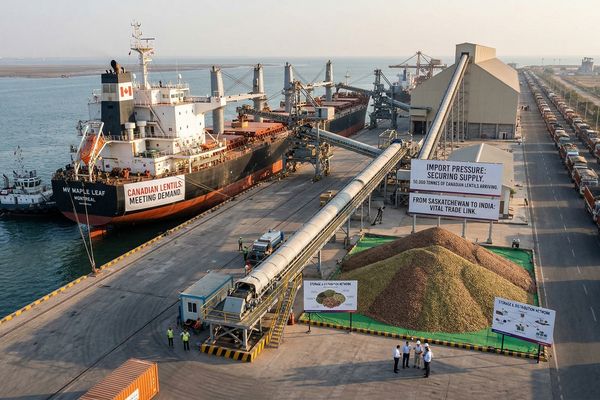
India’s lentil complex is currently defined by competing forces: firm domestic prices after a brief correction, a fresh Canadian vessel landing over 22,000 tonnes at Mundra, a weaker rupee and a maintained 10% import duty. Together, these drivers are keeping domestic quotes underpinned in key consuming regions while tempering import price strength. Demand from eastern states remains seasonally solid, but mill buying is cautious and largely hand-to-mouth, as the market closely watches the pace of arrivals from Madhya Pradesh and Uttar Pradesh and the role of central government stocks in smoothing volatility.
Exclusive Offers on CMBroker

Lentils dried
small, green
99.5%
FOB 1.25 €/kg
(from CN)

Lentils dried
small, green
99.5%
FOB 1.16 €/kg
(from CN)

Lentils dried
Red football
FOB 2.58 €/kg
(from CA)
📈 Prices & Spreads
Domestic lentils in Delhi recovered on Thursday, gaining about EUR 68.46–68.71 per quintal (converted from USD) after two days of softness, signalling renewed firmness at the consumer end. In the central Indian hub of Katni, values are slightly lower but still solid, at roughly EUR 66.43 per quintal, reflecting steady regional demand and slower-than-ideal crop arrivals.
Imported lentils are sending a mixed signal. Canadian and Australian containerised product is trading lower around EUR 61.00–61.50 per quintal, while bulk Canadian cargo at Mundra and Hazira ports is still cheaper at roughly EUR 60.00–60.52 per quintal. This leaves a discernible but not overwhelming spread versus domestic origins, once duty and currency effects are accounted for.
| Market / Product | Latest level (EUR/quintal) | Trend (short term) |
|---|---|---|
| Delhi domestic lentils | ≈ 68.5–68.7 | Firming after brief dip |
| Katni domestic lentils | ≈ 66.4 | Stable to firm |
| Canadian containers (India) | ≈ 61.0–61.5 | Slightly softer |
| Australian containers (India) | ≈ 61.0–61.5 | Steady |
| Canadian bulk, Mundra/Hazira | ≈ 60.0–60.5 | Capped by fresh vessel arrival |
🌍 Supply, Demand & Policy Drivers
The key structural support for Indian lentil prices remains policy-driven. The government’s decision to retain a 10% import duty, coinciding with a weaker rupee, has raised landed costs and limited the competitiveness of overseas supply. Even though imported quotes in India appear lower than domestic on a pure price basis, currency and duty together effectively create a price floor under local values.
On the supply side, fresh Rabi crop arrivals from Madhya Pradesh and Uttar Pradesh are lagging expectations. Uttar Pradesh output is believed to be down this season, tightening available domestic supply at the margin. At the same time, a sizeable central pool of about 400,000 tonnes acts as a buffer, curbing the scope for an aggressive price rally but not fully removing upside potential, particularly if arrivals continue to disappoint.
Demand is seasonally supported from Bihar, West Bengal and Assam, where lentils are a dietary staple and dal mills need to keep pipelines running. Yet processors are currently buying on a need-only basis rather than building large inventories, reflecting both the comfort provided by central stocks and uncertainty about the eventual size and pace of domestic arrivals.
📊 International Benchmarks & Relative Value
International FOB offers provide additional context. Recent indications (converted to EUR/kg) show Chinese small green lentils around EUR 1.16–1.25/kg (conventional vs. organic) FOB Beijing, while Canadian Eston and Laird greens are roughly EUR 1.65–1.75/kg FOB Ottawa and red football lentils about EUR 2.58/kg. These export benchmarks, while slightly softer week-on-week in some segments, still translate into relatively firm replacement costs for India once ocean freight, duty and FX are included.
The arrival of a 22,293-tonne Canadian vessel at Mundra has temporarily eased tightness at western ports and is helping to keep import prices in check there. However, given the structural support from import policy and currency, this fresh inflow is more likely to stabilise rather than significantly depress the broader Indian price complex. The domestic-import spread remains narrow enough that any additional rupee weakness or freight increase could quickly reassert upside pressure on internal values.
📆 Short-Term Outlook (2–3 Weeks)
The market is expected to trade in a relatively well-defined band over the next two to three weeks. With import costs elevated by the weaker rupee and the 10% duty, analysts see domestic prices broadly supported in the EUR-equivalent range of about 68–73 per quintal (aligned with the underlying USD 70–75 range). Downside appears limited by seasonal demand and the de facto duty floor.
At the same time, prospects for a sustained rally remain constrained. The 400,000-tonne central pool and the likelihood of gradually improving arrivals from Madhya Pradesh and other producing regions should discourage aggressive stockpiling by mills. As a result, price action is likely to be characterised by bouts of firmness on slow-arrival days, followed by consolidation whenever imported cargoes land or government stock policies reassure the market.
🧭 Trading & Procurement Recommendations
- Mills in eastern consuming states: Continue staggered, need-based buying rather than front-loading purchases, but consider modest coverage when Delhi prices approach the lower end of the projected band, as downside is limited.
- Importers: Be cautious about new positions at current levels; the combination of high landed costs and central pool overhang argues for selective buying, preferably when rupee volatility or nearby freight softness improves margins.
- Stockists / Traders: Avoid betting on a sharp bull run; instead, focus on capturing intra-band moves, selling into strength near the upper edge of the EUR 68–73/quintal range and buying dips driven by short-lived sentiment shifts.
- End users / Food companies: Use the current consolidation to secure medium-term requirements with flexible delivery schedules, as policy and currency risks still skew medium-term price risk slightly to the upside.
📍 3-Day Price Indication (Directional)
- Delhi wholesale market: Stable to slightly firmer; likely to hold within the upper half of the recent band as arrivals remain measured.
- Katni (central India): Mostly steady with a mild upward bias, tracking local arrival pace and nearby mill demand.
- Western ports (Mundra, Hazira): Import values to stay capped by the recent Canadian vessel, with a stable bias as the market digests new stocks and monitors currency moves.