
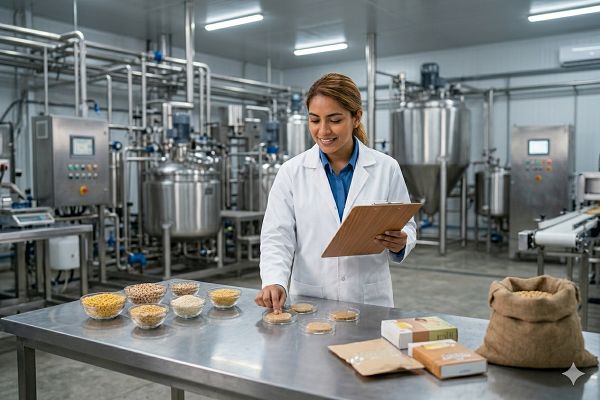
Brazil’s recent regulatory moves to streamline evaluation of new foods and ingredients, while leveraging foreign regulatory decisions, are poised to modestly accelerate market access for high-value food ingredients. For global suppliers, especially those already holding FDA or other major-agency approvals, the shift could reduce time-to-market and strengthen Brazil’s role as a growth destination for value-added food inputs.
These changes come as Brazil’s food processing sector expands and relies heavily on imported specialty ingredients, additives, and functional components. Faster and more predictable clearance for novel ingredients would lower regulatory friction, potentially shifting trade flows in favor of exporters able to meet Brazil’s evolving technical and documentation standards.
Headline
Brazil’s ANVISA Leans on Foreign Regulators to Speed Novel Ingredient Approvals, Supporting Import Demand
Introduction
Brazil’s National Health Surveillance Agency (ANVISA) has been progressively incorporating “reliance” mechanisms that allow it to use assessments from equivalent foreign regulatory authorities when evaluating regulated products. Recent regulatory bulletins highlight that ANVISA now applies optimized evaluation models using decisions from agencies such as the U.S. Food and Drug Administration (FDA) for certain categories, in line with a broader 2026–2027 regulatory agenda focused on efficiency and risk-based oversight.
In parallel, RDC 839/2023, which entered into force in March 2024, consolidated Brazil’s framework for “new foods and new ingredients,” defining them as products without a history of safe consumption in the country and subjecting them to a prior authorization process. While this framework initially extended review timelines, ANVISA’s subsequent adoption of reliance-based, optimized analysis for selected product classes establishes a regulatory template that is expected to be mirrored gradually in food and ingredient pathways, including the evaluation of technical dossiers from foreign authorities.
🌍 Immediate Market Impact
For agricultural commodity markets, the most direct effect is not on bulk staples but on higher-value micro-ingredients—such as proteins, nutraceuticals, enzymes, flavors, colors, and functional additives—that depend on prior approval before import and use in Brazil. As reliance mechanisms are operationalized, suppliers whose ingredients already hold approvals from recognized agencies (e.g., FDA, EMA or other listed “equivalent” foreign regulators) may see shorter and more predictable timelines for Brazilian authorization.
This could accelerate Brazil’s uptake of premium imported inputs used in sports nutrition, plant-based alternatives, functional beverages, and clean-label reformulations. In the near term, this is likely to support steady to firmer demand for specialized ingredients rather than sharply moving prices. However, by lowering regulatory barriers, the policy changes can increase competitive pressure on incumbent suppliers, compressing margins for higher-cost origins and rewarding those with regulatory and documentation readiness.
📦 Supply Chain Disruptions
The regulatory adjustments are designed to reduce, rather than create, bottlenecks. Brazil’s 2024 ANVISA executive summary notes that evaluation times for new foods and ingredients had lengthened by an average of 51 days under the new framework, underscoring the need for process optimization. As reliance pathways expand, this backlog risk should ease, helping to limit delays in launching reformulated products or new ingredient-dependent lines.
Nonetheless, the system still requires comprehensive technical dossiers and proof of foreign approval from designated equivalent authorities, which may constrain smaller exporters lacking regulatory capacity. In practice, global ingredient majors and well-capitalized regional suppliers are best placed to exploit the simplified routes, while smaller firms may continue to face administrative delays, documentation gaps, and compliance-driven shipment holds at Brazilian ports.
📊 Commodities Potentially Affected
- Specialty animal and plant proteins (e.g., milk derivatives, alternative proteins) – Products used in sports nutrition and plant-based analogues often require pre-market authorization when using novel protein fractions or processing technologies. Easier reliance on FDA or EU approvals could accelerate import growth.
- Functional ingredients (vitamins, minerals, bioactives, nutraceuticals) – Many fall under “new ingredients” if novel to Brazil, making them prime beneficiaries of reliance-based evaluation and faster dossier review.
- Enzymes, texturizers, stabilizers, and clean-label additives – Used extensively in bakery, beverages, and processed foods, these often originate from specialized suppliers in the U.S., EU, and Asia and can move more quickly through approval if previously evaluated by equivalent regulators.
- Flavor and color systems – Complex compound flavors or natural color extracts that qualify as novel may obtain Brazilian authorization more efficiently when backed by foreign safety assessments and specifications.
- High-value beverage ingredients (e.g., hop extracts, botanical concentrates) – Reliance on foreign dossiers may ease entry for new variants and formulations used in premium beverages and craft segments.
🌎 Regional Trade Implications
Brazil’s adoption of reliance tools strengthens its alignment with major regulatory hubs and is likely to favor exporters from jurisdictions already recognized as “equivalent” by ANVISA. Normative Instruction 338/2024 formally lists several foreign authorities whose approvals can underpin optimized analysis, including agencies in the U.S. and EU. This recognition can tilt the playing field toward North American and European suppliers in high-value segments.
Regional competitors in Mercosur—such as Argentina, Chile, and Uruguay—already have strong positions in consumer-oriented agricultural exports to Brazil but may have fewer officially recognized reference authorities for certain novel ingredient categories. Over time, as reliance pathways expand, multinational ingredient companies with global regulatory portfolios may consolidate share, while smaller regional players lag unless they invest in compliance upgrades. Conversely, Brazilian processors and food-service operators stand to benefit from a broader menu of imported inputs, supporting product diversification and export competitiveness.
🧭 Market Outlook
In the next 30–90 days, the regulatory developments are unlikely to trigger abrupt price shifts in bulk commodities, but they will influence contract discussions and product launch calendars in the ingredients space. Traders and suppliers will focus on mapping which product lines can qualify under reliance mechanisms and adjusting lead times and inventory planning around expected approval-cycle reductions.
Over a 6–12 month horizon, the combined effect of RDC 839/2023 implementation and reliance-based optimization should gradually reduce regulatory uncertainty for novel ingredients, encouraging more aggressive formulation innovation by Brazilian processors. Key monitoring points for market participants include ANVISA’s publication of further implementing norms for food and ingredient reliance, updates to the list of equivalent foreign regulators, and any data on actual approval time reductions in the food category versus 2024 baselines.
CMB Market Insight
For commodity and ingredient market participants, Brazil’s evolving regulatory architecture represents a structural, rather than cyclical, change. Bulk agricultural flows into Brazil will see limited direct impact, but value-added ingredient trade—where regulatory friction is often the main barrier—stands to benefit meaningfully as reliance procedures take hold.
Exporters with strong regulatory teams, established approvals in equivalent jurisdictions, and the ability to furnish high-quality technical dossiers in alignment with ANVISA’s expectations will be best positioned to capture incremental Brazilian demand. Over time, this could reinforce Brazil’s status as a strategic growth market for premium ingredients, shifting a greater share of global trade in high-value food components toward the country’s expanding processing and food-service sectors.
Related posts:
 Lentil Market Holds Firm as India Balances Costly Imports and Slow Arrivals
 U.S. Delisting of Three Russian Vessels Eases Friction Around Black Sea Grain Logistics
 India Extends Duty-Free Tur and Urad Imports, Eases Yellow Pea Rules to March 2027, Stabilising Global Pulse Trade
 Indian Lentil Harvest Pressures Prices, Opening a Brief Buyer’s Window
 Botswana Food Imports Hit $614M as U.S. Exports Rise
 Iranian Oil Offered to Indian Refiners at Premium Over Brent as US Sanctions Waiver Opens Narrow Window
 Ukrainian Pea Prices Flat but Competitive as Export Window Opens