
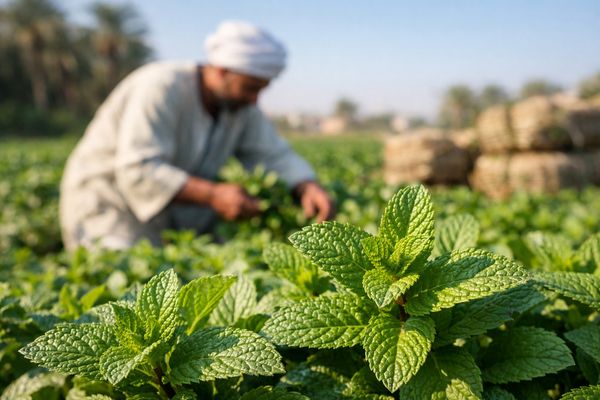
Egyptian FOB prices for dried spearmint leaves from Cairo are edging up in EUR terms, supported by higher fuel and logistics costs and a weaker local currency, while near‑term physical demand remains steady rather than exuberant.
In the Egyptian herbs and spices complex, dried spearmint is showing a mild firming tendency rather than a sharp rally. Export flows are constrained by higher freight and insurance costs linked to the wider Middle East conflict and shipping disruptions, which are inflating logistics and input prices across the agri‑complex in MENA. Domestic inflation and surging energy prices are lifting production and processing costs, while the market still benefits from resilient regional and EU demand for Egyptian herbal products. The result is a cautiously supportive environment for prices, but buyers are resisting aggressive offers and focusing on short‑term coverage.
Exclusive Offers on CMBroker

Spearmint dried
leaves
FOB 1.33 €/kg
(from EG)
📈 Prices & Market Tone
Spot FOB Cairo indications for conventional dried spearmint leaves from Egypt, converted to EUR, are slightly above last week and broadly stable over the past month. The mild upward drift reflects cost inflation rather than a pronounced shortage of raw material. Exporters report that buyers remain price‑sensitive, often negotiating smaller parcels and shorter validity periods given freight volatility and geopolitical risk in the wider region.
| Product | Origin | Location / Term | Current level (EUR/kg, FOB) | 1‑week change | 4‑week change |
|---|---|---|---|---|---|
| Spearmint, dried leaves (conventional) | Egypt | Cairo, FOB | ≈€1.23 | Slightly higher | Marginally softer |
Compared with other dried speciality crops exported from Egypt, current spearmint levels in EUR remain competitive versus alternative origins offered into Europe and the Gulf, helping to sustain order flow despite freight and insurance surcharges on some Middle Eastern routes.
🌍 Supply, Demand & Logistics
On the supply side, Egypt’s herb and leafy crop conditions are seasonally adequate, and there are no reports of major yield losses in key irrigated areas. Water availability along the Nile Basin for the March–May 2026 season is assessed as generally in the normal range, providing a neutral backdrop for mint and other specialty crops.
However, producers face sharply higher fuel and fertilizer costs due to the broader Middle East conflict. Disruptions around the Strait of Hormuz and elevated energy prices are pushing up input costs and transport charges, a trend reflected across grains and oilseeds and increasingly visible in higher‑value crops such as herbs. Export logistics from Egypt are functioning but with greater uncertainty: regional shipping routes have been repeatedly disrupted since late 2023, and recent escalation has again raised insurance premia and transit risks, especially for cargoes transiting Gulf routes, indirectly affecting container availability and freight rates from Mediterranean and Red Sea ports.
On the demand side, European and GCC buyers continue to seek Egyptian herbs, but the wider food price shock in the Arab region is tempering downstream consumption, particularly in lower‑income markets. Recent UN analysis warns that a 20% rise in global food prices could push an additional 5 million people into food insecurity across Arab countries, underscoring the fragility of discretionary demand for processed herbal products even as importers prioritize essential categories.
📊 Fundamentals & Cost Drivers
Egypt’s domestic macro environment is strongly inflationary, with food and energy costs rising rapidly and the government already increasing local wheat procurement prices to support farmers. This cost‑push backdrop spills over into spearmint via higher labour, irrigation, and processing expenses, placing a floor under export offer levels despite only moderate changes in field supply.
At the same time, global energy prices have surged following the effective closure of the Strait of Hormuz, with Brent crude moving well above USD 120/bbl and LNG exports from key Gulf suppliers curtailed. This is driving up fertilizer and freight costs worldwide, particularly for countries like Egypt that rely on imported inputs and on stable Suez and Red Sea traffic for outbound shipments of agricultural products. The inflationary impulse is therefore structural rather than temporary, reinforcing a gently bullish tone for spearmint in the absence of a major supply shock.
⛅ Weather Outlook – Egypt Spearmint Belt
For early April, weather in the main irrigated herb‑growing zones of Egypt is seasonally warm and dry, with no extreme heat or flooding events reported that would threaten spearmint yields in the short term. Irrigation from the Nile remains the key determinant of crop performance, and the latest hydrological outlook for March–May 2026 points to broadly normal river flows across the basin, implying stable water availability for speciality crops under managed schemes.
In the 1–2 week horizon, no major weather‑driven production shock is anticipated. As a result, short‑term price risk is more likely to come from currency moves, fuel prices, or shipping disruptions than from agronomic stress.
📆 Trading Outlook & Strategy
- Short‑term (next 2–4 weeks): Bias moderately firm. Cost inflation and fragile logistics argue against a significant downside correction in FOB Cairo spearmint prices, while benign weather caps sharp upside from the supply side.
- For importers: Consider covering near‑term needs on price dips and negotiating flexible shipment windows to manage freight volatility. Shorter contract tenors and diversification of ports (Mediterranean vs Red Sea) can mitigate logistics risk.
- For Egyptian exporters: Maintain disciplined offer levels that reflect higher costs, but remain competitive against alternative origins into the EU and GCC. Linking offers to freight indices or adding explicit surcharge clauses can help protect margins in a volatile shipping environment.
- Risk watch: Escalation in regional conflict, further constraints on fertiliser or fuel supply, or renewed disruptions to Red Sea and Suez traffic could all trigger a faster‑than‑expected tightening in spearmint export availability and prices.
📉 3‑Day Price Direction – Key Region
- Egypt – FOB Cairo (dried spearmint leaves, conventional): Slight upward bias over the next three days in EUR terms, with offers expected to remain firm to modestly higher as exporters price in elevated logistics and energy costs, while weather and crop conditions stay seasonally normal.
Related posts:
 Egyptian Dried Sage FOB Cairo Edges Lower Amid Logistics Uncertainty
 Egyptian Spearmint FOB Cairo Edges Lower Amid Stable Supply
 Egyptian Sage FOB Cairo Edges Higher Amid Stable Supply and Cost Pressures
 Egyptian Peppermint FOB Cairo Edges Higher Amid Stable Supply
 Egyptian Marjoram FOB Cairo: Mild Firmness Amid Stable Supply
 Egyptian Lemongrass FOB Cairo Edges Higher Amid Costly Freight Environment