
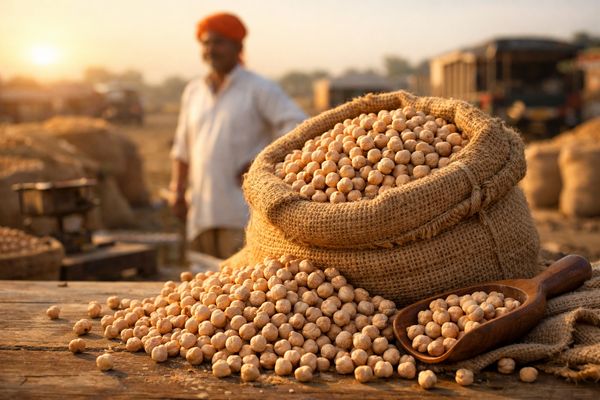
Indian chickpea prices are pausing after a modest recovery, with Kabuli values in Punjab moving higher on stockist buying while desi grades in key northern hubs remain broadly steady. The market is finely balanced between temporarily tight arrivals and expectations of a larger overall crop, implying limited room for sharp rallies but also only shallow downside. For European and Gulf buyers, the coming 2–4 weeks look like a tactical window to fine‑tune coverage rather than lock in large volumes at current levels.
Domestic spot stability is mirrored in export offers, with Indian dried chickpeas (FOB New Delhi) currently assessed around EUR 0.83–0.96/kg depending on size, only marginally above late‑March levels. With government procurement advancing, a sizeable central stock and elevated imported Kabuli inventories at ports, any near‑term price softening is likely to be short‑lived and largely driven by the timing and pace of April arrivals.
Exclusive Offers on CMBroker

Chickpeas dried
count 46-48, 10 mm
FOB 0.90 €/kg
(from IN)

Chickpeas dried
count 44-46, 11 mm
FOB 0.93 €/kg
(from IN)

Chickpeas dried
count 42-44, 12 mm
FOB 0.96 €/kg
(from IN)
📈 Prices & Market Mood
India’s chickpea complex is in a temporary equilibrium. Kabuli chickpeas in Bhatinda, Punjab, have surged by about INR 500 per quintal, now at roughly INR 7,000–8,500/q (around EUR 77–94/q), as stockists stepped back in after the recent recovery. In contrast, dal mills have reduced buying at these elevated levels, preferring to wait for heavier new‑crop arrivals later in April.
Desi chickpeas in Delhi and Rajasthan-linked markets are holding steady: new‑crop desi is quoted around INR 5,525–5,600/q (approximately EUR 61–62/q), with no significant change from the previous session. Export-oriented Indian dried chickpeas out of New Delhi are indicated near EUR 0.90/kg (46–48 count), EUR 0.93/kg (44–46 count) and EUR 0.96/kg (42–44 count) FOB, confirming a slightly firmer but still contained upward trend versus mid‑March.
🌍 Supply & Demand Drivers
Near-term supply tightness is largely a function of timing. New-crop arrivals from Madhya Pradesh, Rajasthan, Gujarat, Karnataka and Maharashtra are currently running below last year, reflecting both a shifted harvest pattern and some variability in sowing. Traders, however, expect a clear acceleration in arrivals through the rest of April, which should ease the local tightness and cap further spot gains.
On the demand side, dal mills are operating with a just‑in‑time strategy, deliberately delaying large purchases in anticipation of lower prices once peak arrivals hit. Stockists, by contrast, have become more active in Kabuli, betting on firm export demand from the Middle East and Europe and using today’s pause in the market to rebuild inventories. Elevated port stocks of imported Kabuli remain a key buffer, limiting the scope for any sustained domestic price spike.
📊 Fundamentals & Policy Backdrop
Structurally, the fundamentals are comfortable. Acreage under chickpeas has expanded this season, and production estimates for leading states such as Madhya Pradesh and Rajasthan point to a large crop. This suggests the current tightness is seasonal rather than structural, with the main risk being the exact timing and size of the arrival wave rather than a genuine supply deficit.
Government support adds another stabilising layer. Minimum Support Price (MSP) procurement has already reached around 100,000 tonnes, and purchases in the major producing regions are expected to grow further. The central pool is understood to hold roughly 300,000 tonnes of chickpeas, providing additional supply flexibility if prices were to overshoot on the upside or if local deficits emerged in specific regions.
🌦️ Weather & Crop Outlook
Weather across the main chickpea belts in central and western India is broadly favourable for ongoing harvest operations, with no widespread reports of major damage. The key question for the market is now less about yield risk and more about logistics: how quickly the crop moves from the fields into wholesale markets during April.
Barring an unexpected late‑season weather event, the larger planted area and generally benign conditions support expectations of a sizeable 2025/26 chickpea crop. This reinforces the view that any price strength driven by short-lived arrival bottlenecks is likely to fade once the marketing flow normalises.
📆 Price Outlook & Trading Strategy
Market consensus in India sees a pullback of roughly INR 100–200/q (about EUR 1–2/q) from current levels as a reasonable buying zone, especially for desi chickpeas. Once peak arrivals pass in late April to early May, prices are expected to firm again as selling pressure eases and pipeline coverage needs to be rebuilt. This creates a narrow but clear tactical window over the next 2–4 weeks.
- Importers in Europe & Gulf: Calibrate purchases to the anticipated April dip rather than locking in large volumes today; focus on staggered coverage into May–June.
- Indian stockists: Use any INR 100–200/q correction to add to positions, prioritising Kabuli where export demand is structurally robust.
- Dal mills: Maintain just‑in‑time buying into late April but be prepared to accelerate coverage once evidence emerges that arrivals have peaked.
📍 Short-Term Regional Indications (Next 3 Days)
| Market / Product | Indicative Level (EUR) | 3‑Day Bias |
|---|---|---|
| Bhatinda Kabuli (domestic equivalent) | ~EUR 77–94/q | Slightly firm on stockist interest, but capped by port stocks |
| Delhi/Rajasthan desi (domestic) | ~EUR 61–62/q | Mostly sideways, mild downside risk ahead of wider arrivals |
| Indian export chickpeas 42–48 ct (FOB New Delhi) | ~EUR 0.90–0.96/kg | Range‑bound; modest softening possible if arrivals accelerate |
Related posts:
 Desi Chickpeas Turn the Corner as Indian Mills Return to the Market
 Pigeon Peas Caught Between Strong Dollar and Indian State Support
 Tightening Pulse Fundamentals Support a Steady-to-Firmer Lentil Complex
 Indian Chickpeas Edge Higher as Tight Domestic Supply Trumps Harvest Pressure
 Indian Chickpeas Ease from Highs as Supplies Rebuild and Heat Sets In
 China Black Bean Market: Stable Prices Underpinned by Farmgate Support
 Rangebound Black Gram Signals Subtle Support for Global Lentil Prices
 New Indian Crop Pressures Chickpea Prices as MSP Support Looms