
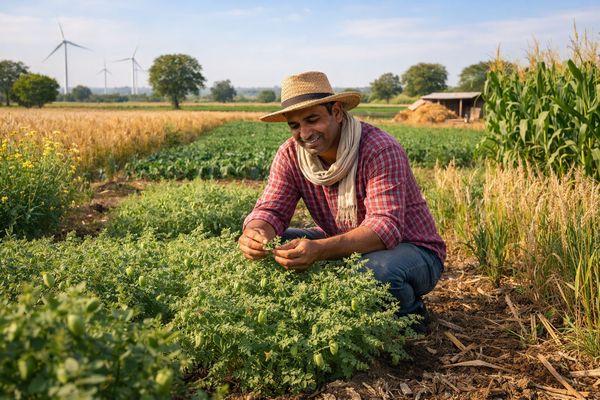
Indian and Mexican chickpea prices are edging higher on renewed mill buying and steady export interest, with Indian FOB New Delhi offers now testing recent highs while Mexican origins track slightly firmer in thin trade. Weather over key rabi belts in India and spring areas in Mexico looks generally non-threatening for the next few days, keeping the market mainly driven by arrivals and policy rather than immediate crop risk.
Chickpea markets enter early April with Indian desi and kabuli values stabilising after earlier weakness, as mills return to the market and imports ease. Fresh analysis shows Indian chickpea prices beginning to recover, though still below the government’s support price band, while strong domestic production has sharply reduced India’s broader pulse imports in 2025–26, easing concerns over tightness. Mexican export values are slightly firmer but remain competitively priced into key destinations. With near-term weather benign in both India and Mexico, traders’ focus stays on arrivals pace, domestic demand and policy signals for pulses.
Exclusive Offers on CMBroker

Chickpeas dried
count 42-44, 12 mm
FOB 1.29 €/kg
(from MX)

Chickpeas dried
count 75-80, 8 mm
FOB 0.82 €/kg
(from MX)

Chickpeas dried
count 60-62, 8 mm
FOB 0.84 €/kg
(from IN)
📈 Prices & Recent Moves
Using an indicative rate of 1 USD ≈ 0.92 EUR for conversion:
| Origin | Type (indicative) | Location / Term | Latest price (EUR/kg) | 1-week change (EUR/kg) |
|---|---|---|---|---|
| India | Kabuli 42–44, 12 mm | New Delhi, FOB | ≈0.88 | Firm vs mid-March |
| India | Smaller kabuli / desi equivalents | New Delhi, FOB | ≈0.79–0.83 | +0.01–0.05 |
| Mexico | Kabuli 42–44, 12 mm | Mexico City, FOB | ≈1.19 | +0.01 |
| Mexico | Smaller kabuli 8 mm | Mexico City, FOB | ≈0.75 | +0.01 |
Recent market commentary confirms that Indian desi chickpea prices have “turned the corner” as mills step back in, with Rajasthan and Madhya Pradesh levels stabilising and New Delhi FOB kabuli 42–44 mm quoted around USD 0.95–0.97/kg (≈EUR 0.87–0.89/kg), broadly in line with the firming implied by the latest offers. Spot reports from Delhi wholesale markets also indicate improving demand for chana and kabuli as festival-related consumption and retail stocking pick up.
🌍 Supply, Demand & Trade Flows
Indian chickpea supply for 2025–26 remains ample after another strong rabi, with recent research highlighting Maharashtra as the leading producer and overall chickpea output contributing to India’s record foodgrain harvest. At the same time, India’s total pulse imports for April–January 2025–26 have fallen 35% in value and more than 18% in volume year-on-year, reflecting robust domestic crops and comfortable stocks. This has reduced pressure from cheap imports that previously capped chana prices.
Market reports note that domestic wholesale chickpea prices are still below the government’s minimum support benchmarks, but the downside pressure has eased as new-crop arrivals meet steady mill demand rather than being swamped by low-cost imports. Trade channels in Gujarat and central India report significant chickpea stocks available for export and inter-state movement, supporting a gradual normalisation of basis levels.
On the Mexican side, there are no major fresh headlines on chickpea-specific export disruptions over the last few days. The broader grains and oilseeds context in Mexico suggests a firm but orderly demand environment, supported by a modestly improving macro outlook. In the absence of crop shocks or policy changes, Mexican kabuli prices are tracking global pulses sentiment rather than any local supply squeeze.
⛅ Weather & Crop Conditions
For India’s main chickpea belt (Madhya Pradesh, Rajasthan, Maharashtra), the India Meteorological Department expects a hotter-than-normal April with increased heatwave days over parts of central and northwest India, including Rajasthan and central Maharashtra. However, for the immediate 3-day window, conditions are largely dry and favourable for ongoing harvest and post-harvest handling, with no widespread excessive rainfall risk flagged in the latest outlooks.
In Mexico’s key chickpea regions (e.g. Sonora, Sinaloa, Zacatecas), early-April forecasts point to seasonally warm, mostly dry conditions without major storms or prolonged rainfall episodes expected in the next few days, which should allow normal fieldwork and logistics. (Inference based on regional early-April climate normals and absence of storm warnings in current synoptic summaries.) With no acute weather threats in either India or Mexico, price drivers in the very short term remain centred on demand, arrivals and currency rather than weather shocks.
📊 Market Drivers & Outlook
- India: arrivals vs. demand – Research on seasonal patterns shows chickpea arrivals usually peak February–April, which tends to weigh on prices, but this year the impact is moderated by improved mill buying and reduced import competition, enabling a modest price recovery from earlier lows.
- Policy backdrop – Recent policy focus has been on curbing excessive pulse inflation via earlier import relaxations; with domestic availability now improved and imports falling, further aggressive easing looks less likely in the near term, reducing downside policy risk for chickpea prices.
- Macro & cross-commodity signals – Strong rabi production in wheat and other crops underlines generally good growing conditions and supports farmer liquidity, which can underpin holding capacity for pulses and limit distress selling at harvest.
Overall, the balance for early April points to a slightly firmer tone in Indian chickpeas and steady-to-firm values for Mexican kabuli, with low immediate weather risk but potential for heatwaves later in April to influence next-season planting decisions.
📌 Trading Recommendations
- Importers in South Asia and MENA: Consider covering near-term kabuli needs from India while FOB New Delhi 42–44 mm remains just under EUR 0.90/kg equivalent, as the downside from imports has diminished and basis could tighten if domestic buying persists.
- European buyers: Diversify coverage between Indian and Mexican kabuli to hedge origin-specific risks; current spreads suggest India remains cost-competitive for 42–44 mm, while Mexico offers an alternative for premium quality and shipment flexibility.
- Indian mills: With prices still below MSP-equivalent levels but trending up, stagger purchases into April rather than front-loading; avoid waiting for deep discounts that are less likely if imports continue to slow.
📆 3-Day Regional Price Direction (EUR, indicative)
- India – New Delhi FOB: Kabuli 42–44 mm around EUR 0.87–0.90/kg; bias slightly firmer over the next 3 days on ongoing mill buying and normal arrivals.
- Mexico – Mexico City FOB: Kabuli 42–44 mm around EUR 1.17–1.20/kg; tone steady to marginally firmer amid stable export demand and benign logistics.
Related posts:
 Indian Chickpea Prices Firm as Mills Return and Imports Cap Upside
 Indian Chickpea Market Pauses as New Crop Nears and Supply Outlook Improves
 Indian Chickpea Market Softens as New Rabi Crop Arrives and Mills Step Back
 Chickpea Prices Steady to Soft in India, Premium Persists for Mexican Origin
 Lentil Market Steady with Chickpea-Led Support and Firm Export Demand
 Indian Chickpea Market Finds a Floor as New Crop and Imports Build Pressure
 New Indian Crop Pressures Chickpea Prices as MSP Support Looms
 Chickpea Prices Steady but Supported as Indian Procurement Ramps Up