
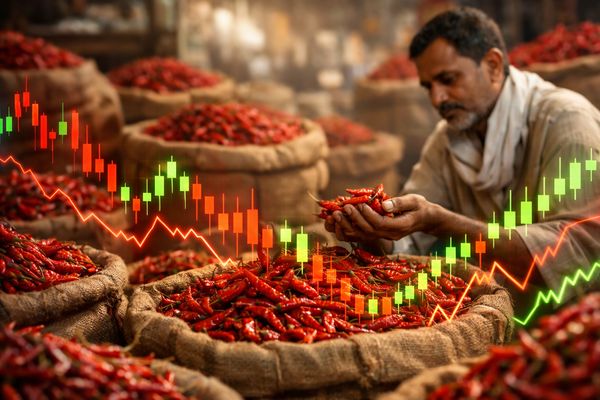
Indian chilli export offers are broadly steady with a firm undertone as fresh arrivals from Andhra Pradesh balance robust domestic and export demand. Processed organic grades remain at a clear premium to conventional whole chillies, and no major weather or policy shock is visible in the very near term.
Indian chilli markets are entering a crucial post-harvest phase with comfortable but not burdensome supplies from key growing belts in Andhra Pradesh and Telangana. Recent mandi data show that dry chilli prices spiked sharply in late March before consolidating at higher levels, indicating strong underlying demand rather than a temporary squeeze. Export flows from hubs such as Guntur continue to service South and East Asian buyers, while overall Indian export momentum remains healthy despite broader trade headwinds. With no immediate extreme-weather risks flagged for southern India, short-term price direction will likely hinge on arrivals, local festival demand and nearby export buying.
Exclusive Offers on CMBroker

Chilli dried whole
bird eye, grade a
FOB 4.65 €/kg
(from IN)

Chilli dried
powder, grade a
FOB 4.40 €/kg
(from IN)

Chilli dried
flakes, grade a
FOB 4.35 €/kg
(from IN)
📈 Prices & Spreads
FOB India export indications (converted to EUR at ~1 USD = 0.92 EUR):
| Product | Location | Spec | Price (EUR/kg, FOB) | 1‑week change |
|---|---|---|---|---|
| Chilli dried whole, bird eye, organic | New Delhi | Grade A | ≈ 4.28 | Stable |
| Chilli dried powder, organic | Andhra Pradesh | Grade A | ≈ 4.05 | Stable |
| Chilli dried flakes, organic | Andhra Pradesh | Grade A | ≈ 4.00 | Stable |
| Chilli dried whole, stemless | Andhra Pradesh | Conventional, Grade A | ≈ 1.96 | Stable |
| Chilli dried with stem | Andhra Pradesh | Conventional | ≈ 1.97 | Stable |
Spot data from Indian mandis show that dry chillies rallied by over 15% on 25 March, driven by short-term tightness and strong buying, before easing into a sideways pattern into early April. Export-grade prices are holding near recent highs, with organic processed forms (powder, flakes) commanding almost double the price of conventional whole chillies on a EUR/kg basis.
🌍 Supply, Demand & Trade Flows
Andhra Pradesh remains the key driver of Indian chilli supply, with overall rabi crop area in the state up 47% year-on-year as of early April, signalling ample acreage for spices and other cash crops. Within this, chilli arrivals into major yards such as Guntur and Warangal have been sufficient to meet domestic demand, even after the late-March price spike.
On the demand side, Indian export performance to key partners such as China and other Asian markets remains solid, with overall goods exports to China up strongly year-on-year. While this is not chilli-specific, it underpins a supportive environment for high-value agri exports including spices. Domestic consumption is seasonally steady, and no new government interventions (unlike for tomatoes, where targeted procurement has been ordered to cool retail prices) are currently reported in chillies.
📊 Fundamentals & Weather
Fundamentals for chillies are broadly balanced: acreage and arrivals point to adequate supply, yet inventories are not excessive, allowing prices to consolidate at elevated levels after March’s rally. Export hubs like Guntur, which hosts Asia’s largest chilli market yard, continue to anchor the value chain and provide liquidity for both domestic and overseas buyers.
No credible alerts for extreme rainfall or cyclones over Andhra Pradesh and Telangana have been issued in the last three days, and the region is between the main monsoon seasons. Recent climatological work highlights rising long-term heatwave risk for India, but this is more a structural than immediate concern for chilli fields in the coming week. In the short run, neutral weather implies that arrivals and prices will be driven more by market behaviour than by climate shocks.
📆 3‑Day Outlook & Trading View
Trading Outlook
- Exporters: With FOB chilli prices in India consolidating after a sharp local spike, consider locking in near-term export sales at current levels, especially for organic powder and flakes where margins remain attractive.
- Importers/Buyers: For near-shipment coverage, stagger purchases over the next 1–2 weeks; the balanced supply picture and neutral weather reduce the risk of sudden upside, but a tight carryover warrants caution on waiting for deep corrections.
- Processors in India: Maintain moderate raw chilli stock; replacement costs look stable for now, but any renewed surge in mandi prices similar to 25 March would quickly feed into higher input costs.
3‑Day Price Indication (Directional)
- FOB Andhra Pradesh (conventional whole, EUR/kg): Sideways to mildly firm around 1.95–2.00 as arrivals and demand stay balanced.
- FOB Andhra Pradesh (organic powder/flakes, EUR/kg): Sideways around 4.00–4.10; limited downside unless mandis see a sharp drop in bids.
- FOB New Delhi (bird eye organic, EUR/kg): Sideways near 4.25–4.30 with a slight upward bias if export inquiries pick up.