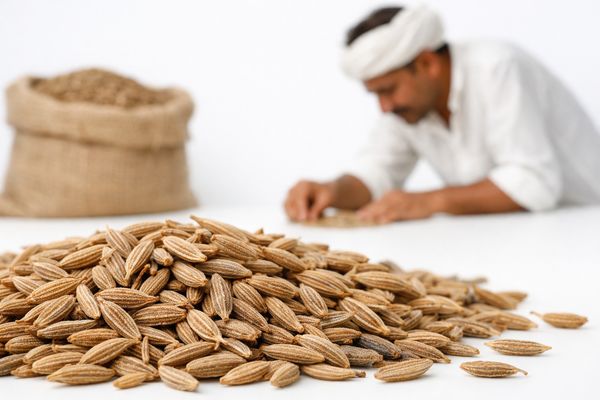
Indian cumin prices are edging lower in early April, with New Delhi FOB values for both organic and conventional grades slipping 0.5–1% over the past week. The market remains fundamentally well supplied after a sizeable 2025/26 crop, while export demand is steady but not strong enough to trigger a fresh rally.
Cumin trade this week is dominated by the return to normal activity at Unjha, Gujarat, after earlier disruptions, and by improving availability from the new rabi harvest. Futures on NCDEX are broadly stable around the mid‑₹22,000/quintal mark, reflecting a market that is balanced rather than tight. At the same time, short‑term weather risks are emerging: forecasters warn of unseasonal rain and storms over parts of Gujarat between 7–10 April, which could briefly slow arrivals or affect late‑harvest quality, but stocks already in warehouses should cushion any immediate supply shock.
Exclusive Offers on CMBroker

Cumin seeds
whole, grade - A
FOB 4.35 €/kg
(from IN)

Cumin powder
grade - A
FOB 3.50 €/kg
(from IN)

Cumin seeds
grade - A
99%
FOB 2.24 €/kg
(from IN)
📈 Prices & Market Tone
All prices converted to EUR using an indicative rate of ₹1 = €0.011.
| Product | Origin | Location / Term | Latest Price (EUR/kg) | 1‑Week Change |
|---|---|---|---|---|
| Cumin seeds, whole, organic, grade A | India | New Delhi, FOB | €4.35 | ▼ ~1% vs 28 Mar |
| Cumin powder, organic, grade A | India | New Delhi, FOB | €3.50 | ▼ ~1.5% vs 28 Mar |
| Cumin seeds, 99% purity | India | New Delhi, FOB | €2.24 | ▼ ~0.9% vs 28 Mar |
| Cumin seeds, 98–99% purity | India | Unjha/New Delhi, FOB | €2.10–2.20 | ▼ ~1–2% vs mid‑Mar |
Domestic benchmark prices at Unjha and on NCDEX largely confirm this softening tone. NCDEX jeera futures traded around ₹22,285/quintal on 2–3 April, with limited intraday movement, pointing to a consolidation phase following previous months’ sharp correction from 2023 peaks.
🌍 Supply, Demand & Trade Flows
India remains the dominant global cumin supplier, with Unjha in Gujarat acting as the key physical hub. Recent reports note that Unjha markets have reopened after earlier closure and that arrivals from the new crop are flowing steadily, helping cap prices despite only moderate export demand.
Export performance this marketing year has been softer than the previous one: from April–January 2025–26, cumin shipments fell to about 166,878 tonnes (≈€383m equivalent), down from roughly 197,050 tonnes a year earlier. This suggests that while global demand remains solid, especially from Gulf and Western markets, buyers have become more price‑sensitive after last year’s extreme volatility. Abundant Indian availability means importers can afford to buy hand‑to‑mouth.
🌦 Weather & Crop Conditions (India – Gujarat Focus)
Short‑term weather risk is back on the radar. Local forecasts for Gujarat call for unseasonal rainfall and thunderstorms between 7 and 10 April, with alerts issued for several districts in North and Central Gujarat. These systems are linked to broader pre‑monsoon instability over northwest India.
Much of the 2025/26 cumin crop has already been harvested and moved to market or storage, so yield loss from this event should be limited. The main near‑term effect is likely logistical: temporary disruptions to arrivals, slower drying of late‑cut fields, and some localised quality downgrades. Given healthy stocks at Unjha and other mandis, this is more supportive for spot prices at the margin than a structural bullish driver.
📊 Fundamentals & Price Drivers
- Large Indian crop, comfortable stocks: Recent analytical work on India’s spice complex points to higher cumin output versus the previous year, and government/industry commentary over recent months has highlighted a shift from extreme tightness to comfortable availability.
- Export growth, but slowing momentum: Cumin exports surged strongly through 2024 as India captured share with relatively competitive prices. More recent customs data show volumes still high but off their peak, explaining why fresh export buying is not yet tightening the domestic market.
- Futures vs physical alignment: NCDEX jeera futures near ₹22,000–22,500/quintal are broadly aligned with Unjha mandi levels reported in late Q1 2026. This reduces the risk of sharp basis moves and encourages hedging activity for both exporters and domestic grinders.
- Spice complex oversight: NCDEX has recently tightened surveillance margins on turmeric contracts, signalling the exchange’s focus on curbing speculative spikes across agri contracts. While not cumin‑specific, this may dampen aggressive speculative positioning in jeera as well.
📆 Short‑Term Outlook (3‑Day, Region IN Focus)
Over the next three days (6–8 April), the cumin market in India is expected to trade in a narrow range, with a mild upward bias if forecast unseasonal showers materialise in key Gujarat districts. Weather alerts for 7–10 April could briefly slow arrivals into Unjha and nearby mandis, lending intra‑day support to spot prices even as overall stocks remain ample.
- New Delhi FOB (seeds and powder): Bias mildly firm, but moves likely contained within ±2% around current EUR levels as exporters and grinders continue to buy on dips.
- Unjha physical spot: Potential for small weather‑related bounce versus NCDEX, yet strong underlying arrivals and comfortable inventories should cap sustained rallies.
💼 Trading & Procurement Suggestions
- Importers / end‑users: Current EUR‑denominated prices for Indian cumin seeds and powder look attractive versus 2023–24 peaks. Consider layering purchases over the next 1–2 weeks, with a bias to cover near‑term needs ahead of the 7–10 April weather window in Gujarat.
- Indian exporters: Use NCDEX jeera futures in the ₹22,000–22,500/quintal band to hedge forward sales, especially for shipments to the Middle East and Europe where demand is steady but price‑sensitive. Focus offers on 98–99% purity grades where international interest is strongest.
- Domestic grinders and traders: Treat any short‑lived, weather‑driven rally as an opportunity to sell into strength, given comfortable supply and only moderate export pull at present.
Overall, the Indian cumin market enters mid‑April with prices slightly softer but fundamentally stable. Weather in Gujarat bears watching over the coming week, yet barring severe damage, the broader trend still points to a well‑supplied market with only modest upside risk in the very near term.