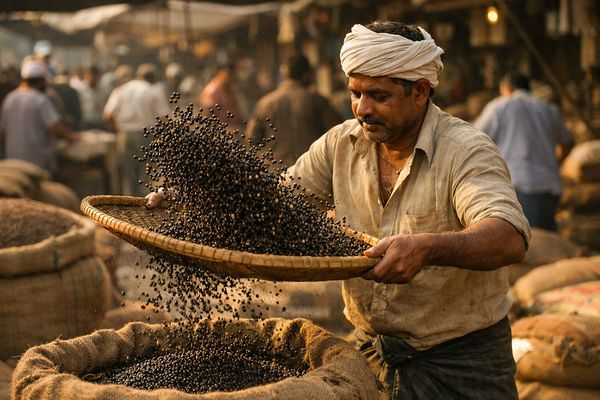
Indian, Sri Lankan and Vietnamese pepper FOB prices are edging lower in early April, with modest week‑on‑week declines but no sign of a sharp correction. Tight global supply and firm domestic demand in India keep the market broadly supported, while exporters in Vietnam remain cautious at already elevated levels.
Spot and retail data from India indicate pepper remains one of the highest‑priced spices in the domestic basket, but recent days show more sideways than upward momentum, especially in key producing states like Kerala where APMC prices are consolidating after previous rallies. Vietnam’s export statistics still reflect structurally high prices after the 2025 surge, and buyers are negotiating hard around current offers. In Sri Lanka, macro and geopolitical noise has not yet translated into clear, pepper‑specific shocks. Overall, the complex looks mildly softer but fundamentally tight.
Exclusive Offers on CMBroker

Pepper powder
black
FOB 8.75 €/kg
(from IN)

Pepper
white whole
FOB 7.05 €/kg
(from IN)

Pepper
green dehydrated
FOB 8.55 €/kg
(from LK)
📈 Prices & Short-Term Trend
| Origin | Product | FOB level (EUR/kg) | 1-week move |
|---|---|---|---|
| India (New Delhi) | Black pepper powder, organic | ≈ €8.75 | ▼ ~0.6% |
| India (New Delhi) | Black whole 500 g/l, organic | ≈ €8.05 | ▼ ~0.6% |
| India (New Delhi) | White whole, organic | ≈ €7.05 | ▼ ~0.7% |
| India (New Delhi) | Black 500 g/l, clean | ≈ €5.89 | ≈ flat |
| Sri Lanka (Kotte) | Green dehydrated, organic | ≈ €8.55 | ▼ ~0.6% |
| Vietnam (Hanoi) | Black 500–600 g/l, clean | ≈ €5.70–6.45 | ▼ ~0.7–1.0% |
In India, domestic mandi prices in key pepper districts like Idukki (Kerala) are holding at high but steady levels, with yesterday’s APMC readings near ₹68,000 per 100 kg in Munnar, indicating no fresh spike into April so far. National retail monitoring also shows black pepper whole near the top of the spice cost range, confirming the underlying strength of domestic demand and constrained supply.
Vietnamese export benchmarks remain historically high in dollar terms after the late‑2025 rally, with recent reports still describing export prices around the upper US$6,000s per tonne for black pepper, even if the market has shifted into a slower, more cautious adjustment phase. The small easing visible in the latest FOB quotes from Hanoi is thus best interpreted as technical profit‑taking rather than a structural downturn.
🌍 Supply, Demand & Trade Flows
India enters Q2 2026 with pepper supply still constrained by previous years’ acreage shifts away from plantation crops and localized weather stress in Kerala, while domestic consumption through food service and packaged foods stays robust. Domestic spot quotes in Cochin for garbled black pepper around ₹707/kg on 1 April underline the tight balance between limited arrivals and steady buying.
Vietnam continues to capitalize on its position as the leading global exporter. Recent trade intelligence highlights that the sharp increase in export values seen in 2025 was driven largely by price rather than volume, with black pepper export prices moving into the US$6,400–6,700/tonne range and white pepper even higher. While January 2026 exports from Vietnam remained substantial at over 21,000 tonnes, exporters are more selective at current price levels, limiting aggressive undercutting despite buyer resistance.
For Sri Lanka, the broader export sector has been recovering since 2025, but spices remain a smaller component, and pepper shipments face competition from Vietnam and India. Import restrictions on spices in Sri Lanka’s own market keep domestic prices relatively firm, yet the latest geopolitical tensions off the southern coast have not directly disrupted pepper trade routes so far.
🌦️ Weather Outlook (IN, LK, VN)
India (Kerala and adjoining pepper belts): Pre‑monsoon conditions in early April are characterized by warm temperatures with intermittent showers and thunderstorms over southern India, including Kerala, according to the latest meteorological outlook. These pre‑monsoon rains can briefly ease plant stress and support flowering, but excess downpours or strong winds could still pose localized disease risks; for now, forecasts suggest typical variability rather than a disruptive event.
Sri Lanka: Early-April conditions around the south‑western and central highlands, where pepper is intercropped with other plantations, are seasonally warm with humidity rising ahead of the southwest monsoon. No major weather anomalies or storm systems are flagged over land in the immediate 3‑day window, implying neutral short‑term production risk. (Inference based on regional climate patterns and absence of current severe‑weather advisories.)
Vietnam (Central Highlands and Southeast pepper regions): Available regional reports continue to point to generally supportive weather following the 2025 harvest season, with no extreme heatwave or flooding events reported in recent days. Combined with previously tight supply, this stable weather backdrop removes an immediate bullish trigger but also offers no relief through bumper yields.
📊 Fundamentals & Drivers
- Structural tightness: Multi‑year under‑investment in pepper acreage in India and disease‑related yield issues in several origins have left global stocks lean, which is reflected in elevated export prices across Vietnam and India through 2025–26.
- Demand resilience: Despite cost‑of‑living pressures in many importing markets, pepper demand in food processing and HoReCa remains relatively inelastic. India’s retail monitoring shows pepper maintaining premium status within the spice basket without significant demand destruction yet.
- Freight & macro environment: Shipping costs and energy prices, pressured by broader logistics and fuel issues in India and regionally, add a modest bullish layer to FOB quotations, particularly for containerized spice exports.
Taken together, these fundamentals justify current high price levels even as day‑to‑day offers soften slightly. The market remains vulnerable to any negative weather surprise in Q2 or further freight disruptions.
📆 3-Day Market View & Trading Outlook
India (IN)
- Short-term price bias (FOB, EUR): Sideways to mildly softer for black pepper powder and whole (about −0.5% to 0%) as buyers resist further hikes but origin holders are in no rush to sell.
- Strategy:
- Importers: Consider scaling in small‑to‑medium coverage on dips for Q2–Q3 needs; downside looks limited unless a very strong new‑crop outlook emerges.
- Exporters/stockists: Maintain disciplined offer levels; avoid heavy forward selling below current benchmarks given still‑tight fundamentals.
Sri Lanka (LK)
- Short-term price bias (FOB, EUR): Slight softening possible (around −0.5%) in dehydrated green offers, tracking the broader complex but with limited liquidity.
- Strategy:
- Buyers: Use any minor corrections to test offers from high‑quality processors, but stay mindful of logistics premiums.
- Producers: Weather is not a near‑term threat; holding moderate stocks appears reasonable while monitoring regional competitors’ moves.
Vietnam (VN)
- Short-term price bias (FOB, EUR): Gentle downward drift (roughly −0.5% to −1%) across 500–600 g/l black, as exporters adjust from very high 2025 price peaks and buyers push for concessions.
- Strategy:
- Importers: Use current softening to lock in partial volumes; consider staggered purchases in case of further small declines.
- Exporters: Prioritize premium qualities and long‑standing clients rather than chasing volume at deeper discounts.
3-Day Regional Directional Outlook (EUR terms)
- India FOB (black & white, organic and conventional): Stable to −0.5%.
- Sri Lanka FOB (green dehydrated): Stable to −0.5%.
- Vietnam FOB (black 500–600 g/l): −0.5% to −1.0% amid gradual normalization from 2025 highs.