
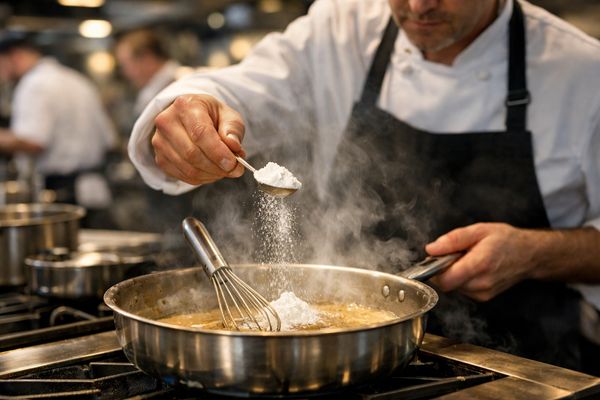
Arrowroot powder export prices from India are holding steady, with no change in New Delhi FOB quotations over the past week and only a modest uptick over the last month when measured in EUR. Stable farmgate supply and orderly export flows are offsetting weather noise from recent rain and thunderstorms in North India.
India’s arrowroot market is currently calm: export demand from key buyers such as the US remains active, but not overheated, while growers are not under immediate weather stress in April. Cooler-than-normal conditions and pre-monsoon showers around Delhi NCR are more supportive than threatening for upcoming tuber and starch crops, provided rainfall stays within forecast ranges. In this environment, near-term price risk for organic arrowroot powder looks balanced, with a slight upward bias if logistics are disrupted or if competing starches tighten later in Q2.
Exclusive Offers on CMBroker

Arrowroot powder
Powder - average
99%
FOB 2.15 €/kg
(from IN)
📈 Prices & Recent Trend
FOB New Delhi quotations for organic arrowroot powder from India are broadly stable week-on-week. Converting from recent USD-based export indications to EUR, current values around EUR 2.00–2.05/kg FOB are in line with the last quote on 4 April 2026, showing no daily change and only a marginal rise from mid‑March.
Over the last four weeks, the price path shows a small but gradual firming as earlier offers near EUR 1.95/kg were replaced by the current plateau near EUR 2.00/kg, reflecting firm freight, stronger demand for clean-label starches, and a generally supportive environment for specialty tubers within India’s wider starch complex. Broader Indian starch processors also report steady to slightly better margins on niche starches, underpinned by growing domestic food and nutraceutical use.
🌍 Supply, Demand & Trade Flows
On the export side, customs-based shipment data for February 2026 show India as the leading supplier of arrowroot shipments into the US, underlining the country’s central role in the global trade of this niche starch. Demand from North America and Europe is driven by gluten‑free, baby food, and clean-label processed foods, where arrowroot competes with tapioca and potato starch.
Within India, the broader starch industry is on a moderate growth trajectory, supported by rising usage of modified and specialty starches in food and pharma applications. Recent industry commentary points to 4–8% annual revenue growth in starch and derivatives, which indirectly supports farmgate incentives for tuber crops, including arrowroot, though capacity additions have been focused more on tapioca and maize starch.
🌦 Weather Impact – Focus on North India (IN)
Weather in and around New Delhi has turned unusually active for early April. IMD and local media report cloudy skies, rain, thunderstorms and gusty winds across Delhi NCR on 4–5 April, with temperatures dipping to the 18–31 °C range—well below typical April heat levels. These showers are linked to successive western disturbances that have brought above‑normal rainfall to North India in March–early April 2026, resulting in generally cooler conditions versus the long‑term norm.
For arrowroot and other tuber crops in North and East India, this pattern is currently neutral‑to‑supportive. Moist soils and moderated daytime temperatures help early vegetative growth and reduce irrigation needs, though localized hail or high winds (flagged in some regional alerts) could damage exposed crops if events become severe. For now, there are no indications of large‑scale crop losses in arrowroot-growing belts, so production risk for 2026/27 remains limited and does not justify a weather‑driven risk premium.
📊 Fundamentals & Market Drivers
- Supply side: Stable field conditions and the absence of major pest or disease outbreaks keep India’s arrowroot supply outlook comfortable. Broader tuber markets (notably cassava and potato) are currently more influential for starch processors’ utilization decisions than arrowroot volumes.
- Demand side: Ongoing growth in processed and health‑oriented foods sustains multi‑year demand for niche starches. The absence of any fresh trade barriers for HS code 071490 (including arrowroot) in India’s current tariff schedule suggests no immediate policy shock on export flows.
- Macro & cross‑commodity: Other edible oil and starch markets (e.g., castor oil, palm kernel oil, and potato products) show mixed pricing, but none are spiking sharply enough this week to pull arrowroot prices higher through substitution alone.
📆 Short-Term Outlook & Trading Ideas
- Price bias (next 1–2 weeks): Sideways to mildly firm in EUR terms, with the main upside risk stemming from logistics disruptions if pre‑monsoon storms intensify, rather than from fundamentals.
- For buyers (importers, food processors): Consider covering nearby physical needs at current levels; the flat forward tone and stable Indian supply reduce the opportunity cost of securing Q2 volumes now.
- For sellers (Indian exporters, aggregators): Maintain offer discipline near current EUR benchmarks; avoid undercutting as weather volatility and firm demand for clean-label starches provide a modest floor.
- Risk watch: Monitor IMD advisories for any shift from scattered storms to damaging hail or flood events in North and East India, which could tighten Q3 supply if fields are affected.
📉 3-Day Regional Price Indication (India, FOB New Delhi)
| Date | Region / Port | Product | Indicative Price (FOB, EUR/kg) | Direction (vs. today) |
|---|---|---|---|---|
| 5 April 2026 | New Delhi, IN | Arrowroot powder, organic, 99% | 2.00–2.05 | Flat |
| 6 April 2026 | New Delhi, IN | Arrowroot powder, organic, 99% | 2.00–2.05 | Flat |
| 7 April 2026 | New Delhi, IN | Arrowroot powder, organic, 99% | 2.00–2.07 | Slightly firm |
Related posts:
 Indian Coriander Prices Hold Firm as Futures Turn Bullish
 Indian Chilli Prices Hold Firm as New Crop Flows Steady from Andhra Pradesh
 Ajwain Prices Ease Slightly as North India Faces Stormy Harvest Weather
 Egypt and India Thyme FOB Prices Hold Firm Amid Input Cost Pressures
 Indian Arrowroot Powder Stable but Firm as Summer Heat Builds
 Stable Organic Oregano FOB India Prices Amid Hot, Dry North Indian Weather
 Nigella (Kalonji) Prices Hold Firm as Indian FOB Premium Over Egypt Narrows