
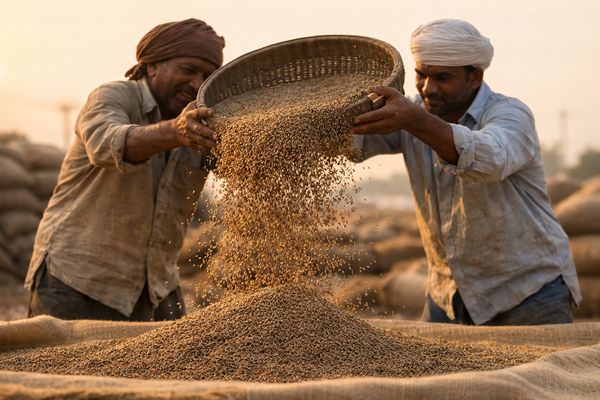
Cumin prices are holding up surprisingly well against record arrivals in India, but with export demand still weak, the market bias for the next weeks remains mildly bearish.
In India’s physical markets, fresh harvest pressure is clearly visible, yet strong stockist interest – especially in Delhi – has so far prevented a sharp correction. Record or near-record arrivals at Unjha are being absorbed at only modest discounts, while Delhi wholesale prices have even edged higher. However, the broader balance is shifting: export volumes and revenues are down year on year, arrivals are likely to stay elevated, and global support from earlier Turkish tightness is fading. For European buyers, this creates a short tactical window for slightly better purchase conditions, but weather risks in Rajasthan and any export demand revival could cap the downside.
Exclusive Offers on CMBroker

Cumin seeds
whole, grade - A
FOB 4.35 €/kg
(from IN)

Cumin powder
grade - A
FOB 3.50 €/kg
(from IN)

Cumin seeds
grade - A
99%
FOB 2.24 €/kg
(from IN)
📈 Prices & Spread Picture
At Unjha, India’s key cumin hub, arrivals surged to around 65,000 bags at the start of the week, a record or near-record level. Despite this, GL Gulab eased only marginally to the equivalent of roughly EUR 2.28–2.29 per kg (4,560–4,580 INR per 20 kg, using an indicative EUR/INR rate), after briefly testing slightly higher levels. Ganesh-grade cumin slipped just about 25 INR per 20 kg, pointing to only mild harvest pressure in the heart of the producing region.
In contrast, Delhi’s wholesale market tightened: standard and machine-cleaned grades each gained about 300 INR per 100 kg, lifting quotations to roughly EUR 25.80–26.23 per 100 kg for standard and EUR 26.99–27.74 per 100 kg for machine-cleaned product. Export-oriented FOB offers reflect a slightly softer undertone, with latest indicative values around EUR 2.10–2.24 per kg for conventional Indian seeds (98–99% purity, Unjha/New Delhi), and about EUR 4.35 per kg for organic whole seeds FOB New Delhi. Egyptian 99.9% cumin remains competitive around EUR 4.23 per kg FOB, while Syrian cumin delivered into the Netherlands is indicated near EUR 3.55–4.35 per kg FCA, depending on form and quality.
🌍 Supply & Demand Balance
On the supply side, farmer selling is aggressive. Gujarat’s cumin sowing area fell by about 14.7% this season and traders initially feared a production shortfall of around 25%. The strength and consistency of recent arrivals, however, have prompted some market participants to reassess these deficit expectations, at least for Gujarat. Rajasthan, meanwhile, is set to deliver a comparatively better crop, further adding to near-term availability.
Demand is showing a clear divergence between domestic and export channels. Stockist and downstream buying in Delhi has been strong enough to absorb the surge in fresh crop, underpinning prices despite peak arrivals. Export demand, by contrast, remains lacklustre: shipments for the first ten months of FY 2025–26 reached about 166,878 tonnes worth USD 417.87 million, down 15% in volume and 28% in value from 197,050 tonnes and USD 579.12 million a year earlier. This weaker export pull is the main factor preventing a more pronounced rally despite tightness earlier in competing origins such as Turkey.
📊 Fundamentals & Trade Flows
The current market configuration is characterised by peak physical availability, cautious traders and subdued exporters. Stockists have been the marginal buyers, stepping in on dips in Unjha and Delhi, but they are wary of building excessive long positions while arrivals remain at or near record levels. With the sowing area in Gujarat smaller but arrivals strong, the market narrative is shifting from fear of acute shortage to a more balanced, if still finely poised, supply outlook.
On the international side, the earlier tightness in Turkey had provided a bullish backdrop for Indian cumin, supporting prices and encouraging aggressive coverage by some overseas buyers. Now, the sheer weight of Indian arrivals is offsetting that support. European processors and spice blenders are beginning to see a modest price advantage for Indian origin versus some alternatives, particularly for machine-cleaned and higher-purity grades. However, the absence of strong buying from large Indian exporters underscores that international demand has not yet normalised, leaving the market vulnerable to further, if limited, downside.
⛅ Weather & Regional Risks
Weather in the remaining harvest period, especially in Rajasthan, is a key swing factor. With arrivals already at peak levels, any unexpected rainfall or adverse conditions could quickly disrupt logistics and quality, triggering a short-covering rally from both domestic stockists and export buyers who have stayed on the sidelines. At present, however, there is no confirmed broad-based weather shock impacting the major producing belts, allowing the harvest to continue flowing into primary markets.
Given the current high throughput, even a brief weather-related interruption could have outsized psychological impact, particularly if it coincides with renewed export enquiry from Europe or the Middle East. Market participants should therefore treat weather headlines from Rajasthan and Gujarat as potential catalysts, capable of quickly shifting sentiment from comfortable supply to renewed tightness, even if the underlying crop size ultimately proves adequate.
📆 Short-Term Outlook & Trading Strategy
Over the next two to four weeks, cumin prices are likely to remain under moderate pressure, with a bias towards consolidation or mild correction rather than a sharp break. Elevated arrivals in Unjha and other mandis, combined with still subdued export demand, point to limited upside in the very near term. The key downside risk is a further softening if exporter buying fails to resume as expected once the bulk of the harvest is marketed.
- Importers/Processors (Europe & MENA): Consider staggered coverage in this window, using current modestly softer levels to secure part of Q2–Q3 needs, but retain some flexibility in case further downside materialises.
- Indian Stockists: Avoid aggressive new longs at current firm Delhi levels while arrivals stay near record; instead, focus on selective buying on dips and quality spreads (e.g. upgrading to machine-cleaned).
- Exporters: Monitor weather in Rajasthan and competitor origins closely; short-term price dips could offer an opportunity to rebuild export pipelines if forward demand from Europe picks up.
📉 3‑Day Directional Price Indication (EUR)
| Market / Product | Current Level (approx.) | 3‑Day Bias |
|---|---|---|
| Unjha, IN – FAQ/GL Gulab seeds (ex‑mandi) | ~EUR 2.25–2.30/kg | Slightly softer / sideways |
| Delhi, IN – machine‑cleaned cumin (wholesale) | ~EUR 0.27/kg (per 100 kg basis) | Sideways with mild downside risk |
| FOB India – conventional cumin seeds 98–99% purity | ~EUR 2.10–2.25/kg | Slightly softer |
| FOB Egypt – 99.9% cumin seeds | ~EUR 4.20–4.30/kg | Sideways |
Related posts:
 Indian Arrowroot Powder Prices Hold Firm Amid Cool, Wet North India Weather
 Indian Cumin Prices Ease Slightly as New Crop Arrivals Build in Gujarat
 Indian Chilli Prices Hold Firm as New Crop Flows Steady from Andhra Pradesh
 Indian Chilli Market Holds Firm at Peak Arrivals as Export Demand Stays Hot
 Coriander Prices Firm as Indian Supply Stays Tight Despite New Crop Arrivals
 Cumin market softens as record Indian supply meets weak export pull
 Indian Chilli Prices Hold Firm on Tight Quality Supply and Export Interest
 Indian Chilli Prices Hold Firm at Peak Arrivals as Cyclone Losses Tighten Supply