
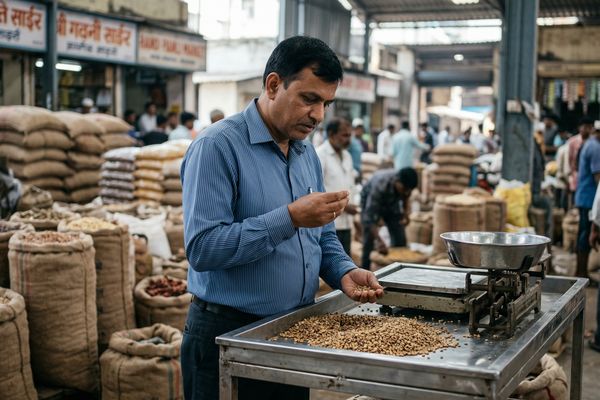
Green gram prices in India remain broadly stable in early April 2026, with a heavy government stockpile and ongoing procurement capping any sharp rallies and dampening speculative appetite. This soft but stable pulse environment in India is helping to anchor international lentil values, which are trading sideways with only a mild upward bias over the next few weeks.
Indian green gram markets are characterized by cautious mill buying, selective government procurement at Minimum Support Prices, and the psychological weight of the country’s largest pulse stockpile in this commodity. For European and international buyers of lentils and other pulses, this backdrop translates into a relatively predictable short‑term price environment, even as freight, geopolitics, and weather risks linger in the background.
Exclusive Offers on CMBroker

Lentils dried
Red football
FOB 2.58 €/kg
(from CA)

Lentils dried
Laird, Green
FOB 1.75 €/kg
(from CA)

Lentils dried
Eston Green
FOB 1.65 €/kg
(from CA)
📈 Prices & Spreads
Green gram (often competing with lentils in Indian consumption and import decisions) is stable to narrowly firm across India’s main wholesale hubs. Bold-quality green gram in Indore is quoted around 8,200–8,400 rupees per quintal, while Jaipur chamki grade sits near 7,650 rupees per quintal. Delhi, Jalgaon, Akola and Hisar all report steady quotations across grades, with only minor location-specific differences reflecting freight and local mill demand.
On the export side, Canadian lentil offers remain flat on a week-on-week basis. Indicative FOB Ottawa prices converted to euros using current FX are approximately:
| Origin / Type | Location / Term | Latest Price (EUR/t) | 1 Week Ago (EUR/t) | Trend |
|---|---|---|---|---|
| CA Red lentils, “Red football” | Ottawa, FOB | ~2,390 EUR/t | ~2,390 EUR/t | Stable, at premium to greens |
| CA Green lentils, Laird | Ottawa, FOB | ~1,620 EUR/t | ~1,620 EUR/t | Stable |
| CA Green lentils, Eston | Ottawa, FOB | ~1,530 EUR/t | ~1,530 EUR/t | Stable |
| CN small green lentils, organic | Beijing, FOB | ~1,160 EUR/t | ~1,170 EUR/t | Marginally softer |
| CN small green lentils, conventional | Beijing, FOB | ~1,070 EUR/t | ~1,080 EUR/t | Marginally softer |
Red lentils continue to command a significant premium over green classes, reflecting tighter nearby availability and sustained demand for decorticated product in South Asia and the Middle East, while China-origin greens edge slightly lower amid comfortable supply.
🌍 Supply & Demand Drivers
India is the pivotal demand center for both green gram and lentils. The Indian government currently holds around 780,000 tonnes of green gram in public stocks, by far the largest inventory among pulse categories. This stockpile, together with ongoing procurement at MSP, acts as a ceiling on domestic green gram prices and discourages speculative hoarding or aggressive long positioning.
Wholesale arrivals of green gram into key Indian markets remain steady, and traders expect a continued flow of fresh supply from producing regions over the coming weeks. Dal processing mills are purchasing hand-to-mouth, focusing on immediate requirements rather than building large inventories. In this environment, any attempt to significantly lift prices is expected to trigger government stock releases, reinforcing a narrow trading band for green gram and, by extension, contributing to a stable overall pulse price complex that includes lentils.
Globally, Canadian lentil export supply is described as comfortable but not burdensome, while Indian pulse imports, including lentils, are somewhat softer than last year yet remain structurally necessary to cover domestic consumption. The combination of ample Indian green gram stocks and balanced Canadian lentil availability limits near-term upside for international lentil prices, even as some regional tightness persists in specific grades.
📊 Fundamentals & Policy Context
The central feature of the current pulse complex is policy-driven support and control in India. Government procurement of green gram at MSP is active across several states, though volumes are modest compared with total market arrivals. Still, the very existence of large public stocks changes market psychology: traders are nearly unanimous that any sharp rally would provoke official stock releases, making sustained price spikes improbable in the near term.
For lentils, MSP-based procurement and broader pulse support measures in India provide a floor to farmer returns while simultaneously moderating consumer price volatility. Alongside this, Canada’s stable pre-seeding weather outlook and adequate carryover stocks support a benign supply picture into the next marketing year. Together, these factors contribute to a range-bound lentil market where fundamentals argue more for patience than for directional bets.
For European buyers sourcing green gram and lentils for sprouting, snack, and processed food applications, the current configuration means reasonable predictability in input costs. With no imminent signs of crop disruption or demand shock, forward coverage decisions can be based more on logistics and basis opportunities than on fears of a runaway flat-price rally.
🌦️ Weather Outlook (Key Regions)
In India’s pulse belt, there are currently no reports of acute weather stress affecting green gram flows in the very short term. Planting and harvesting patterns for other rabi pulses and lentils are progressing against a backdrop of generally adequate stocks, reducing the sensitivity of near-term prices to localized weather events.
Across Canada’s Prairies, early spring 2026 conditions are mixed but not extreme. Forecasts for April suggest largely seasonal to slightly warmer temperatures in parts of the southern Prairies, which should allow fieldwork and lentil seeding preparations to proceed broadly on schedule, barring localized moisture issues. At this stage, weather is not yet a primary bullish driver for the lentil market, but it will gain importance if dryness or excessive moisture emerges during seeding and early vegetative stages.
📆 Short-Term Outlook & Trading Strategy
The base case for the next 2–4 weeks is continued price stability in green gram with a mild upward bias if government procurement remains selective and market arrivals begin to ease seasonally. A significant rally, however, appears unlikely without an unexpected disruption to incoming crops or a sudden acceleration in export demand—developments that are not visible at present.
- Importers / Food manufacturers: Consider layering in coverage for Q2–Q3 2026 needs in both red and green lentils at current stable levels, focusing on optimizing freight and currency rather than timing a price breakout.
- Producers (Canada, Australia, Black Sea): Avoid over-hedging new-crop lentils aggressively at current flat prices given limited upside catalysts but also constrained downside due to Indian policy support; use rallies induced by weather or freight headlines to scale in hedges.
- Traders / Speculators: Market conditions in pulses, led by India’s green gram stockpile, argue against aggressive long positions; relative-value strategies between red and green lentils or cross-pulse spreads may offer better risk-adjusted opportunities than outright directionals.
📍 3-Day Directional Price Indication (EUR)
- Canada, FOB Ottawa: Red lentils and green Laird/Eston expected to remain in a narrow sideways band, with potential intraday moves of only ±5–10 EUR/t driven mainly by FX and freight adjustments.
- China, FOB Beijing: Small green lentils likely to trade slightly soft to flat, with downside limited by replacement costs but modest pressure from competitive origins.
- India, wholesale markets (green gram proxy for pulse complex): Local rupee prices seen holding broadly steady, implying a stable to marginally firm undertone for imported lentils into South Asia in euro terms over the next three days.
Related posts:
 Lentil Markets Hold Range as Indian Green Gram and Canadian FOB Stay Steady
 Lentil Markets Steady as Indian Green Gram Policy Caps Global Upside
 Lentils Market: Indian Green Gram Buffer Stocks Cap Global Upside
 Pigeon Pea Market Holds Mixed Tone as MSP Buffer Caps Upside
 Lentils Market Steady as Indian Green Gram Stocks Cap Upside
 Lentil Market Treads Water as Indian Green Gram Sowing Surges