
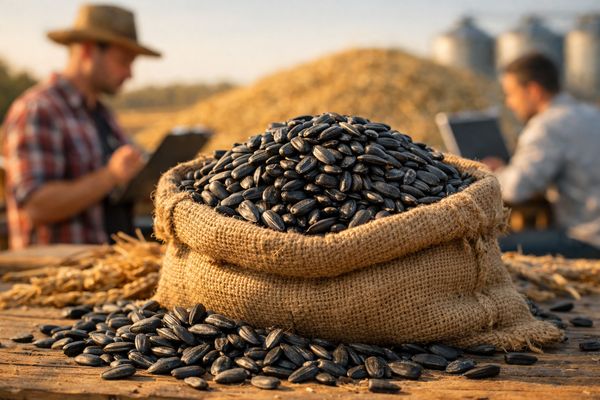
Sunflower seed prices are broadly steady to slightly firmer, but the sunflower oil complex is drawing support from higher energy prices, stronger palm and vegetable oils, and tight global stocks. The market remains well supplied in seeds near term, yet logistics and geopolitical risks are underpinning crush margins and oil values.
Sunflower is currently trading in a narrow range, with SAFEX futures in South Africa drifting only marginally lower across nearby contracts, while Black Sea physical seed prices in Ukraine and Moldova hold stable to slightly higher in euro terms. At the same time, the broader vegetable oil complex has firmed on rising crude oil prices and fresh uncertainty in the Middle East and Strait of Hormuz, tightening biodiesel-linked demand. This divergence suggests limited downside for seeds but more pronounced upside risk for oils if energy markets remain volatile.
Exclusive Offers on CMBroker

Sunflower seeds
black
98%
FOB 0.58 €/kg
(from UA)

Sunflower kernels
meal
FOB 0.58 €/kg
(from UA)

Sunflower seeds
black
98%
FCA 0.65 €/kg
(from UA)
📈 Prices & Spreads
SAFEX sunflower futures eased only slightly on 2 April 2026: April 2026 closed at 9,085 ZAR/t (−0.07% d/d), May at 9,190 ZAR/t (−0.18%), and July at 9,411 ZAR/t (−0.17%), indicating a stable forward curve with modest carry into late 2026.
Converted at roughly 20 ZAR/EUR, SAFEX April values equate to about 454 EUR/t, keeping South African prices broadly aligned with competitively priced Black Sea origins.
| Product | Origin / Term | Latest price (EUR/kg) | WoW change (EUR/kg) | Comment |
|---|---|---|---|---|
| Sunflower seeds, black, 98% | UA, Odesa, FOB | 0.58 | +0.01 | Firming, export demand steady |
| Sunflower seeds, black, 98% | UA, Kyiv/Odesa, FCA | 0.65 | Stable | Domestic crushers well covered |
| Sunflower seeds, black, 98% | MD → DE, FCA | 0.61 | Stable | Continuous flow into EU |
| Sunflower kernels, hulled bakery | UA, Dnipro, FCA | 0.96 | Stable | Value‑added segment supported |
Chinese confection and bakery kernels remain a clear premium, trading around 1.15–1.24 EUR/kg FOB Beijing, reflecting higher processing costs and differentiated quality. The modest uptick in Ukrainian FOB seed (0.57 to 0.58 EUR/kg since late March) points to slightly firmer export interest, but not yet to an aggressive rally.
🌍 Supply, Demand & Competing Oils
The sunflower complex is currently shaped more by external vegetable oil and energy dynamics than by seeds alone. Malaysian palm oil futures have recently risen, supported by expectations of lower March production and heightened geopolitical risk in the Middle East, while Brent crude trades above 100 USD/bbl, strengthening biodiesel-linked demand across the vegoil space.
Global sunflower oil stocks remain historically tight, and recent analysis still points to elevated prices year on year as the 2025/26 season progresses. Higher edible oil import demand in key buyers such as India, where sunflower oil is part of a broader mix of cooking oils, adds a demand floor if the current conflict-driven energy shock persists.
In the Black Sea region, Russia’s recent adjustment of sunflower oil and meal export duties is reshuffling trade flows: weaker export margins for Russian crushers are pressuring domestic seed prices, but also directing some demand towards alternative origins like Ukraine, where export logistics have slowly stabilized despite ongoing infrastructure risks. This reinforces Ukraine’s dominant role in EU sunflower oil supply, even as absolute volumes lag last season.
📊 Fundamentals & Weather
Structurally, oilseed markets are influenced by higher fertilizer and diesel costs, particularly in exporters such as Australia, where farmers are reportedly shifting area away from nitrogen‑intensive crops including rapeseed. This could tighten medium‑term global oilseed supply and indirectly support sunflower and other soft oils if rapeseed availability falls by an estimated 10–12%. In the near term, however, sunflower seed availability remains comfortable, as reflected in stable SAFEX and Black Sea pricing.
In Ukraine, early spring 2026 has been unusually mild, with mean daily temperatures passing the +5°C threshold two to three weeks earlier than normal and soil temperatures reaching 7–15°C by late March, enabling timely sowing of spring crops including sunflower. Current forecasts for April call for mostly normal precipitation and moderate temperatures, which should support establishment and keep yield potential intact if realized.
On the balance sheet side, recent projections for Ukraine’s 2026/27 sunflower campaign imply a notable rebound in production compared with 2025/26, driven by slightly higher area and a significant yield recovery, lifting output and crush but leaving end‑season stocks still low in absolute terms. This confirms a tight but improving fundamental picture: enough supply to prevent a spike, yet little buffer against new weather or logistical shocks.
📉 Risk Drivers & Market Sentiment
- Energy & freight: The ongoing Iran and Strait of Hormuz crises keep crude and bunker costs elevated, raising freight and biodiesel demand, and thereby underpinning vegetable oil prices across the board.
- Black Sea logistics: While Ukrainian exports have normalized compared with early war disruptions, port and corridor risks persist and could quickly widen sunflower oil premiums versus seeds if flows are interrupted again.
- Policy shifts: Russian export duty changes on sunflower oil and meal can abruptly alter crush incentives and cross‑border price relationships, adding volatility to sunflower seed basis levels.
📆 Trading Outlook & 3‑Day View
- Crushers: Current FCA seed prices around 0.61–0.65 EUR/kg in Ukraine and Moldova still offer workable crush margins given firm oil values; consider locking in a portion of Q2–Q3 seed needs while basis remains benign.
- Exporters: With FOB Black Sea seed at about 0.58 EUR/kg and freight under upward pressure, prioritize short nearby positions and flexible destinations rather than long‑dated commitments.
- Buyers (EU food & feed): The seed market looks directionless in the very short term; use any minor dips in sunflower oil offers, driven by day‑to‑day energy volatility, to extend coverage modestly into late Q2.
Over the next three trading days, sunflower seed prices in key Black Sea and EU origins are likely to remain broadly sideways in euro terms, tracking within current ranges given balanced nearby supply. Sunflower oil offers, by contrast, should retain a mild upward bias, moving in line with palm and crude oil if geopolitical tensions persist. SAFEX sunflower futures are expected to consolidate near current ZAR levels, with only limited sensitivity to external shocks in the immediate term.
Related posts:
 Rapeseed market steadies as energy shock meets looming Australian acreage cuts
 China Soybeans: Stable FOB, Firmer Futures as Demand Signals Improve
 Rapeseed Tracks Energy Rally as New-Crop Gains Outpace Nearby
 Rapeseed Market Holds Firm as Energy Rally Meets Cautious Fund Selling
 Rapeseed Supported by Soaring Oil and Firmer Vegoils Despite Flat MATIF Close
 Soybeans supported by Chinese demand hopes and firmer oil share
 India’s Sharp Excise Duty Cut and New Fuel Export Taxes Reshape Energy Cost Curve for Agri Supply Chains
 China Sunflower Prices Edge Mixed as Energy Shock Lifts Cost Floor